

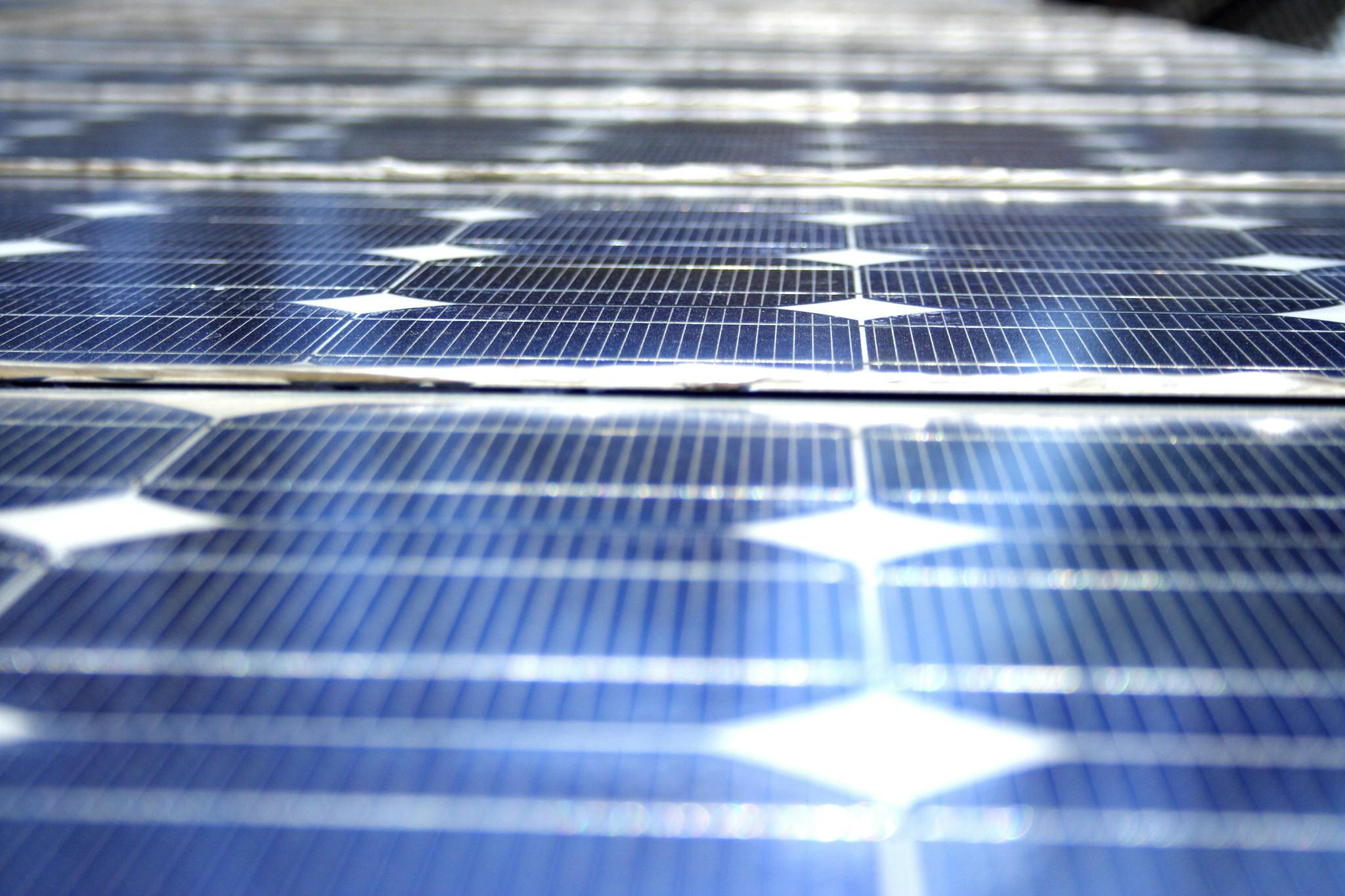
In the summer of 1982, I spent my school holidays working on a construction site on Fota Island. Fourteen years old, sunburned, boots too big, and absolutely clueless about the scale of what I was helping build. Ireland’s first solar energy station - a 50 kWp array costing an eye-watering £750,000 Irish pounds. Fifteen pounds per watt. Utter madness by today’s standards, but visionary at the time.
I remember standing there, holding a cavity block for someone older, stronger, and far more qualified to actually do something with it, thinking: This is amazing. Solar panels felt like science fiction. A curiosity. A side bet on the future that almost no one expected to matter.
Fast forward to 2018: the solar array on my own roof — 5 kWp for €10,000 — worked out to just over €2 per wattinstalled. And today, in 2025, global module costs are down again, with some markets seeing 10–12 cents per watt at utility scale.
A drop from £15/W to €0.10/W in a lifetime.
If any other technology fell in price that fast, we’d be calling it a civilisational shift, not an energy option.
And yet the real story is not how far solar has come - it’s how far it’s about to go.
Because the next decade is shaping up to be the steepest climb in efficiency, scale, and systemic importance the energy system has ever seen. What we’ve witnessed so far is the prelude. The overture. Phase One. The solar century is now getting underway in earnest.
1. The Data Says… the Surge Is Already Astonishing
Let’s start with the numbers we cannot ignore.
According to IRENA’s Renewable Capacity Statistics 2025 update, the world added roughly 452 GW of new solar PV capacity in 2024 alone - more electricity generation than the entire continent of Africa consumes in a year. China accounted for over half, but Europe, India, Brazil, and the US all set national records.
Solar now represents:
7% of global electricity generation (IEA, 2025)
Over three-quarters of all new capacity additions in 2024 (IRENA, 2025)
The cheapest source of new electricity in history, with utility-scale costs averaging $0.043/kWh (IRENA, 2024)
The IEA estimates that global solar generation will surpass gas for annual electricity production before 2030, and coal not long after. On present trends, solar could become the world’s single largest source of electricity by the early 2030s.
But, and here is where it gets really interesting - current growth is built entirely on first-generation silicon technology whose efficiency has basically stalled. We’ve inched up from ~14% in the 1970s to ~25% today - impressive, but we’re near the theoretical ceiling.
And that’s exactly where the breakthroughs begin.
In my recent Climate Confident conversation with Caelux’s Aaron Thurlow, he laid out what many in the industry quietly acknowledge: silicon alone can’t take us much further. The physics simply won’t allow it.
But tandem cells can.
By layering a perovskite film over silicon, manufacturers can build a two-storey power generator in a single module. The lab records for this are already brushing 35% efficiency, with commercially manufacturable products expected to hit 28–30% within a few years.
For context:
A 20% performance uplift in solar is like discovering a new oil field every six months, except it never runs out, and it doesn’t fry the planet.
If global solar averaged 30% efficiency tomorrow, we could generate the world’s entire electricity demand using less land than France.
Talking a couple of weeks back on Climate Confident to, Scott Therien from REC Solar, he underscored another accelerating trend:
ownership is moving from customers to developers.
Power Purchase Agreements (PPAs) - subscription-style solar, are rapidly becoming the default in commercial and industrial markets. Companies no longer buy solar systems; they buy cheap electricity, long-term certainty, risk management, and resilience.
This shift matters because it:
Removes CapEx barriers
Aligns incentives (developers only profit when systems perform)
Integrates storage more naturally
Enables sophisticated optimisation across tariffs, load profiles, and grid constraints
Extends solar to organisations with limited technical expertise
Put simply: business model innovation is now as important as hardware innovation.
Solar 101 - A Quick Guide
A sidebar for readers who want the foundations without the jargon.
Efficiency:
The percentage of sunlight converted into electricity. Silicon peaks at ~29% theoretically. Tandem cells can surpass 33–34%.
Perovskites:
A class of materials with extraordinary light absorption. Cheap to produce, scalable, and ideal for layering atop silicon.
PPAs:
Long-term agreements where a developer builds, owns, and maintains the solar system, selling electricity to the customer at an agreed rate.
Storage:
Batteries shift solar generation to the hours people use it - crucial in markets where exporting excess energy is restricted or undervalued.
2. The Implications… This Isn’t Just an Energy Story
Solar’s ascent isn’t merely a triumph of engineering. It’s shaping four of the defining pressures of our age.
Solar must scale because the climate isn’t giving us options.
Spain’s olive oil crisis is a case study: bottles that cost €4–€5 a decade ago hit €12–€15 in recent years because drought and heatwaves ravaged harvests. Climate change is now priced into everyday life - first silently, then loudly, then painfully.
Electricity is how we decarbonise everything else: transport, heat, manufacturing, digital infrastructure. The faster the grid decarbonises, the faster every downstream sector can follow.
Solar is the backbone of that decarbonised grid.
If climate is the moral case, affordability is the tactical case.
Solar’s cost decline - 99% in 40 years, is unmatched in energy history. Its price stability is becoming a competitive edge for manufacturers, tech companies, and public-sector budgets under strain.
In an era of energy volatility:
Solar is predictable
Solar is local
Solar is inflation-resistant
You decarbonise because it’s right, but you install solar because it’s cheap.
Europe learned the hard way in 2022 what dependency means.
Solar is the first energy technology where every country has a viable domestic resource. It reduces import reliance, lowers exposure to geopolitical risk, and strengthens national resilience.
As Aaron Thurlow put it:
“Economies run on energy. Solar is the energy source of the future.”
Storage is the quiet revolution here.
Solar-plus-storage reshapes load curves, reduces congestion, and supports frequency stability. In the commercial world, storage turns solar from a daytime resource into a 24-hour economic optimisation engine.
This matters for the AI boom too:
Data centres need colossal amounts of reliable power. Solar-plus-storage is becoming one of the fastest ways to supply it.
3. The Strategies… What Leaders Should Do Next
Senior executives and policymakers have four clear strategic priorities.
Stop treating solar as infrastructure and start treating it as a strategic hedge - against cost volatility, carbon risk, supply-chain fragility, and political exposure.
PPAs, virtual PPAs, and community solar aren’t procurement methods. They’re competitive advantages.
Storage is no longer optional:
It unlocks higher solar penetration
It balances local grids
It improves project IRR
It ensures energy availability during peak-hour pricing
It increases the reliability of renewable-heavy operations
Ignoring storage today is like ignoring cybersecurity in 2005.
The winners of the 2030s will be the organisations that:
Secure early supply agreements
Hedge against silicon-only module constraints
Redesign rooftops, carports, and land footprints for higher efficiency
Invest in dual-use solar (agrivoltaics, parking canopies, industrial shade structures)
The efficiency step-change is not hype. It’s arriving.
Between AI, EVs, data centres, and electrified manufacturing, demand will surge.
Solar is uniquely positioned to supply that growth at scale without adding climate risk.
If you wait for certainty, you’ll enter the queue behind your competitors who acted sooner.
4. The Signal of Change… Evidence the Shift Is Already Here
Three signs tell us the second wave of solar is not coming - it has begun.
What was theoretical five years ago is now commercial. Not fully scaled yet, but real.
The shift Scott Therien described - from EPC contractor to long-term energy partner, is happening globally. Solar is no longer a product purchase; it’s a strategic service.
The US faces ITC uncertainty, Europe faces grid bottlenecks, emerging markets struggle with finance, and yet global installations keep rising. Momentum is now structural, not cyclical.
This is what a tipping point looks like.
Conclusion: Back to 1983, Standing in a Field in Fota
If you told my teenage self - sunburned, hauling blocks for Ireland’s first solar experiment, that solar would become the cheapest power source on Earth, I’d have laughed. If you’d added that it would one day outperform fossil fuels, reshape geopolitics, and help stabilise the planet, I’d have assumed you’d inhaled too much solvent from the timber shed.
And yet, here we are. Solar is everywhere.
And yet, the truly transformative part still lies ahead.
Higher efficiency.
Smarter business models.
Cheaper electricity.
A cleaner, safer, more resilient world.
This is the second sunrise of solar power.
Let’s not blink and miss it.
Call to Action
If you want to go deeper into the breakthroughs, business models, and grid implications shaping solar’s next decade, check out the full Climate Confident podcast episodes with Aaron Thurlow, Scott Therien, and Laura Miranda Perez of Oxford PV on solar innovation. And while you’re there, hit “Follow” or “Subscribe” - it helps more people discover the insights that accelerate climate action.
This article was originally published on TomRaftery.com
Photo credit: Nick Blackmer on Flickr

