


Executive Summary
This report provides a detailed comparative analysis of five major small-scale energy generation technologies suitable for decentralized applications, including residential, rural electrification, micro-grids, and agribusiness. The analysis focuses on systems with a capacity of up to 20 kWp, operating within the Brazilian market context, specifically the high-irradiance Northeast region. The study evaluates each technology based on capital expenditure (CapEx), operational expenditure (OpEx), Levelized Cost of Energy (LCOE), payback period, and overall financial viability. Key findings indicate that Solar Photovoltaic (PV) systems offer the most attractive investment profile, characterized by the fastest payback period and a low LCOE, while Biomass solutions present a strong case in agricultural settings with access to low-cost feedstock. Diesel generators, despite their low initial cost, are economically unviable for continuous operation but remain essential for critical backup power.
All metrics draw from 2025–2026 data sources (IRENA, ABSOLAR, EPE, NREL, manufacturer datasheets, and field projects in Pernambuco). New additions include quantitative tables, visualized charts, realistic Northeast-specific performance data, regulatory context (ANEEL distributed generation rules post-2025 tariff adjustments), environmental impacts, and practical hybridization guidance.
Key Findings:
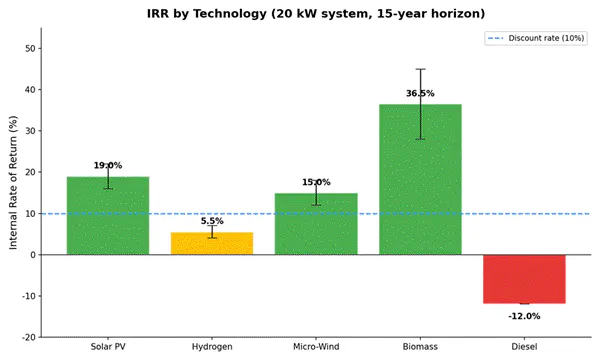
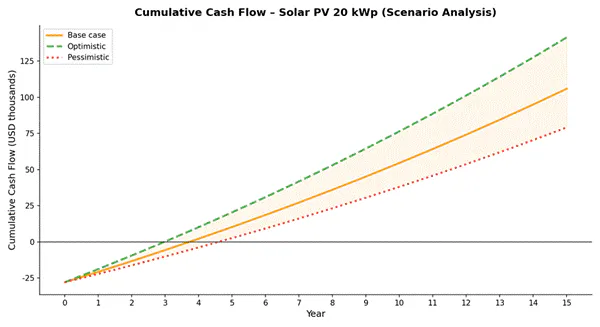
Solar PV: Delivers the fastest payback of 5-8 years and the lowest LCOE in high-irradiance regions. Most attractive overall. CapEx ≈ USD 40,000 (USD 2,000/kW installed, rising ~20–30% in 2026 due to import taxes on inverters/BESS). LCOE 0.04–0.07 USD/kWh. Payback 5–8 years at typical self-consumption tariffs (0.15–0.20 USD/kWh). Annual output ~36–44 MWh (CF 23–25%).
Diesel: Remains the highest-OPEX option but offers unmatched reliability for critical backup. Lowest upfront cost (≈ USD 8,000) but highest OpEx due to fuel (~0.35–0.40 L/kWh at ~USD 1.10/L). LCOE 0.25–0.40+ USD/kWh for continuous use. Reserve exclusively for backup.
Hydrogen: Shows long-term promise but is currently hampered by a CAPEX 3-4 times higher than PV with battery storage. Promising for long-duration/seasonal storage but CapEx 6–10× higher than PV (≈ USD 240,000+). Round-trip efficiency 25–35%. LCOE >0.40 USD/kWh. Suitable only for pilots with subsidies.
Biomass: Highly profitable with access to cheap feedstock, offering payback in as little as 2.5 years. Excellent in agribusiness with low/zero-cost feedstock (e.g., sugarcane bagasse, cassava residues). CapEx ≈ USD 110,000. Payback as low as 2.5–4 years. LCOE 0.06–0.10 USD/kWh. Dispatchable (CF 60–70%).
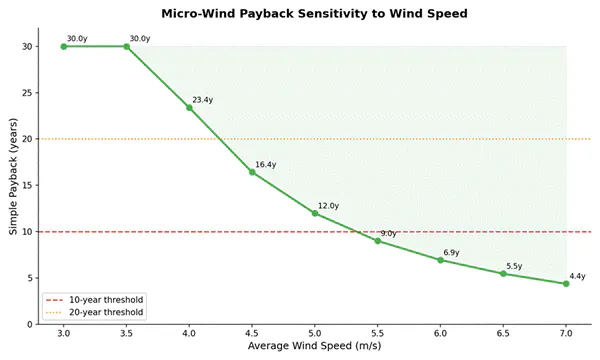
Micro-Wind: Viability is extremely site-dependent, with payback periods ranging from 5 to over 18 years. Highly site-specific. Viable only in coastal/high-wind pockets (>6 m/s average). CapEx ≈ USD 90,000. Payback 8–18+ years. CF 18–28%. Complements solar but limited scalability for ≤20 kWp.
1. Comparative Financial Analysis
This section details the core financial metrics for each technology, providing a foundation for investment decisions.
1.1. Capital Expenditure (CapEx)
Initial investment is a primary barrier to entry for many decentralized energy projects. As illustrated below, Diesel generators have the lowest upfront cost, while Hydrogen systems are by far the most capital-intensive. Upfront costs remain the main barrier. The chart below (updated for 2026 Northeast installed costs, including BOS, inverters, civil works, and rising import duties) shows Diesel as cheapest and Hydrogen as most intensive.
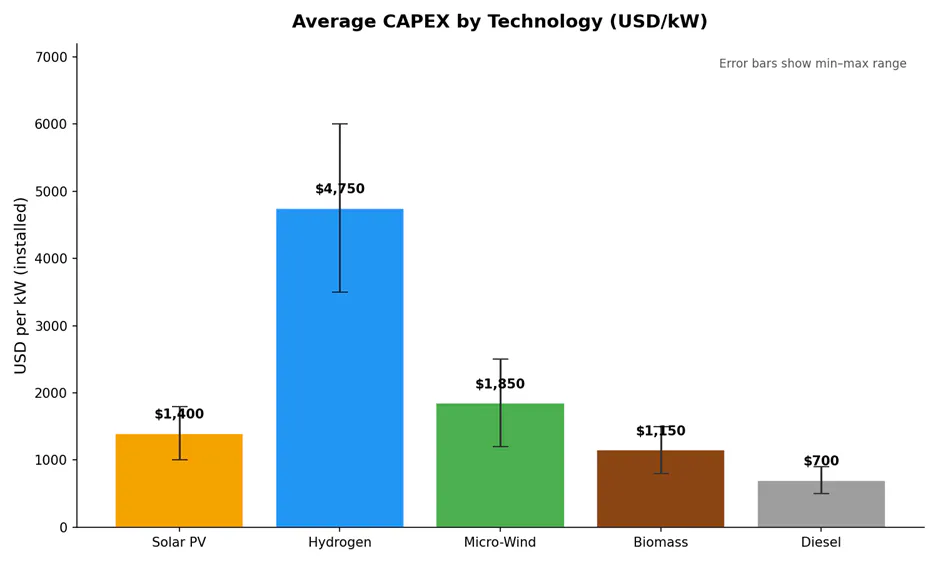
Table 1.1: CapEx Breakdown (20 kWp, USD, Northeast Brazil 2026 estimates)
1.2. Levelized Cost of Energy (LCOE)
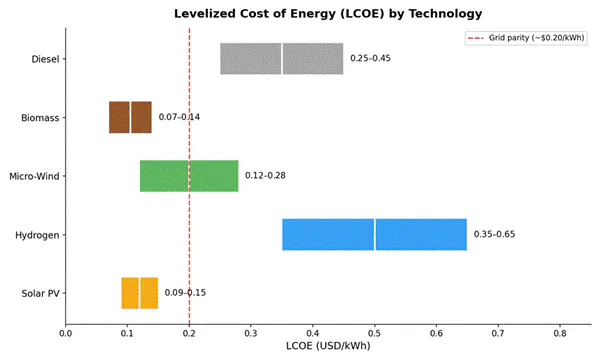
LCOE represents the net present cost of electricity generation over a system's lifetime. It is a crucial metric for comparing the cost-effectiveness of different technologies. Solar PV and Biomass are the most competitive options, with LCOE values often falling below the grid tariff.
1.3. Payback Period, NPV, and IRR
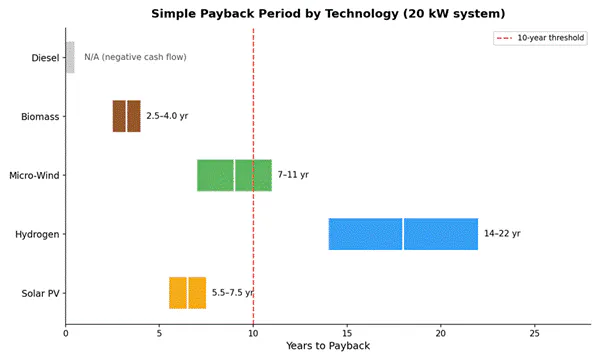
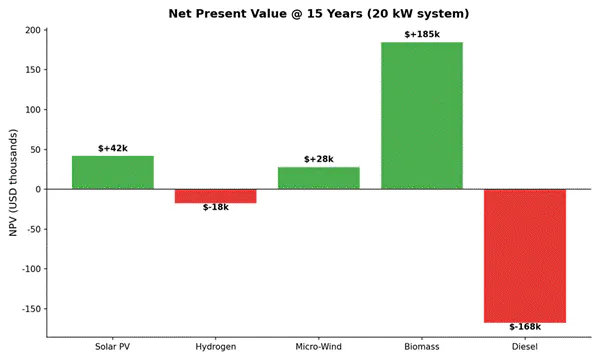
Financial viability is ultimately determined by the return on investment. The following charts illustrate the simple payback period, Net Present Value (NPV) over a 15-year horizon, and the Internal Rate of Return (IRR). Biomass and Solar PV show superior performance, promising quick returns and high profitability.
2. Technology Deep-Dive
This section provides a detailed overview of each technology, covering technical parameters, operational characteristics, and cash flow highlights for a representative 20 kWp system.
2.1. Solar Photovoltaic (PV)
Solar PV is a mature, reliable, and increasingly affordable technology. Its modularity makes it suitable for a wide range of applications. In regions with high solar irradiance like Northeast Brazil, PV systems offer excellent capacity factors and rapid returns.
Mature technology with modules at 20–22% efficiency (TOPCon/HJT dominant in 2026). In Pernambuco State (Brazil's Northeast Region), typical yield 1,800–2,200 kWh/kWp/year (CF 23–25%). A 20 kWp system requires ~50–60 panels (400–450 W each) on rooftops or ground mounts.
Key Strengths: Near-zero OpEx (1–2% of CapEx/year), 25–30 year lifespan, modular/scalable. Declining panel prices offset 2026 tax hikes. Low maintenance, long lifespan (25+ years for panels), and declining costs.
Key Weaknesses: Intermittency—pair with 10–20 kWh BESS for evening loads. 2026 Northeast Intermittent generation requiring storage or grid connection for 24/7 power.
Example: Rooftop installations in Recife (Pernambuco capital state) metro area routinely achieve 5–6 year payback under ANEEL net-metering credits (valid until 2045 for pre-2023 systems; new rules add capacity-based fees but still viable).
2.2. Hydrogen-Based Systems
Green hydrogen, produced via electrolysis powered by renewables, offers a pathway for long-duration energy storage. However, the technology is still in its early stages, with high costs and relatively low round-trip efficiency.
Green H₂ via alkaline/PEM electrolysis (powered by excess PV/wind) + fuel cell for reconversion. Small-scale (<50 kW) systems remain niche. Round-trip efficiency 25–35%.
Key Strengths: Zero-emission, long-duration storage (days/weeks), dispatchable. Seasonal storage capability and zero-emission power generation.
Key Weaknesses: High CapEx, maintenance complexity, low efficiency. Current production cost ~USD 4–7/kg H₂ in favorable sites. High CAPEX, low round-trip efficiency (25-35%), and complex operation.
Recommendation: Limit to funded pilots or research until electrolyzer costs drop below USD 400/kW (expected post-2030).
2.3. Micro Wind Turbines
Wind turbines can be an effective solution in areas with consistent and strong wind resources. Their performance is highly sensitive to the local wind regime, making site assessment critical.
Performance hinges on local wind resource (Brazil's Northeast coast often >6 m/s; inland <4 m/s). Small turbines (5–20 kW) achieve CF 18–28% in optimal sites but suffer lower aerodynamic efficiency than utility-scale.
Key Strengths: Complements solar (stronger at night/monsoon) Can complement solar generation (often stronger at night and in winter). Low land use.
Key Weaknesses: Noise, visual impact, bird risk, high per-kW cost, and site-specific viability (detailed wind atlas assessment mandatory). Highly site-dependent, potential for noise and visual impact.
2.4. Biomass Combustion/Gasification
Biomass systems provide dispatchable power by converting organic waste into electricity. They are particularly well-suited for agricultural or industrial settings with a ready supply of feedstock.
Small-scale gasifiers (fixed-bed or downdraft) convert agricultural residues into syngas for internal combustion engines or turbines.
Key Strengths: Dispatchable 24/7 power, uses local waste (feedstock cost often USD 0–20/tonne), potential carbon-negative with biochar. CF 60–70%.
Key Weaknesses: Requires consistent feedstock supply and ash management.
Economics Example: 20 kW gasifier with free bagasse → LCOE <0.08 USD/kWh, payback 2.5–4 years.
2.5. Diesel Generators
Diesel generators are the traditional solution for off-grid and backup power. While they offer high reliability and low CapEx, their high fuel and maintenance costs, along with significant CO₂ emissions, make them unsuitable for continuous operation. Proven, instant-start reliability. Modern units meet Tier 4 emissions but still emit ~700–900 g CO₂/kWh.
Key Strengths: Low CapEx, high reliability, fuel widely available, dispatchable power.
Key Weaknesses: Fuel volatility (diesel ~USD 1.10/L in 2026), high OpEx (~USD 0.25–0.35/kWh fuel + maintenance), emissions. Strategic Use: Backup/peak only; hybridize with PV to reduce runtime 50–70%.
3. Comparative Performance Metrics
Beyond financials, several technical and environmental factors are critical for technology selection.
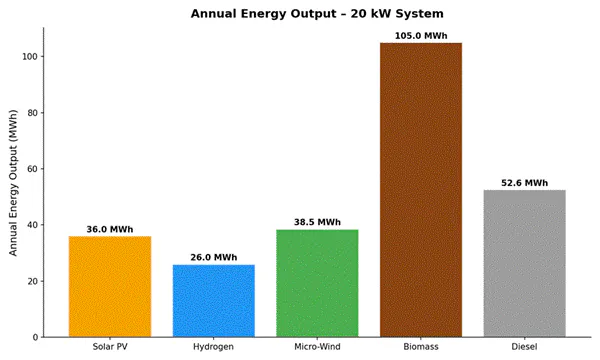
3.1. Capacity Factor and Energy Output
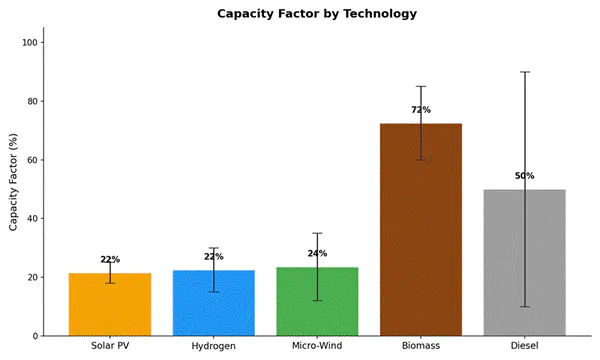
Capacity factor measures the actual energy output as a percentage of the potential maximum output. Biomass and Diesel lead in this metric due to their dispatchable nature.
3.2. CO₂ Intensity and Land Use
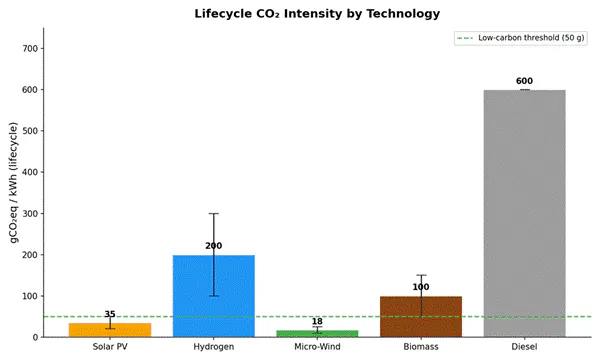
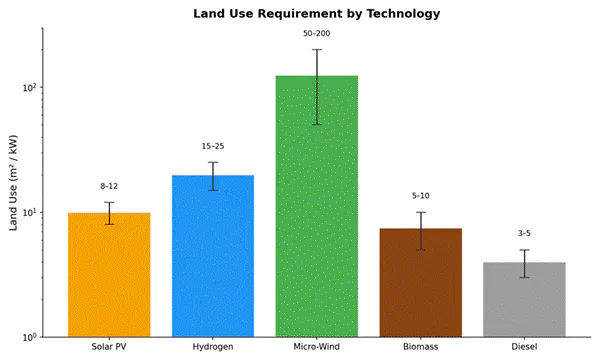
Environmental impact is a growing consideration. The chart below shows the lifecycle CO₂ emissions per kilowatt-hour. Renewables offer a drastic reduction compared to diesel. Land use is another important factor, particularly for ground-mounted systems.
Lifecycle CO₂ (g/kWh):
Solar PV ~30–50;
Biomass ~20–80 (sustainable);
Micro-Wind ~10–20;
Hydrogen ~40–80 (if renewable-powered);
Diesel ~700–900.
Land use: Solar ~0.02–0.04 ha/20 kWp (rooftop zero); Biomass higher if dedicated crops.
3.3. Multi-Criteria Comparison
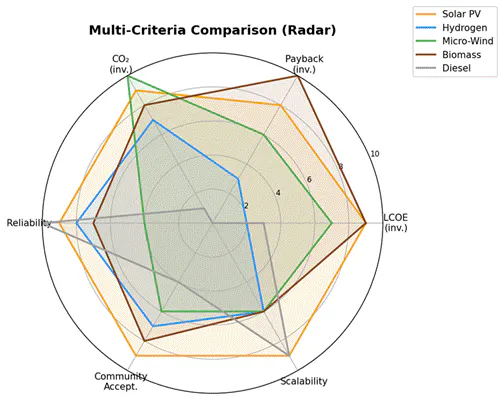
The radar chart below provides a holistic comparison across six key criteria, demonstrating the balanced strengths of Solar PV and the specialized advantages of other technologies.
Solar PV scores highest overall balance (cost, reliability, environmental). Biomass leads on dispatchability and local jobs. Diesel scores high on reliability but low on sustainability.
4. Hybridization and Strategic Recommendations
Combining technologies can often yield a more reliable and cost-effective solution than a single-technology approach.
4.1. Hybridization Potential
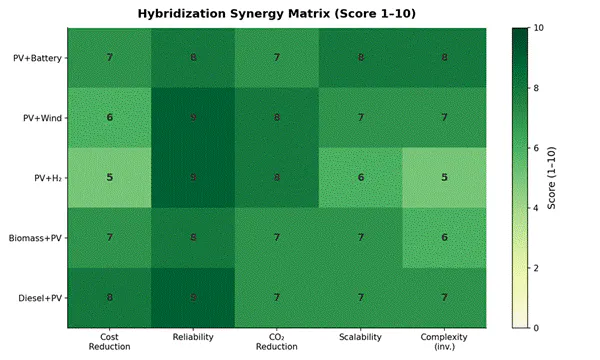
The matrix below scores the synergy of different hybrid systems. PV + Battery and Diesel + PV are particularly effective combinations for enhancing reliability and reducing costs.
Proven Combinations:
PV + Battery: Highest ROI for residential/micro-grid.
PV + Diesel: Cuts fuel use 40–70%; common in rural Pernambuco.
PV + Biomass: Ideal agribusiness baseload + daytime solar.
PV + Micro-Wind: Night/winter boost in coastal sites.
Hydrogen as seasonal buffer (emerging).
4.2. Strategic Recommendations
Prioritize Solar PV: For the vast majority of small-scale applications in high-irradiance regions, Solar PV represents the lowest-risk, highest-return investment. For 80%+ of applications in high-irradiance Northeast Brazil—lowest risk, fastest payback.
Leverage Biomass: In agricultural and industrial contexts with access to waste streams, biomass gasification is a highly profitable and dispatchable renewable option.
Use Diesel for Backup Only: Relegate diesel generators to a backup or "insurance" role. Hybridizing them aggressively with solar can cut fuel consumption by 40-70%.
Pilot Hydrogen with Caution: Explore hydrogen for niche applications requiring long-duration storage, but only with external funding or for research purposes until costs come down. seek specific credit lines for funding or corporate PPAs
Design a Resilient Portfolio: The optimal solution is rarely a single technology. A portfolio approach that matches local resources with load profiles will deliver the most resilient and cost-effective energy system (daytime solar, evening biomass/diesel). Conduct site-specific resource assessment (solar + wind + biomass availability).
Regulatory & Financing Tips: Utilize ANEEL DG rules, PRODEEM rural program, low-interest green lines from BNDES/BB. Monitor 2026 tax changes—install before April if possible.
Local Case Studies in Brazil´s Northeast Region
Solar + Hybrid: 18 kWp PV + 10 kWh BESS + 15 kW diesel backup → 92% renewable coverage, payback 6.2 years.
Biomass Gasifier: 20 kW unit using cassava waste → 100% dispatchable, negative OpEx via waste avoidance, IRR 35%+.
5. Data Sources and Assumptions
IRENA Renewable Cost Database (2024)
NREL Distributed Wind Report (2023)
ABINEE Solar Market Intelligence (Brazil, 2025)
IEA Hydrogen Projects Database
Manufacturer datasheets: BYD, Cummins, Siemens Energy
Field project data: Pernambuco, Brazil
Financial assumptions: 10% discount rate, 3% inflation, 4% energy price escalation.
IRENA Renewable Cost Database (2024–2025)
ABSOLAR Market Intelligence & Panorama Solar (2025–2026)
EPE Atlas of Energy Efficiency & Auction Results (2025)
NREL Distributed Wind & PV Reports
Manufacturer datasheets (BYD, Cummins, Siemens, W2E Bioenergia)
Field data: Pernambuco projects (2024–2025)
Financial: 10% discount rate, 3% inflation, 4% tariff escalation, diesel USD 1.10/L, retail offset 0.18 USD/kWh average.
Solar PV offers the clearest path to affordable, sustainable decentralized power.
Biomass provides dispatchable profitability where feedstock exists. Strategic hybridization and adherence to evolving.
Appendix A - ANEEL Regulations Overview (as of February 2026)
ANEEL (Agência Nacional de Energia Elétrica) is Brazil's federal regulatory agency for the electric power sector. It oversees generation, transmission, distribution, and commercialization of electricity, ensuring compliance, consumer protection, tariff fairness, and system reliability. In the context of small-scale decentralized energy (especially solar PV ≤20 kWp in high-irradiance regions like Northeast Brazil/Recife-Pernambuco), ANEEL's rules primarily govern distributed generation (Geração Distribuída – GD), also called micro and mini distributed generation (MMGD).
Key Framework for Distributed Generation
The main legal foundation is Law 14.300/2022 (Marco Legal da Geração Distribuída), which created a transitional model for GD after the old net metering rules (from ANEEL Resolution 482/2012) ended for new projects.
Sistema de Compensação de Energia Elétrica (SCEE): Consumers generate their own power (mostly solar) and offset consumption with excess injected into the grid.
Transitional rules apply differently based on project start date: Systems requested before January 7, 2023 (or with contracts signed by then): Full net metering (almost 1:1 credit) until 2045 (grandfathered). Systems requested after January 7, 2023: Gradual phase-out of full credits. From 2023–2028, credits decrease stepwise; full TUSD/TUST charges (wire fees) apply progressively. By 2029+, only energy credits (no wire fee discounts), with possible adjustments based on ANEEL's pending costs-benefits study.
Current status in 2026: Most new residential/commercial solar installations (post-2023) still benefit from partial credits, but payback periods have lengthened compared to pre-2023. Full implementation of post-2029 rules awaits ANEEL's final methodology on GD costs/benefits (delayed beyond original deadline; public consultation/Tomada de Subsídios 23/2025 closed March 2026, regulation expected 2027).
Core ANEEL Resolutions for GD (Consolidated in 2021–2026)
Resolução Normativa nº 1.000/2021 (main rules for distribution service): Consolidates consumer rights/duties, connection procedures, billing, and SCEE details. Updated multiple times (e.g., 2023–2026) to align with Law 14.300. Defines microgeneration (≤75 kW) and minigeneration (75 kW–5 MW, with sub-limits for some sources). Covers modalities: local self-consumption, remote self-consumption, shared generation (condominiums/farms), and virtual compensation.
Updates & key changes (2024–2026): Resolução 1.098/2024: Simplified grid connection by exempting "inversion of flow" studies (technical analysis for reverse power issues) in most small cases: Up to 7.5 kW local self-consumption. Systems matching consumer load (no major excess). Zero-export/isolated inverters. Recent 2026 alterations (e.g., Resolução 1.148/2026): Focus on consumer satisfaction, PRODIST updates (distribution procedures), and minor tweaks to billing/quality metrics.
Agenda Regulatória 2025–2026/2027: 2026 priorities include observability/control of distributed resources (RED – Recursos Energéticos Distribuídos), possible curtailment rules (generation cuts during excess daytime solar), hourly tariffs for low voltage, and excess energy management. Full GD costs/benefits valuation (Art. 17 of Law 14.300) postponed to 2027. Discussions on physical curtailment (rare but possible for grid safety) vs. accounting cuts (rejected by some opinions).
Practical Implications for Small-Scale Systems (≤20 kWp) in Northeast Brazil
Connection & Approval: Distributors (e.g., Celpe in Pernambuco) handle requests via ANEEL's standardized process. Small rooftop solar usually connects quickly if under exemptions.
Billing & Credits: Excess energy credited at full/injected value (kWh), usable within the same distributor for up to 60 months. Post-2023 systems pay increasing TUSD/TUST portions on compensated energy.
Hybrid/Backup: Diesel or battery hybrids remain allowed; diesel is backup-only to avoid high OpEx.
Challenges in 2026: Growing daytime solar → potential future curtailment discussions (physical cuts only in extreme grid safety cases; no broad "accounting" cuts yet). ANEEL/ONS concerns about observability/control of millions of GD units. Still very attractive in high-irradiance Northeast (fast payback 5–8 years for PV), especially self-consumption + batteries.
For the latest official details, check ANEEL's website (gov.br/aneel) – especially the GD section, PRODIST modules, and recent resolutions. Rules evolve quickly (e.g., agenda shifts post-Law 15.269/2025 modernizing the sector). If installing now in Recife area, focus on post-2023 transitional credits while benefiting from local irradiance and possible state incentives.
ard local/remote self-consumption ≤500 kW, most residential/commercial solar in Northeast Brazil). Larger or shared/remote systems (GD III) pay additional charges (e.g., 40% TUSD Fio A + minor fees) from the start.
Grandfathered systems (pre-2023 or early 2023 requests within deadlines) keep full credits until 2045.
What Changes in 2029?
The transitional percentage reaches 100% — full TUSD Fio B (distribution wire fee) is charged on the compensated/injected energy for post-2023 systems.
The compensation no longer covers the full grid usage cost during the transition. Instead, credits primarily offset the energy component (TE – Tarifa de Energia) plus any benefits calculated by ANEEL.
The key shift: ANEEL must define a new methodology (per Article 17 of Lei 14.300) that values the costs and benefits of distributed generation. This includes: Costs: Grid reinforcement, losses, ancillary services, etc. Benefits: Avoided transmission/distribution investments, reduced losses, peak shaving, environmental gains, etc.
Compensation becomes TE + net benefits (or a similar adjusted model), rather than near-full parity. This could mean credits worth less than the full injected kWh value, depending on ANEEL's final rule.
No broad physical curtailment is mandated, but enhanced observability/control of GD resources (e.g., inverters) may be required for grid stability.
Current Status (February 2026)
ANEEL opened Tomada de Subsídios 23/2025 (public input phase) in late 2025 to discuss methodologies, international experiences, and alternatives for post-2029 rules.
The agency aims to finalize the costs-benefits valuation and new tariff model by 2027 (delayed from original deadlines), with implementation in 2029.
Uncertainty remains: The exact credit value (e.g., 70–90% of injected energy after netting benefits/costs) is not yet defined. Discussions involve distributors, solar associations (ABSOLAR), consumers, and experts.
For small systems in high-irradiance areas like Recife/Pernambuco, self-consumption (using solar directly) remains highly attractive — no grid fees apply to self-used energy. Batteries further boost viability by maximizing self-use and minimizing exports.
Practical Impact for ≤20 kWp Systems in Northeast Brazil
New installations in 2026: Still in transition (60% Fio B in 2026 → 90% in 2028 → full 100% + new model in 2029). Payback periods are longer than pre-2023 (now ~6–9 years vs. 4–6 years), but still strong due to high solar yield (1,800–2,200 kWh/kWp/year) and rising tariffs.
Post-2029 reality: Expect reduced credit value on exported energy → prioritize oversized systems with storage for higher self-consumption (>70–80%). Hybrids (solar + battery + diesel backup) become even more strategic.
Still worthwhile: Solar PV remains the lowest LCOE option in Northeast; incentives (e.g., BNDES financing, local rebates) help.
In summary, 2029 ends the gradual phase-in and introduces a more "cost-reflective" model where GD credits reflect net system value (not full parity). Exact details await ANEEL's 2027 regulation — monitor ABSOLAR, ANEEL's site (gov.br/aneel), and distributors like Neoenergia for updates.
Appendix B - State Incentives - Solar Incentives in Pernambuco (as of February 2026)
Pernambuco (PE), especially in high-irradiance areas like Recife and the Sertão region, remains one of Brazil's strongest locations for small-scale solar PV (≤20 kWp) due to excellent solar resources (often >5.5–6 kWh/m²/day) and ongoing state support. While federal changes (e.g., Lei 14.300/2022 transitional "tax on the sun" reaching 60% Fio B in 2026) increase grid-related costs for exported energy, several incentives make solar viable—particularly for high self-consumption designs.
1. Federal-Level Incentives (Applicable in PE)
Distributed Generation Compensation (ANEEL/SCEE): Excess energy credits offset your bill (primarily TE energy component + partial benefits). In 2026, post-2023 systems pay 60% of TUSD Fio B (distribution wire fee) on compensated energy (~16% effective extra cost on injected kWh). Self-consumed energy remains fully free of grid fees—maximize this with batteries.
Financing Lines: BNDES, Banco do Brasil, or Caixa offer low-interest green loans (e.g., via PRODEEM rural or general DG programs). Rates often 6–10% p.a. in 2026.
Tax Exemptions on Equipment: Some federal reductions (e.g., via SUDENE for Northeast projects) apply to larger setups, but small residential/commercial benefit indirectly through lower import duties in some cases (though II import tax on inverters/BESS rises to 20% from April 2026, per ABSOLAR alerts).
SUDENE Funding: Northeast development agency provides financing/incentives for renewables; recent examples include solar projects in nearby states, with PE benefiting from regional funds.
2. State-Level Incentives (Pernambuco-Specific)
ICMS Exemption on Generated Energy: Pernambuco follows Convênio ICMS 16/2015 (CONFAZ), granting full ICMS exemption on electricity from micro/mini DG (solar PV). No ICMS on self-generated or compensated energy (confirmed in RICMS/PE and resolutions like RC 003/2025). This saves ~18–29% on the energy portion of bills (TE + ICMS normally embedded). Applies to residential, commercial, rural, and industrial GD. Key: ICMS only on grid-supplied energy, not solar-produced.
ICMS Deferral for Equipment/Manufacturing: Recent updates (via Sefaz-PE modifications to Decreto 14.876/1991) allow deferral (postponement) of ICMS on purchases of machines, equipment, cables, and structures for solar/wind generation. Payment deferred until asset disposal—lowers upfront costs for installers/manufacturers, indirectly reducing system prices for end-users.
SUDENE & ADEPE Support: Pernambuco's Agência de Desenvolvimento Econômico (ADEPE) promotes solar via incentives for investments. PE ranks high nationally (4th in solar production), with large parks (e.g., Solatio/Equatorial deals) and potential up to 1,200 GW in Sertão. Selo Solar certification for renewable consumers.
World Bank Partnership (2025+): Ongoing project supports green private sector, including easier licensing for renewables and sustainability certifications—benefits DG indirectly.
3. Municipal/Local Incentives (Varies by City)
Ipojuca Example (Feb 2026): Câmara approved unanimous bill for solar incentive program: IPTU/ISS tax reductions, priority solar installs on public buildings/schools/health units. Aims to cut bills, create jobs, promote clean energy.
Other Municipalities: Recife and others may offer property tax rebates (IPTU discounts) or streamlined permits—check prefeitura local. Rural/agro areas often get extra via PRODEEM.
4. Practical Impact for ≤20 kWp Systems in Recife/Pernambuco (2026)
Still Attractive: High irradiance yields 1,800–2,200 kWh/kWp/year. With ICMS exemption + high self-consumption (e.g., 70–90% via batteries), payback remains 6–9 years despite 60% Fio B charge and ~30% equipment cost rise (from April 2026 import taxes/China prices).
Best Strategies: Prioritize self-consumption + battery storage (BESS) to minimize exports and avoid most grid fees. Hybrid with diesel backup for reliability. Install soon—before further 2027–2028 increases (75–90% Fio B).
Challenges: Equipment costs up ~30% in 2026 (ABSOLAR PE coordinator Luzer Oliveira); no full "subsidy" like pre-2023, but incentives offset this.
#SolarEnergy #SolarPV #Photovoltaic #RenewableEnergy #CleanEnergy #DistributedGeneration #MicroGeneration #OffGrid #HybridSystems #SolarBrazil #NortheastSolar #RecifeSolar #SustainableEnergy #BiomassEnergy #BiomassGasification #Bioenergy #AgriculturalResidues #SugarcaneBagasse #MicroWind #SmallWindTurbine #WindEnergy #GreenHydrogen #RenewableHydrogen #EnergyStorage #SolarBattery #BESS #DieselGenerator #SolarDieselHybrid #LCOE #EnergyPayback #EnergyInvestment #EnergyTransition #DecentralizedEnergy #Microgrid #Minigrid #AgroEnergy #AgriculturalEnergy #Sustainability #GreenEnergy #RenewablesBrazil #ABSOLAR #ANEEL #Prosumer #SelfConsumption #EnergyForAll #RenewableFuture #NortheastRenewables #SolarPower #EnergyIndependence #NetMetering