As North American diesel prices flirt with historic highs, a Q3 2026 road trip down Electric Avenue is in order.
Overall, traffic remains light, with no rush to join a world market shifting from fossil fuel molecules to electrodes. So, no high-demand traffic jams to worry about; but also far too few Plan Bs available to detour around retail diesel price spikes that, in Canada, recently jumped 15% higher than the November 2022 record and, for the first time, surged past US$6.50 per gallon on average in the United States.
So, will more businesses and consumers be asking for directions to Electric Avenue?
Maybe. There are plenty of unused maps available.
Outside of China, commercial trucking remains marginally invested in an electric truck market estimated today at around US$84 billion but, according to Global Market Insights Inc. (GMI), is on pace to hit US$1.9 trillion by 2035.
The Delaware-based market research company forecasts the global unit volume of electric trucks to jump to 10,497,832 from 2025’s 497,630.
Considering that the world’s commercial truck fleet is around 38 million units, extended stretches of Electric Avenue’s truck lane, especially in North America, are traffic-free.
But back to the truck fleet later.
On the consumer side of the white line, EV sales are gaining momentum.
The International Energy Agency’s (IEA) Global EV Outlook 2026 reports that electric car sales globally grew 20% in 2025 on their way to exceeding 20 million units. That is one-quarter of the new car sales market.
The biggest increase was in Europe, where EV sales jumped 30% last year compared with 2024 to reach a 28% market share; in China, EVs accounted for 55% of the market.
However, in the United States and Canada, EVs were stalled at under 10%.
According to Cox Automotive’s Q3 2026 report, EV sales in the U.S. bottomed out at the beginning of the year following the expiration of government tax credits in late 2025.
However, Stephanie Valdez Streaty, the director of EV market insights for the U.S.-based automotive services and technology company, noted that “building blocks for electrification continue to improve, even as consumer adoption varies across powertrains.”
Those blocks include an average 20% boost in EV range to around 300 miles (480 kilometres) since 2021 and global battery pack prices that “have fallen 21% over five years to US$108 per kilowatt-hour.”
Valdez Streaty added during Cox’s September 24 Q3 2026 sales forecast update that there are now approximately 74,000 public fast chargers across the U.S., which is a 27% increase compared with the same time last year. Canada’s fast-charger network has increased 40% to around 8,500 this year, up from roughly 6,100 in Q3 2025.
According to Cox data, Q3 2026 EV sales in the U.S. stabilized near 6% of the new vehicle market. That’s a significant drop from Q3 2025, when EVs had a 10.6% share of the market, driven in large part by the looming expiration of federal EV tax credits.
Valdez Streaty noted that the EV price premium vs. internal combustion engine (ICE) gap continues to narrow.
“In August,” she said, “the average EV transaction price was US$54,754, compared with US$49,907 for ICE+, bringing the price premium to 9.7%, down from 16.5% a year ago.”
Valdez Streaty added that hybrids (HEVs) are the electrified vehicle market’s top sellers. HEV sales increased 23% in Q2 2026 compared with Q2 2025.
Meanwhile, electrodes are winning converts in the hard-to-electrify commercial trucking segment.
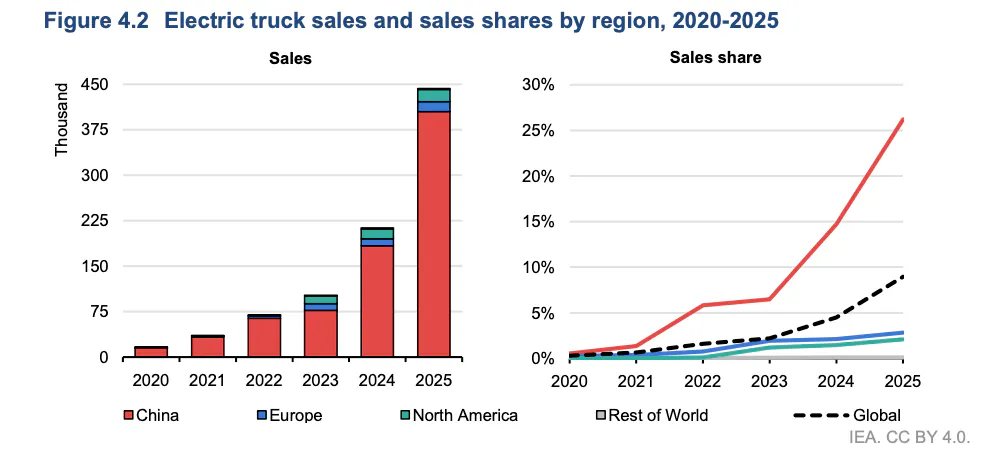
IEA numbers show worldwide electric truck sales more than doubling in 2025 compared with 2024 to reach a 9% market share.
The caveat here, however, is that EV truck adoption is concentrated geographically, and China is at the centre of that electrification concentration.
IEA data shows that one in four trucks sold in China in 2025 were electric.
Price is fundamental to the calculus here.
Electric trucks remain two to three times more expensive to buy than their diesel counterparts; however, with battery prices falling, the total cost of ownership in China, according to the IEA, “is already competitive.”
The IEA forecasts that electric trucks will “constitute at least 20% of global truck sales in 2035, led by sales in China, where they [will] reach a 60% sales share.”
According to GMI, the pivotal transition for commercial truck electrification will be in the local short-haul fleet segment of “depot-bound medium-duty … to heavy vehicles that need predictable access to high-power charging.”
Widespread conversion of long-haul trucks will require battery technology breakthroughs in size, weight, and range, and the widespread availability of fast recharging and battery-swap infrastructure so that, as GMI points out, “a long-range electric tractor can return to service within driver-rest windows rather than losing productive hours.”
Its global electric truck analysis adds that, “the market’s projected expansion is conditional on coordinated vehicle procurement, grid connections, depot development, and corridor charging.”
Back in North America’s consumer market, transportation electrification today is more evolution than revolution.
However, momentum is on its side as battery technology advances, charging infrastructure expansion, and marketplace adoption defuse range anxiety and narrow EV vs. ICE price gaps.
The choice will come down to overall driving experience.
It will be EV conversion one test drive at a time
www.linkedin.com/in/timothyrenshaw
@timothyrenshaw