Meanwhile, back at container shipping’s high-stakes Texas Hold’em transportation decarbonization table, the dealer has turned over a green ammonia card.
Who is betting, and who is folding?
WinGD is banking on more betting than folding; Envision Energy is too.
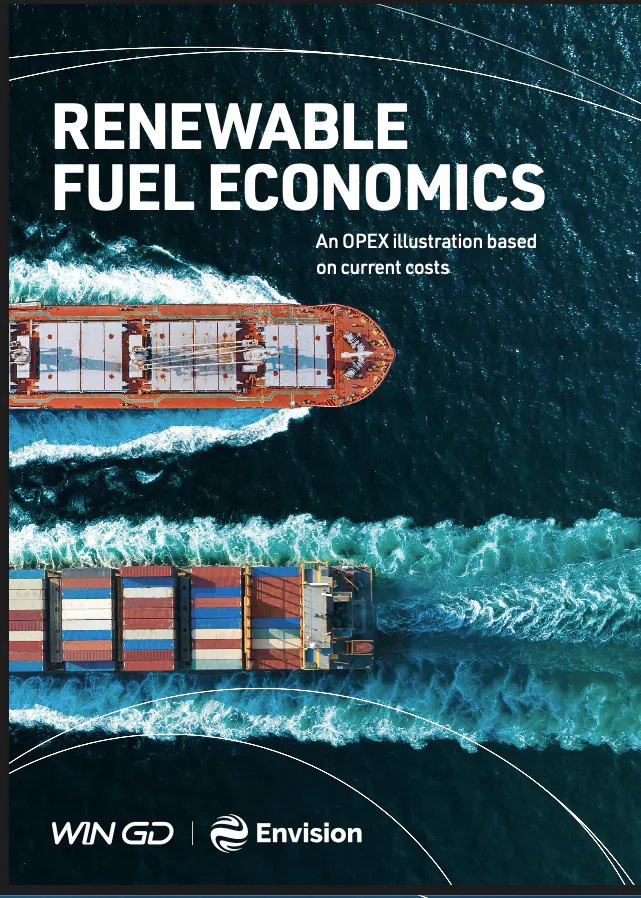
The Swiss engine maker and decarbonization advocate, along with Shanghai-based green hydrogen producer Envision, recently released a study championing green ammonia as the first carbon-free marine fuel with a credible business case to power container shipping and other deep-water commercial fleets.
“Renewable Fuel Economics” charts a complex course through a series of business navigation hazards to conclude that even under a “moderate carbon pricing regime… green ammonia bunkered at today’s price is already capable of narrowing the operational cost gap with conventional fuels.”
It adds that if that calculation is extended across a ship’s 25-year lifespan, “as green fuel costs reduce and regulatory levers tighten, it could outperform other fuels economically.”
Perhaps.
However, the global commercial shipping fleet remains far from any lower-carbon emissions destination.
Recent political winds have blown it further off course.
Substack Shipping News readers will recall, for example, that member states at 2025’s Extraordinary Session of the International Maritime Organization’s (IMO) Marine Environment Protection Committee, who were expected to adopt the IMO’s Net Zero Framework (NZF), instead delayed the NZF adoption vote to October 2026.
That flip-flop threatens to delay NZF implementation to 2030 or sink it altogether.
Political delays aside, European Union and other regional maritime pollution reduction regulations will, in the meantime, continue to tighten. That will inflate fossil fuel premiums and narrow the operating expense price gap between it and lower carbon alternatives.
So, the hunt for the holy grail of a reliable source of cleaner propulsion fuel at a financially viable price continues for ocean carriers facing multibillion-dollar decarbonization bills.
OpEx viability and bottom-line practicality remain elusive.
WinGD appears to be grounded in practicality.
It reasons, for example, that “shipowners need fuels that can compete on economics rather than policy ambition alone.”
They also need assurances of long-term availability of alternative fuels and a reliable network of bunkering hubs along international shipping trade lanes.
Green ammonia is short on both counts.
Only a handful of major shipping hubs have even conducted ammonia bunkering demonstrations:
•In 2025, Envision and COSCO Shipping (SHA:601919), the world’s fourth largest container shipping line, completed China’s first two ammonia bunkering operations at the port of Dalian;
•Rotterdam and Singapore have conducted trial runs of refuelling ships with ammonia; and
•Yokohama completed the world’s first truck-to-ship ammonia bunkering two years ago. Hamburg is also developing ammonia fuelling capacity.
However, no ports today have commercial-scale ammonia bunkering terminals that offer regular refuelling services.
Compare that with liquefied natural gas (LNG) bunkering, which is available at 222 ports.
Ammonia as a reliable ship fuel therefore has a logistics problem.
It also has a safety problem. Ammonia is highly toxic to humans and the environment if spilled.
It has about one-third of the energy density of marine diesel. Ships would therefore have to allocate larger space for ammonia fuel tanks.
Green ammonia is also expensive to produce.
Depending on regional supply and production, it can cost anywhere between US$710 and US$2,900 per tonne compared with very low sulphur fuel oil (VLSFO) or marine gas oil (MGO), which range from US$460 to US$600 per tonne.
“Renewable Fuel Economics” concedes that green ammonia as a commercial shipping fuel has challenges “particularly around crew training, bunkering and safety standards.”
However, it points out that, along with producing no CO2 at combustion while eliminating sulphur and particulate emissions, “ammonia is already a globally traded commodity with established storage and distribution infrastructure at ports worldwide.”
The report adds that the first commercial ammonia-powered ships will enter service in 2026, “providing the industry with real-world operational experience and data.”
For example, A.P. Moller-Maersk (CPH:MAERSK-B), the world’s second-largest container shipping company, took delivery of a Very Large Ammonia Carrier earlier this year and plans to have at least 26 dual-fuel ammonia ships in its container and tanker fleet in the next five years.
WinGD-Envision’s operating expenses math in the “Renewable Fuel Economics” report’s sample scenario using a mid-sized container carrier estimates that Envision Energy’s green ammonia fuel option today would be around three times the cost of a conventional VLSFO-powered ship.
However, the report argues that higher FuelEU Maritime energy-intensity penalties, EU Emissions Trading System carbon-pricing levies, and other international pollution reduction initiatives will narrow that price gap.
Combine that with lower production costs than green methanol or e-LNG, and ammonia becomes a safer bet at the Texas Hold’em transportation decarbonization table.
The report also tips its hat to LNG as a reliable, available, and affordable bridge fuel for deep-water shipping.
Solidifying ammonia’s practicality for ocean carriers plying transpacific trade lanes would require an ammonia bunkering hub along North America’s West Coast.
Vancouver and Prince Rupert would be prime locations for that hub.
Considering Vancouver’s evolution as a potential LNG bunkering hub, adding ammonia to that capacity would establish Canada’s West Coast as a mandatory stop en route to a greener shipping future.
That is a gamble worth pursuing.
www.linkedin.com/in/timothyrenshaw
@timothyrenshaw