


By Kennedy Maize
While the Trump administration pursues rescuing the past of electric generation, solar and wind, with a big boost from batteries, are winning the future.
The Department of Energy’s Energy Information Administration has released its prediction for new electric generation in 2026, headlined, “New U.S. electric generating capacity expected to reach a record high in 2026, noting that “U.S. power plant developers and operators plan to add 86 gigawatts (GW) of new utility-scale electric generating capacity to the U.S. power grid in 2026.” Of that total, 79.5 GW (93%) are solar (434 GW), battery (24.3 GW), wind (11.8 GW). Gas trails the pack (6.3 GW).
Pay attention, White House: no new nukes, big or small; no new coal, none at all. Back to the future is at a crawl.
Pointing out that 2025 was a banner year for solar with 53 GW of new capacity added to the U.S. grid, the most in a year since 2002, EIA said, “We expect 2026 to be another big year for solar additions, similar to the record utility-scale solar capacity added to the U.S. grid in 2024 (30.8 GW) and in 2025 (27.2 GW).” Power developers told EIA their 2026 plans for solar are a 60% increase over 2025 “if realized.”
Four states account for over half of the new solar projected for 2026: Texas (Texas (40%), Arizona (6%), California (6%), and Michigan (5%).
The Lone Star State has a Texas-sized whopper planned. Austin-based developer Solar Proponent LLC is honchoing the Tehuacana Creek 1 Solar and BESS project, with 837-MW of generation and 418-MW of battery storage at a site in Navarro and Freestone counties in central Texas. EIA says Tehuacana will be “the largest solar photovoltaic project expected to come online in 2026.”
Wind has not followed solar’s trajectory, according to EIA: “Annual U.S. wind capacity additions have slowed, following record additions of more than 14 GW in both 2020 and 2021. But wind capacity addition could rise in 2026 with 11.8 GW planned to be added to the grid, more than double the capacity added last year. New Mexico, Texas, Illinois, and Wyoming combined will account for almost 60% of 2026 wind capacity additions. Two large offshore wind plants, the 800-MW Vineyard Wind 1 in Massachusetts and the 715-MW Revolution Wind in Rhode Island, which the companies now plan to bring online in 2026 after delays. The 3,650-MW SunZia Wind project in New Mexico is also expected to start commercial operations this year and will be the largest onshore wind project in the United States.”
When it comes to battery storage, which is revolutionizing renewables by increasing deliverability, EIA said, “Developers plan to add 24 GW of utility-scale battery storage to the grid this year, compared with a record 15 GW added in 2025. U.S. battery storage capacity has grown exponentially over the last five years with more than 40 GW added to the grid during this period.”
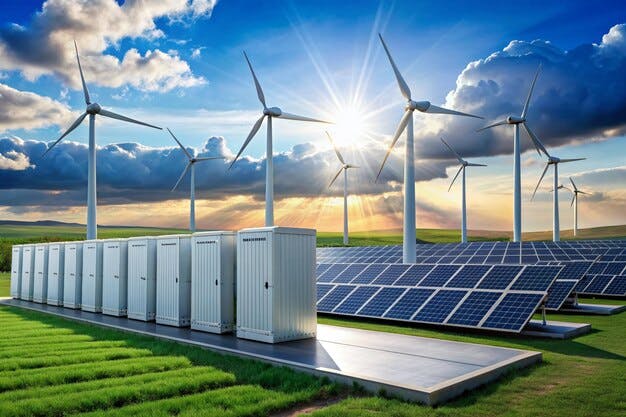
On Monday (Feb. 23), the Solar Energy Industries Association took a broader look at the rise of energy storage for 2025 and the coming year, reporting on total battery storage capacity not just new capacity. According to SEIA, “In 2025, battery energy stationary storage (BESS) installations surpassed 57 GWh/28 GW, a y-o-y increase of 29% (GWh). The utility-scale market underpinned growth with just under 50 GWh/16GW installed, with California, Texas and Arizona accounting for 74% of installed capacity.”
The SEIA report noted that the “behind-the-meter (BTM) market saw its share of demand remain consistent with 2024 at 13% of the total market, representing 8 GWh/12 GW. The BTM market saw strong growth in the residential market as the 25D tax credit came to an end.”
For 2026, SEIA foresees the storage market “set to increase to 70 GWh/35 GW in2026, with the utility-scale market accounting for 62.4 GWh/20.2GW and BTM markets accounting for 7.3 GWh/14.8 GW. This represents an estimated $25.2B in capital investment.
“By 2030, the market is set to exceed annual installations of 110 GWh/47 GW. By 2030 cumulative installed utility-scale BESS is set to reach just under 500 GWh.”
Noting the state of energy politics in Washington, SEIA commented in a news release accompanying its study, “Two-thirds of all utility scale energy storage capacity installed in 2025 was built in states won by President Donald Trump, including 9 of the top 15 states for new installations. Texas is set to overtake California in 2026 as the largest energy storage market in the country.”
Darren Van’t Hof, SEIA interim president and CEO, said, “This record-breaking year for energy storage is just the beginning of its rise as a cornerstone of America’s energy future. Whether it’s paired with solar or standing on its own, energy storage lowers consumer costs, makes the grid more reliable, and keeps the power on in homes during outages. Deployment is rising fast, but without a course correction from federal actions targeting the industry, Americans will face higher electricity prices and a less resilient energy system.”
In a recent article in OILPRICE.com, electric utility experts Leonard Hyman and William Tilles observe that the rise of renewables and storage is rendering the long-honored concept of baseload power anachronistic. “This will mark the end of new fossil-fired, base-load power plant construction,” they write, “because the economics simply won’t justify them. That’s what both the French and Chinese government power modelers are telling us. The formerly base load units are now needed more intermittently and maybe in winter due to displacement by cheaper renewables.
“Thus, at some point in the not-too-distant future, new fossil-fired base load power plant construction will essentially cease. And the legacy fossil fuel generation will have to increasingly accommodate the needs of a renewables-focused grid.”