


As India’s power demand breaks records and decarbonisation deadlines tighten, providers are offering to build, own and run energy assets for a fee. Whether that pays off depends on the fine print.
India’s grid set a record on 21 May 2026. Peak demand reached 270.8 GW, up 26 per cent in 50 days, according to the Union Ministry of Power (via Down To Earth). Installed capacity now stands at about 549 GW, with non-fossil sources at 54.18 per cent (Central Electricity Authority, June 2026) . But capacity is not the same as supply at 7 pm. The ministry has reported that coal generation reached up to 188.8 GW during non-solar peak hours, nearly 75 per cent of the power generated then (Energetica India).
For a factory manager or hotel owner, that mismatch means volatile bills, reliability worries and pressure to decarbonise, all while capital is tight. One response is to stop buying energy equipment and start buying energy outcomes. The idea is called Energy as a Service (EaaS).
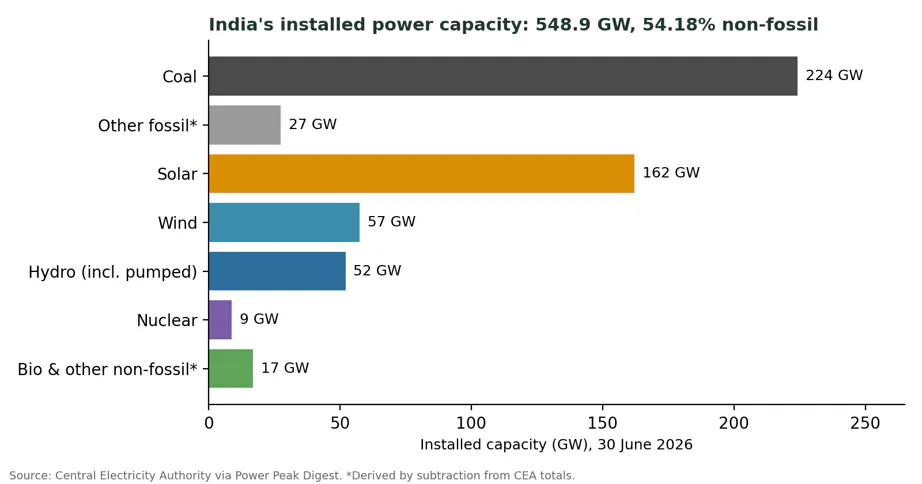
Figure 1. India’s installed capacity mix, 30 June 2026 (CEA data via Power Peak Digest) [Fact].
What EaaS is, and what it isn’t
The US Department of Energy’s Better Buildings programme describes it as a pay-for-performance, off-balance-sheet arrangement with no upfront capital expenditure. The provider pays for development, construction and maintenance, and the customer pays service charges tied to actual savings or equipment performance. The same source notes that the energy services agreement is the most common form, with others including lumens-as-a-service and subscriptions. EaaS is therefore a family of contracts, not one product.
The contrast is with the traditional route. In an energy savings performance contract (ESPC), the building owner owns the installed equipment, often financed through a loan or capital lease that shows up on its balance sheet (Facilities Dive). Under EaaS, the provider buys, installs and owns it. In effect, the customer swaps capital expenditure (CAPEX) for operating expenditure (OPEX).
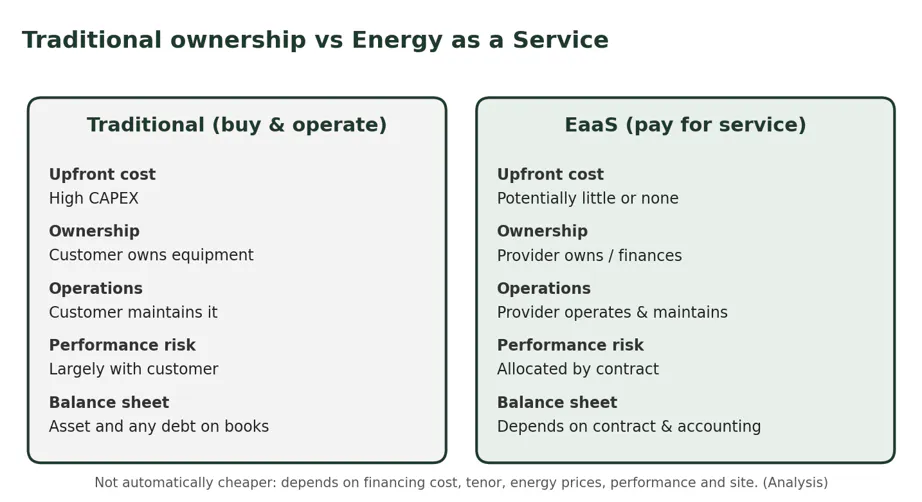
Figure 2. Traditional ownership versus EaaS: a simplified comparison [Analysis].
How the model works
A typical chain runs like this:
1. A customer signs a long-term agreement, often 10 to 25 years.
2. The provider raises finance, usually a mix of its own equity, debt and sometimes tax-driven investors.
3. The provider installs the technology and operates and maintains it.
4. Software monitors and optimises performance.
5. The customer pays per unit of energy, per tonne of cooling or per agreed outcome.
Who owns, finances, operates and bears risk is written into the contract. The US residential solar firm Sunrun, for example, says in its SEC filing that it monitors, maintains and insures systems during a typical 20- or 25-year term, and finances its upfront costs through tax equity, non-recourse debt and project equity.
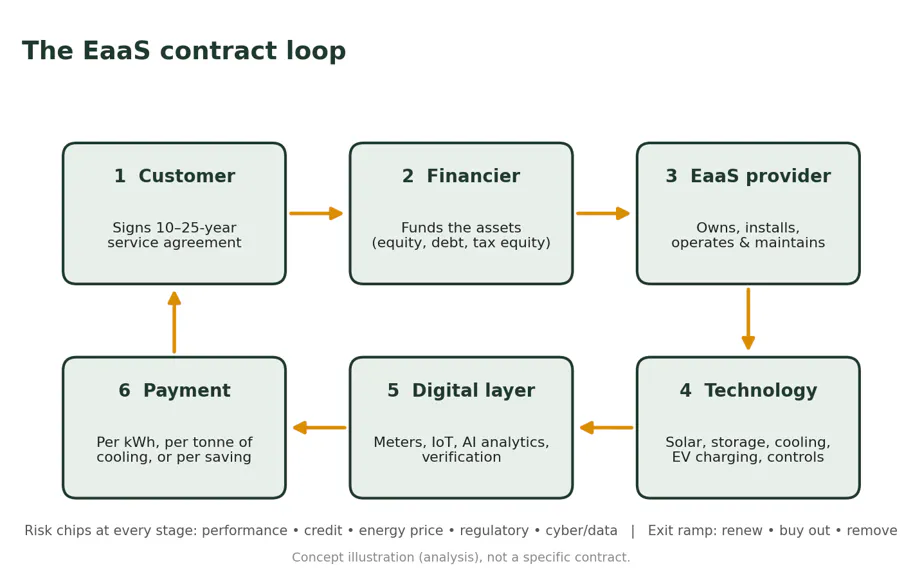
Figure 3. The EaaS contract loop: concept illustration .
The technology stack
EaaS is less about one technology than about combining several: rooftop or off-site solar, batteries, efficient cooling and motors, smart meters, IoT sensors and analytics. India’s own platforms show the pattern. Tata Power’s EnerUni, built with TCS, covers supply, demand, generation, trading and analytics, using IoT data and AI/ML.
Regulators are starting to write these tools into rules. Rajasthan’s final demand-flexibility regulations expand demand-side programmes to include EV charging, battery storage, Cooling-as-a-Service and building management systems (Saur Energy) [Fact].
Why now
The International Energy Agency (IEA) expects global electricity demand to grow 3.6 per cent a year from 2026 to 2030, about 50 per cent faster than the previous decade. For India, it projects 6.4 per cent annual growth, and says air conditioning will account for over 20 per cent of India’s demand growth to 2030. Add electrification, EVs and net-zero pledges, and many companies want reliable, cleaner power without tying up capital.
Market-size forecasts vary widely, which is a reason for caution. Grand View Research puts the global market at $81.3 billion in 2025, rising to $222.7 billion by 2033. Mordor Intelligence starts higher, at $107.59 billion in 2025, reaching $203.74 billion by 2031 .
India’s opening
Several policy threads converge on commercial and industrial (C&I) buyers.
• Captive power. The Ministry of Power’s Electricity (Amendment) Rules, 2026 substituted Rule 3, treating a corporate group as a single captive user and counting electricity consumed through storage systems as captive consumption.
• Open access costs are moving. A consultancy analysis (Reclimatize) says the phase-out of the inter-state transmission waiver adds roughly Rs 0.40–0.50 per kWh to landed costs for new inter-state projects.
• Carbon compliance. Under the Carbon Credit Trading Scheme, about 490 entities across seven energy-intensive sectors now have compliance obligations (ICAP).
• Storage. Government support includes viability gap funding of Rs 91 billion for 43.2 GWh of battery storage (IEEFA). The Central Electricity Authority estimates India will need 236.2 GWh of battery capacity by 2031-32 (Energy-Storage.News).
• EV charging. Guidelines issued under PM E-DRIVE cover nearly 72,300 public charging stations (All India Radio).
• Data centres. JLL projects capacity tripling from 1.6 GW in mid-2026 to 6 GW by 2029. Wood Mackenzie’s figure is 12 GW by 2030, with reliable, cost-competitive power now the defining constraint.
Plausible early users include manufacturers, malls, hotels, hospitals, warehouses, campuses, industrial parks and charging networks. Anywhere with steady cooling or process loads and creditworthy tenants is a candidate.
The financial case, without the hype
EaaS offers lower upfront spending, provider-run maintenance and contractual risk transfer. It is not automatically cheaper. The economics depend on the provider’s cost of capital, the contract tenor, energy price trajectories, actual performance and site conditions.
Accounting is a common selling point but not a guarantee. Advocates say EaaS leaves owners with no added asset or liability (Facilities Dive), but lease-accounting rules have pulled several formerly off-balance-sheet structures onto financial statements (ACEEE), so treatment turns on contract wording. Customers should take advice on their own reporting standards.
Three cases
1. EESL, Visakhapatnam, India (efficiency ESCO, a close relative of EaaS). The state-owned Energy Efficiency Services Limited financed a street-lighting overhaul. The Greater Visakhapatnam Municipal Corporation repays it from electricity savings over seven years. The project cost was about Rs 650 million and the annual savings are 24 GWh (World Bank). The contract bound the provider to performance: payments fall if fewer than 90 per cent of lights work. EESL used deemed savings based on a demonstration area, because weak baseline data made guaranteed savings hard to verify. The programme later scaled to about 1.32 crore LED streetlights by June 2025 (EESL). The case is older, but it is a well-documented Indian template.
2. Intellion Park, Chennai (cooling as a service). Tata Power Trading, with Keppel, will supply 12,100 tonnes of refrigeration under a 15-year contract, scheduled to go live in October 2026, with an AI-driven operations centre. The partners expect about 20 per cent lower overall energy consumption [Company; not yet operating, financial terms not disclosed in the releases reviewed]. Tata Realty’s chief executive framed it as a shift toward performance-driven, service-led models where outcomes define success.
3. Sunrun, United States (solar-as-a-service). Sunrun says most customers choose its lease or power purchase agreements over buying outright (SEC 10-Q). It is a large-scale test of the financing machinery behind service models, including its reliance on tax and other benefits.
What can go wrong
The risks are real.
• Measurement. As EESL found, disputes over baselines are common when data is thin.
• Lock-in. Multi-year contracts need clear terms on uptime, service response, penalties and exit, plus who owns the data and controls dispatch (a vendor-published guide flags this).
• Provider strength. The IEA notes an ESCO assumes both technical and customer credit risk, and needs borrowing capacity.
• Price and policy shifts. The IEA’s mid-year update notes a Middle East crisis temporarily raising generation costs. Open-access charges are time-sensitive and vary by state.
• Underpricing. IEEFA reports lenders are concerned about underbidding as battery prices fall sharply in auctions.
• Cyber and data. Connected meters and controls create exposure. Rajasthan’s rules add provisions on consumer protection and data privacy.
• Comparability. With no standard template, comparing bids is hard.
Who carries the risk?
Party
Risks typically borne
Customer
Long-term commitment, counterparty exposure, data control, exit costs
Provider
Asset performance, O&M, savings shortfalls, customer credit
Technology supplier
Warranties, degradation, product defects
Financier
Cash-flow and credit risk over the tenor
Utility
Revenue effects of self-supply, grid integration
Regulator / government
Rule stability, consumer protection
Policy: who does what
• Ministries: the Ministry of Power sets rules such as the 2026 captive amendments, and oversees the carbon scheme (with the Bureau of Energy Efficiency as administrator). The Ministry of Environment notifies emission targets, and Heavy Industries runs PM E-DRIVE.
• Regulators: state commissions such as Rajasthan’s set open-access charges and demand-flexibility rules.
• Utilities (DISCOMs): they carry demand-flexibility obligations, 0.25 per cent of peak load in FY27, rising to 2 per cent by FY30, in Rajasthan.
• Private players: providers, financiers and technology firms.
Smart-meter coverage remains partial: about 6 crore installed against 20.33 crore sanctioned, roughly 29.5 per cent, as of 4 August 2026. That limits real-time data for verification.
Where it could go
The logical endpoint is buying an integrated outcome such as “24x7 cooled, powered, charged campus at X” rather than panels, chillers and chargers separately. The pieces are solar, storage, EV charging, smart buildings, AI optimisation and demand response, sold as one service.
The bottom line
EaaS matters because it moves risk and capital rather than merely equipment. Whether it scales in India will depend on standardised contracts, credible measurement and verification, provider balance sheets, stable open-access and storage rules, and enough metering data to prove results. Where those conditions hold, the model has room to grow. Where they don’t, it is a long contract with an uncertain payoff.
Five key takeaways
1. EaaS shifts CAPEX to OPEX and moves ownership and performance risk to a provider, through a contract.
2. It is a family of models (ESAs, PPAs, subscriptions, cooling-as-a-service), not one product.
3. India’s peak demand, carbon compliance, storage support and captive-power rules are opening the door for C&I buyers.
4. Savings are not guaranteed. Financing costs, tenor, prices and measurement decide the outcome.
5. Scaling depends on standard contracts, credible verification, provider credit strength and stable regulation.
Sources / References
IEA, Electricity 2026 (demand)
• https://www.iea.org/reports/electricity-2026/demand
IEA, Electricity 2026 (executive summary)
• https://www.iea.org/reports/electricity-2026/executive-summary
IEA, Mid-Year Update 2026
• https://www.iea.org/reports/electricity-mid-year-update-2026/executive-summary
IEA, ESCO contracts
• https://www.iea.org/reports/energy-service-companies-escos-2/esco-contracts
Down To Earth, IEA Electricity 2026 summary
Down To Earth, India peak demand
Energetica India, peak demand (Parliament reply)
• https://energetica-india.net/news/indias-peak-power-demand-climbs-12-percent-in-april-june-2026
Power Peak Digest, CEA capacity June 2026
• https://powerpeakdigest.com/india-installed-power-capacity-548858mw-cea/
Electricity (Amendment) Rules 2026 analysis
Reclimatize, open access / ISTS waiver
• https://reclimatize.in/green-open-access-rules-industrial-route/
SurgePV, open access
• https://www.surgepv.com/solar-compliance/india/guides/open-access
ICAP, CCTS compliance obligations
ICAP, CCTS regulations
• https://icapcarbonaction.com/en/news/india-adopts-regulations-planned-compliance-carbon-market
IEEFA, India battery storage
• https://ieefa.org/resources/indias-battery-storage-boom-getting-execution-right
Energy-Storage.News, VGF domestic content / CEA estimate
All India Radio, PM E-DRIVE guidelines
Saur Energy, Rajasthan DF/DSM rules
RDSS smart meters (Kimbal)
• https://kimbal.io/blog/rdss-scheme-state-wise-update/
JLL, India data centres
• https://www.jll.com/en-in/insights/market-dynamics/india-data-centers
Indian Infrastructure (Wood Mackenzie)
Grand View Research
• https://www.grandviewresearch.com/industry-analysis/energy-as-a-service-market
Mordor Intelligence
• https://www.mordorintelligence.com/industry-reports/energy-as-a-service-market
DOE Better Buildings, EaaS
• https://betterbuildingssolutioncenter.energy.gov/financing-navigator/option/efficiency-a-service
Facilities Dive, EaaS vs ESPC
ACEEE, energy service agreements
• https://www.aceee.org/blog/2019/02/energy-service-agreements-potential
Ameresco / Microgrid Knowledge
• https://www.ameresco.com/microgrid-knowledge-transfer-the-risk-with-energy-as-a-service/
EticaAG (vendor guide)
• https://eticaag.com/energy-as-a-service-explained/
World Bank, EESL Vizag
World Bank Open Knowledge, EESL Vizag
• https://openknowledge.worldbank.org/bitstreams/0c1248c6-b614-5efa-ad48-78f427f6dcf5/download
EESL, Street Lighting National Programme
• https://eeslindia.org/en/ourslnp/
Tata Power press release, Intellion Park
Scanx, Intellion Park comments
Tata Power EnerUni
• https://www.tatapower.com/eneruni
Sunrun Form 10-Q (SEC)
• https://www.sec.gov/Archives/edgar/data/0001469367/000162828026053366/run-20260630.htm
Norton Rose Fulbright on IEA Electricity 2026
Sourcing notes
• An IMARC “India EaaS market” figure of USD 3.1 million was excluded because the release is internally inconsistent.
• The smart-meter figure comes from a secondary site relaying ministry data. Check it against the official dashboard before publication.
• Vendor and law-firm sources are marked as such. Expert quote slots remain placeholders pending verified, permissioned quotes.