North America’s electric vehicle market ended 2025 on a rough stretch of gravel road, but the long-term EV outlook remains upbeat.
Some of that road’s electrification challenges were detailed in Cox Automotive’s 2026 forecast.
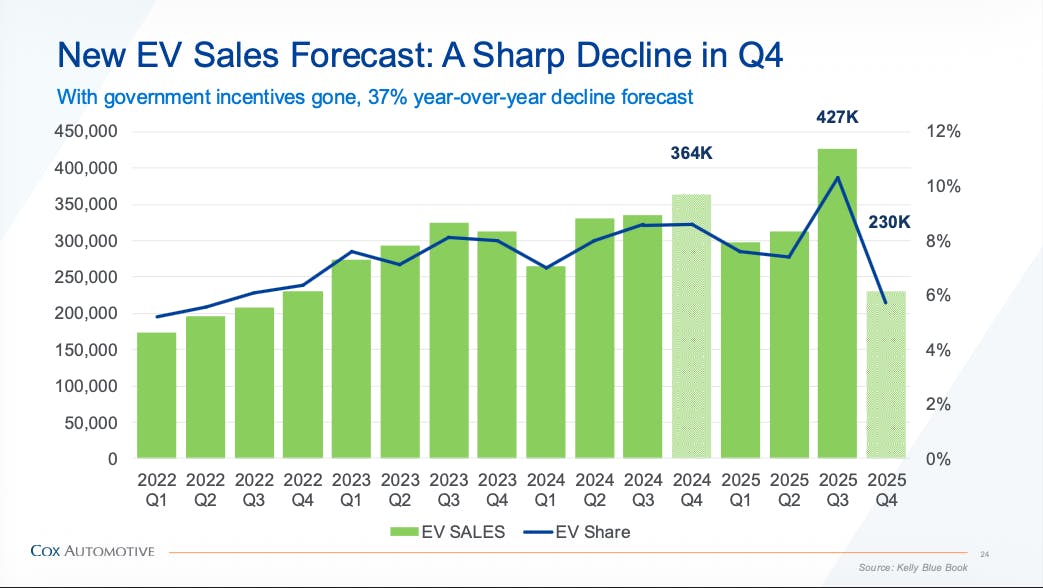
Stephanie Valdez Streaty, the director of industry insights for the U.S.-based automotive technology company, noted that before EV sales stalled in Q4, a record 426,892 units were sold in Q3, which increased the sector’s overall U.S. auto market share to 10.3%.
However, much of Q3’s sales momentum was driven by consumers scrambling to buy before America’s US$7,500 Inflation Reduction Act clean energy tax credits expired in September.
Q4’s backroad detour was therefore predictable but a rough ride, nonetheless.
How rough?
According to Valdez Streaty, sales fell 46% compared with Q3 and 37% year over year. That left EVs with a 5.7% Q4 market share.
All told, a painful downhill sales slide by any measure.
Valdez Streaty said Cox projects overall 2025 EV sales in the U.S. to be 2.1% lower compared with 2024. That would reduce EVs’ market share to 7.8% and sideline the sector’s ambitions of exceeding a 10% U.S. vehicle market share.
Still, there are positive signs for transportation electrification in the consumer market – especially in non-North American regions.
As the Substack Shipping News has previously reported, China is leading the way in EV sales, manufacturing and technology.
Electric vehicles account for 50% of the country’s domestic car sales, and sub-luxury models offered by BYD (SHE:002594) and other Chinese automakers dominate the market.
According to the International Energy Agency’s Global EV Outlook 2025, BYD’s small electric Seagull is one of the best-selling models across all segments.
Nearly 60% of car models for sale in China are EVs. That, according to the IEA, is five times the number available in the United States.
However, North America’s limited range of EV options, especially in the vital sub-US$40,000 price range, is forecast to be expanded starting in 2026.
Valdez Streaty noted that vehicles under US$40,000 represent close to 40% of U.S. auto industry sales, but only 3.7% of EV sales are in that price range.
Main reason: 60% of EV models available in North America are priced above US$65,000 compared with only 33% available in the price range where mainstream vehicle consumers shop.
Valdez Streaty said there are only nine sub-US$40,000 EV models available in North America compared with 56 gas and hybrid counterparts.
But she added that “multiple automakers have announced more [launches of] affordable [battery electric] models targeting this price range for 2026-27 as battery cost continues to decline, and manufacturing efficiency improves. Closing this affordability gap will be essential for mass market [battery electric] growth.”
With 17 million EVs sold worldwide in 2024, an estimated 50 million on the road today, and a projected 200 million by 2030, competition to extend battery range, expand recharging infrastructure, and accelerate overall transportation electrification is inevitable.
China’s strategy of leapfrogging the West in the transportation electrification race has it dominating EV sales in Southeast Asia, Europe and Latin America. It is now on track to be the world’s largest exporter of automobiles for the third year in a row.
Leaving aside the internal combustion engine (ICE) versus EV environmental debate, the upsides of electrified vehicles in urban car fleets continue to multiply.
As Automotive Fleet magazine’s Guide to Fleet Electrification notes, “There are only three types of fluids needed to run EVs: coolant, windshield washer and brake fluid. EVs do not need oil changes, transmission flushes, or other engine fluid replacements.”
The drivetrain moving parts reduction competition is also no contest: EVs (around 20), ICEs (more than 2,000).
Urban freight fleets like those numbers.
As Ishas Jolly, principal of van sales engineering for Mercedes-Benz (ETR:MBG), pointed out in Automotive Fleet’s electric van transition report, lower operating costs make a compelling business case for electric vans.
“That is predominantly because you have longer service intervals and fewer mechanical components that can fail.”
Patrick Wuertz, the company’s manager of strategic fleet sales, added that even small per-van savings multiply quickly in corporate fleets.
“When you’re refreshing a fleet of hundreds of vehicles, those numbers become very real, very fast.”
But in the end, the market will decide whether refuelling your vehicle by plugging it into a home charger is more appealing than waiting in line to pump fuel at a gas station, and whether the EV energy efficiency, digital technology and driving experience advantages are more attractive than what ICE has provided for the past 100 years.
Transportation remains far behind other mass-market consumer products in electrification adoption, but signs of a tipping point are visible on the road ahead.
www.linkedin.com/in/timothyrenshaw
@timothyrenshaw