


(Thursday 26, March 26, IDTechEx, Cambridge, UK)- Turquoise hydrogen is not the same as blue or green hydrogen, which are often discussed in low-carbon hydrogen conversations. IDTechEx’s report, “Blue Hydrogen Production and Markets 2026-2036: Technologies, Forecasts, Players”, provides an analysis of recent technological developments, the landscape of key players, market trends, and ongoing projects in turquoise hydrogen.
Near-zero emission turquoise hydrogen production
Turquoise hydrogen is produced through methane pyrolysis, a process that decomposes methane into two products: hydrogen and solid carbon, typically sourced from natural gas. Instead of reforming methane and capturing CO2, methane pyrolysis produces hydrogen without emitting gaseous CO2. The solid carbon is stored or sold for commercial use. If powered by renewable electricity, the hydrogen achieves near-zero carbon intensity. Using low-carbon feedstocks (such as renewable natural gas (RNG) or biogas) makes the process carbon-negative. Positioned between blue and green hydrogen, turquoise hydrogen is often described as a bridge solution as the energy system scales up renewable energy and electrolyzer capacity.
Methane pyrolysis technologies
Methane pyrolysis is not a single technology. IDTechEx categorizes four approaches, each with different operating principles:
Thermal pyrolysis: Methane decomposes at very high temperatures (typically 1,000-1,400 °C) without oxygen or catalysts. Thermal pyrolysis achieving consistent product selectivity, especially for high-value carbon, remains a key challenge.
Catalytic pyrolysis: By introducing catalysts such as nickel or cobalt, methane is decomposed at lower temperatures (around 600-900 °C). This reduces energy requirements but introduces catalyst deactivation and carbon fouling.
Plasma pyrolysis: Plasma (an ionized gas containing highly energized particles) enables methane decomposition at extremely high temperatures (up to ~2,000 °C). Plasma systems are highly flexible, energy-intensive, and capable of producing advanced carbon materials.
Molten-media pyrolysis: Sitting between thermal and catalytic approaches, molten-media pyrolysis bubbles methane through a molten metal or molten salt bath. The molten medium efficiently transfers heat, acting as a liquid-phase catalyst, offering reactor stability and carbon separation.
Plasma pyrolysis is the most commercially advanced methane pyrolysis technology, followed by catalytic, thermal, and molten-media approaches.
Big players enter the game
Methane pyrolysis has been dominated by startups and small and medium-sized enterprises (SMEs). Monolith is the most commercially advanced company, while other notable players, such as Hazer Group, Modern Hydrogen, and Graphitic Energy, are emerging. Major industrial players are seeing turquoise hydrogen as strategically relevant. One notable example is Hazer Group, a university spin-off focused on catalytic pyrolysis. In May 2025, the company formed a strategic alliance with engineering giant KBR to scale up its HAZER Process for commercial deployment.
In November 2025, ExxonMobil and German chemical producer BASF announced plans to co-develop thermal methane pyrolysis, including the construction of a demonstration plant in Baytown, Texas, to validate on a commercial scale. This signals growing confidence in turquoise hydrogen.
The turquoise hydrogen carbon by-product
For every 1 kg of hydrogen produced, methane pyrolysis generates roughly 3 kg of solid carbon. This offers the potential for two revenue streams from a single process. In practice, when produced at a commercial scale, the volumes of carbon by-product are substantial. This makes carbon sales a necessity to ensure economic viability. Large, established producers dominate the global carbon black market. Overall demand is not sufficient to absorb the carbon byproduct generated by scaled-up turquoise hydrogen production. Identifying suitable markets for the carbon by-product remains a key challenge for methane pyrolysis.
Turquoise hydrogen evolutions
Turquoise hydrogen’s strength lies in specific conditions coming together: access to renewable electricity, availability of methane, particularly RNG or biogas to achieve carbon-negative production, and reliable markets for solid carbon by-product. The outlook for turquoise hydrogen is promising due to a shift in industry participation. A sector once dominated by SMEs has drawn the attention of major industrial and energy companies. This indicates a transition toward larger-scale commercialization rather than small pilot projects, while turquoise hydrogen may continue to hold a smaller market share than blue or green hydrogen.
For information on this report, including downloadable sample pages, visit www.IDTechEx.com/BlueHydrogen, or see www.IDTechEx.com/Research/Energy.
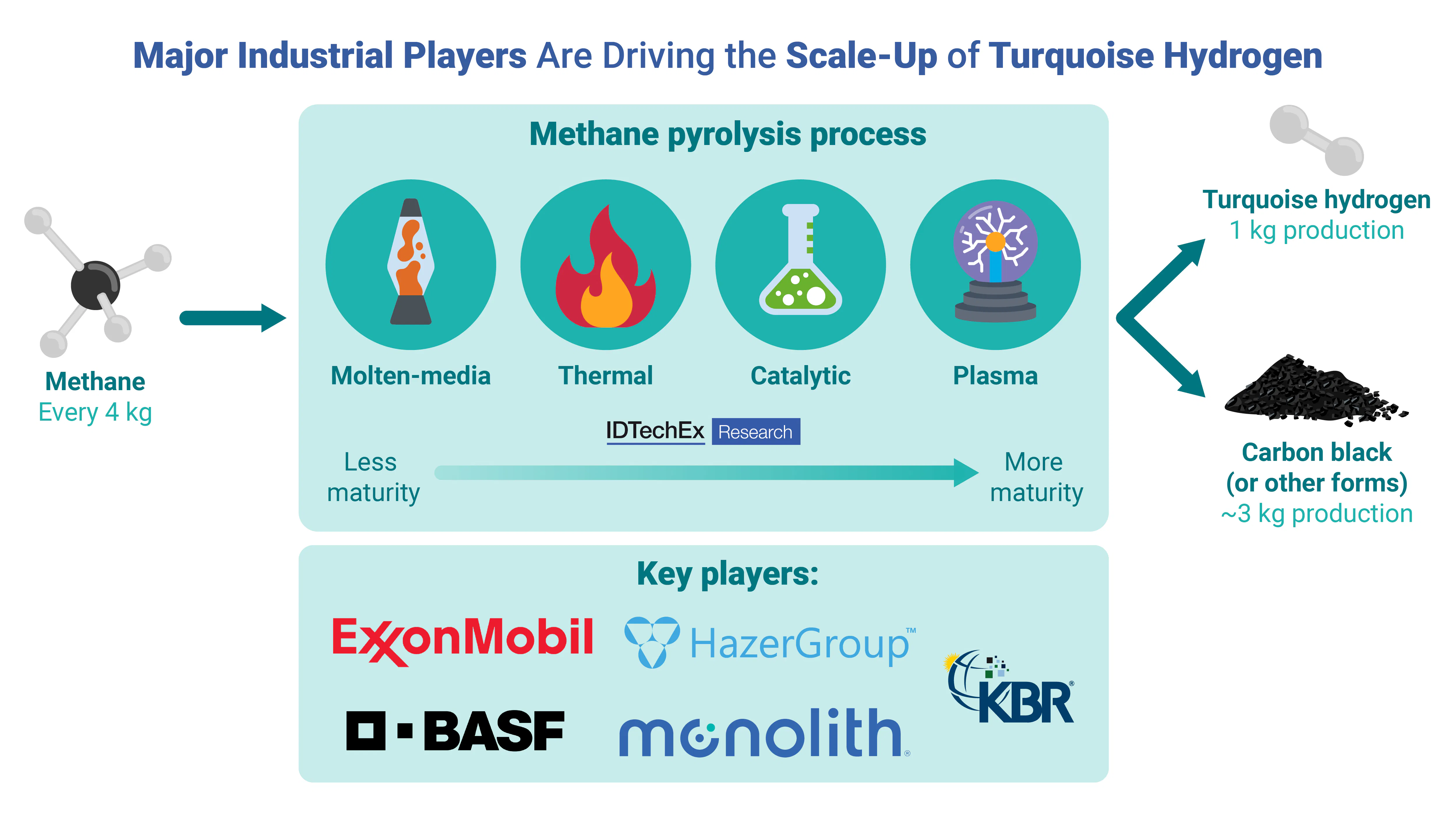
Image from IDTechEx