


By Kennedy Maize
When it comes to the levelized cost of energy (LCOE), “Unsubsidized renewable energy remains the most cost competitive form of new-build generation…. Wind, solar and storage are expected to continue to account for the majority of near-term U.S. capacity additions given their relatively short deployment timeline,” according to a new report from the financial advisory and asset management firm Lazard.
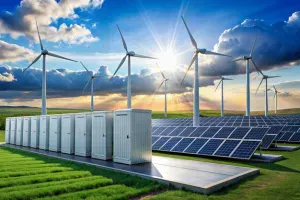
That conclusion squares with recent projections from the Wall Street analysis firm Seeking Alpha, which predicts that the U.S. will “add over 90 GW of new capacity in 2026, including approximately 51.2 GW of solar, 25.7 GW of energy storage, and 13.1 GW of wind.” The analysis says “4 GW of coal capacity is scheduled for retirement, natural gas will see a modest net addition of 1.7 GW, reflecting its ongoing role in the generation mix.”
Lazard notes that “wind and solar LCOEs have continued to rise—reflecting higher capital costs, sustained interest rates, tariff pass-through and supply chain repricing—though they remain below conventional new-build alternatives. Renewables therefore maintain their relative cost advantage despite facing the same cost pressures affecting the rest of the generation stack.”
Wind and solar have seen a dramatic decrease in costs over the past decade and a half, according to the Lazard analysis. In 2009, the LCOE for utility-scale solar was $359/MWh, compared to $285 for gas peaking capacity, $135 for wind, and $83 for gas combined-cycle. In 2021, utility solar was $36, gas peaking was $173, gas combined cycle was $60, and wind was $38.
Since then, Lazard acknowledges that “wind and solar LCOEs have risen from their 2021 lows but remain well below historical peaks and below conventional new-build alternatives.”
“Levelized cost of energy” has become a fairly standard metric for comparing technologies. The Department of Energy’s Energy Information Administration defines LCOE as “the estimate of the revenue required to build and operate a generator over a specified cost recovery period” and adds that it is not the only metric that is useful. EIA notes that another measure, the “levelized avoided cost of electricity (LACE) is the revenue available to that generator during the same period.”
There have been critics of the LCOE metric. In the January 2025 issue of the Energy Research and Social Science journal, Jan Emblemsvåg of the Norwegian University of Science and Technology wrote that “the introduction of variable renewable energy sources into the grid has made the LCOE questionable towards it initial purpose of providing a sound basis for comparison, and most reputed organizations fail to address the issues both computationally and in their communication.”
Lazard took that criticism into account in its use of LCOE, which it dubs “LCOE+” and uses throughout the current analysis, noting that “Lazard’s 2026 LCOE+ Report includes Version 19.0 of the Levelized Cost of Energy, including the Cost of Firming Intermittency analysis, and Version 11.0 of the Levelized Cost of Storage.”
The Lazard analysis also looks at the levelized cost of storage (LCOS), as that resource has been an increasing component of renewable technologies. The analysis looks at the costs of storage on a standalone basis, finding “an increase in costs for utility-scale standalone storage configurations, reversing last year’s declines. While the midpoint remains within the ranges observed since 2020, it has moved toward the higher end of such ranges.
Like the LCOE, the LCOS is a snapshot of projects being built today and therefore captures real-time market dislocations—this year, the materialization of tariffs on lithium-ion battery imports has curtailed access to the low-cost Chinese cell supply that previously helped drive costs lower.”
EIA’s Annual Energy Outlook 2026 examines a longer timeframe than the Lazard report, looking out to 2050. According to EIA, “Although LCOE, LCOS, and LACE do not fully capture all factors contributing to the capacity expansion decisions as modeled, when used together as a value-cost ratio (the ratio of LACE-to-LCOE or LACE-to-LCOS), they provide a reasonable comparison of first-order economic competitiveness among a wider variety of technologies than is possible using LCOE, LCOS, or LACE individually.”
EIA projects that “gas, solar, and wind generation increasingly meet U.S. power demand across all cases examined here. The combined generation share of these technologies rises from about 60% in 2025 to around 80% in most cases by 2050…Although the absolute amount of natural gas generation increases, its share of electricity generation generally stays flat in most cases. This is in contrast to coal; in 2025, coal’s share is 16% but it declines by 2050 in all cases.”
In the meantime, the Trump administration and its Department of Energy pursues a “back to the future” energy strategy built around coal and nuclear generation and the unfettered spread of energy gobbling data centers. Trump dismisses objections to his policies supporting the most expensive ways to make electricity, driving up home electric prices. Concerns about affordability, he asserts, are a “hoax.”
The Quad Report, covering energy policy and politics