


By Kennedy Maize
Donald Trump’s March 21 midnight threat to Iran to “hit and obliterate their various POWER PLANTS, STARTING WITH THE BIGGEST ONE FIRST!” If they don’t bend the knee, is — as are many Trump threats and outbursts — likely empty. An attempt to carry it out would be far more difficult, lengthy, and costly than Trump imagines, probably doomed to failure.
It’s doubtful that Trump sought information from his Central Intelligence Agency, National Security Agency, or Pentagon before popping off about bombing Iran’s power system. If he had, he might have learned some troubling facts, none of which are secret, about Iran’s electric infrastructure.
Here’s the open source take on Iran’s electric grid. From bneIntellinews, “Unlike many countries that rely on a handful of large generating hubs, Iran’s grid is unusually dispersed making it very difficult to attack. There are no significant targets to destroy. Instead a network of small interlinked power stations is much more suited to absorbing strikes and still able to provide electricity to the whole country.”
IranInsights, a UK-based, Saudi-owned publication with ties to the family of Mohammad Reza Pahlavi (1941-1980), deposed in in 1979, commented on the Trump outburst, “Iran’s power system is large, heavily dependent on thermal generation, and widely dispersed – making it difficult to disable through limited military strikes.”
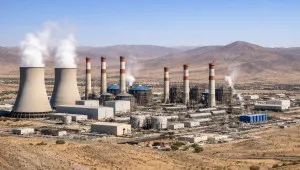
The country’s largest power plant — Trump’s first target? Probably the 2,900-MW Damavand power plant, colloquially known as “Pakdash,” is a gas-fired, combined-cycle (gas burned in a gas turbine, with the heat captured and used in a steam turbine) plant about 50 km southeast of Tehran.
IranInsights notes, “A facility like Damavand, with multiple cooling towers and units spread across 200 hectares – roughly 30 times the size of Tehran’s Azadi Square – would require a wide-scale attack to fully disable.”
Patricia Marins, military analyst for bneIntellinews, notes “the 5-10 largest plants account for only a modest share, probably less than 15–20% of the total. The rest of the capacity is spread across dozens of smaller and medium-sized facilities.”
The openframe ap lists “all 477 power plants in Iran”, starting with Damavand. There are 34 with a capacity of at least 1,000-MW (although several hydro plants are not producing that much power now as the country faces prolonged drought).
Then there is the Iranian electrical transmission and distribution grid, which an effective attempt to black out the country would have to largely destroy.
According to IranInsights, the power grid is also largely dispersed and difficult to attack: “Its transmission and sub-transmission network extends about 133,000 kilometers, and when urban and rural lines are included, the total exceeds 1.3 million kilometers.
“The system is supported by 857,000 transformers and an estimated 2,000 to 5,000 large and medium substations across the country.”
That means that “strikes on substations could cause temporary, localized outages, but they can be replaced relatively quickly.”

Iran’s only nuclear power plant, the 1,000-MW Bushehr plant, some 1,200 km south of Tehran on the Persian Gulf, imposes additional problems, legal and physical, if the U.S. were to attack it.
There have been multiple reports of Bushehr being “hit by projectiles,” but without damage, the most recent on Saturday (Mar. 28). So far, these seem to have been collateral from nearby attacks by the U.S. and Israel. The International Atomic Energy Agency last week, after a second report of the plant being hit, posted a plea on Twitter calling for “maximum restraint to avoid nuclear safety risks during conflict.”
A U.S. attack on Bushehr would be an overt violation of international law. A multitude of treaties, protocols, and provisions going back to Article 56 of the 1949 Geneva Conventions protect civilian nuclear power from hostile attacks. There is a years-long legal dispute over Russia’s takeover of Ukraine’s Zaporizhzhia nuclear plant, the largest in Europe. The Soviet Union originally built the six-unit plant from 1980 to 1995. When the USSR collapsed, Ukraine took over the plant. Russia retook the plant in 2022.
Bushehr is a Soviet-designed pressurized-water reactor, as are the Zaporizhzhia units, VVER-1000s, a design the Russians stole from Westinghouse Electric in the 1970s. Western wags have long referred to them as “Eastinghouse reactors.” The former Shah originally promoted the plant. He wanted to shift the country’s entire electric system to nuclear.
Construction began in 1975 and then moved forward in fits and starts, first under a German contractor, then stalled completely in 1979 with the fall of the Shah. Iran in 1990 signed a deal with Russia to complete the job. In 1991, the Soviet Union collapsed. Bushehr was again in limbo.
Work began again in earnest in 1995 under the Russians, but fitfully, including a new construction contract in 2006. The plant went into service in 2011.
A direct attack on the plant would be difficult, as it is protected by a large, robust concrete and steel containment structure housing all the main components of the reactor.
A strike on the spent fuel pool, which is outside the containment and holds worn out but thermally and radioactively hot fuel rods for up to several years, could produce a catastrophic release of radioactive material that would likely become airborne and spread widely, much as happened after the Chernobyl explosion in 1984.
That would be on Donald Trump.