



SPONSORED CONTENT
For more than a decade, 4G LTE has been the backbone of wireless connectivity across energy infrastructure. Utilities and energy operators rely on it to connect field devices, monitor assets and support operational visibility across wide geographic areas. But as mobile networks evolve, many organizations are asking a difficult but unavoidable question: Is continuing to deploy new infrastructure on LTE a sound long-term strategy?
Energy infrastructure is built to last—often 10, 15 or even 20 years. Connectivity decisions made today must remain viable over that same horizon, even as cellular standards, carrier roadmaps and spectrum priorities change underneath them.
The industrial IoT connectivity dilemma
LTE remains widely available and will continue to operate for years but, the trajectory is clear: mobile operators are increasingly refarming spectrum from 4G to 5G bands, shifting and prioritizing resources and investment toward 5G Standalone (SA) networks.
For utilities, the risk lies in lifecycle mismatch. Field assets are built to be deployed for decades, but LTE networks will eventually sunset on a much shorter timeline. When those timelines collide, this can force unplanned device replacement, unscheduled site visits, and budget disruption—all of which drive up total cost of ownership (TCO).
At the same time, moving directly to full 5G broadband isn’t a realistic answer for many energy use cases.
The 5G eMBB challenge: performance beyond grid requirements
5G Enhanced Mobile Broadband (eMBB) was designed for consumer and enterprise applications that demand high throughput—video streaming, immersive media and dense urban connectivity. Most grid-connected devices operate under an entirely different set of constraints, typically prioritizing:
Low-to-moderate, predictable data rates
Low power consumption
Long operational lifespans
High reliability in remote or harsh environments
Full 5G broadband often brings complexity, higher power draw and added costs that these applications simply don’t require. For many utilities, 5G eMBB solves problems they don’t have—while introducing new ones they don’t want.
That gap between aging LTE and full-scale 5G has left energy operators searching for a more practical path forward.
A middle ground: 5G RedCap
5G Reduced Capability (RedCap) was developed specifically to address this gap. Standardized in 3rd Generation Partnership Project (3GPP) Release 17 and built natively into 5G SA networks, 5G RedCap is designed for applications that need the longevity and futureproofing of 5G without the overhead of full broadband performance.
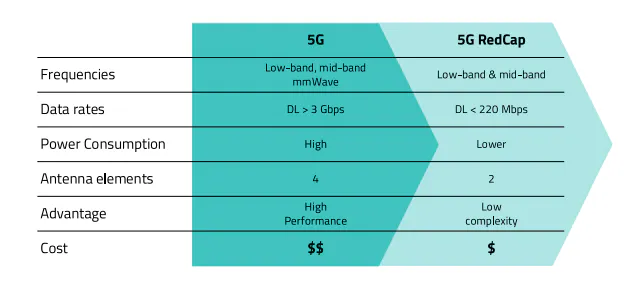
For critical infrastructure, 5G RedCap offers several advantages:
Long-term alignment with 5G roadmaps, avoiding reliance on declining LTE ecosystems
Lower power consumption and simpler hardware profiles than full 5G eMBB
Optimized performance suited to most monitoring, control and telemetry applications
Importantly, 5G RedCap is not a transitional workaround. It is a standards-based approach intended for the kind of long-lived industrial and infrastructure deployments found across the energy sector.
Critical evaluation criteria for infrastructure decisions
As interest in 5G RedCap grows, utilities should evaluate 5G RedCap solutions with the same rigor they apply to any infrastructure decision. Key questions include:
Lifecycle alignment: Will the technology be supported over the full life of the asset?
Network readiness: Is 5G RedCap supported in target regions and carrier environments? If not yet, does the solution also support LTE?
Power and environmental requirements: Does it meet operational constraints in field deployments?
Interoperability: Can it integrate with my existing legacy devices and protocols?
Forward-compatibility: Will the solution support future security and cellular standards?
Management model: Can devices be managed remotely—in cloud, on-premises or air-gapped environments as required?
Vendor stability: Is the supplier positioned to support long-term infrastructure deployments?
Implementing 5G RedCap in real-world operations
For many utility organizations, the challenge is implementing 5G RedCap in a way that fits real-world constraints. Infrastructure deployments rarely involve connectivity alone. Hardware durability, lifecycle management, regulatory requirements, and operational support all play a role.
This is where experience matters. Providers that have supported utilities through previous transitions—from 2G to 3G and from 3G to 4G LTE—bring valuable perspective to the shift toward 5G. That practical experience is often what separates a smooth transition from a costly one.
Semtech® (formerly Sierra Wireless®) has spent decades supporting critical communications across energy and industrial environments. Building on that experience, the company is introducing 5G RedCap AirLink® routers designed specifically for critical infrastructure use cases—balancing performance, power efficiency and long-term support while integrating with existing operational and management models.
Rather than treating 5G as a one-size-fits-all upgrade, this approach reflects a growing recognition within the energy sector: the next generation of connectivity must fit the realities of grid operations, not the other way around.
Planning the next phase of grid connectivity
The decision to move beyond 4G may not require urgency—but it does require foresight. As utilities plan new deployments and refresh aging infrastructure, 5G RedCap offers a practical path forward: one that aligns with 5G’s future while respecting the operational demands of energy networks.
For organizations evaluating their next connectivity strategy, or in the midst of a refresh cycle, the most important step is asking the right questions today—before long-lived assets are locked into technologies that may not age as well as the infrastructure they support.

Interested in learning more about how 5G RedCap bridge the Utility Connectivity Gap?
Download full whitepaper
______________________________
Semtech®, the Semtech logo, AirLink®, and Sierra Wireless ® are registered trademarks or service marks of Semtech Corporation or its affiliates. Other product or service names mentioned herein may be the trademarks of their respective owners.