


By Kennedy Maize
Coal was once king of the U.S. electric generating hill, despite the many problems with the dusky diamonds. Nukes surged in the ‘70s, but never caught coal. Natural gas made a move in the 1980s, the period of the short-liven “gas bubble” when federal prices controls got lifted.The bubble deflated and coal came back.
Around 2008, directional drilling and hydraulic fracking started a long-lasting boom that dethroned coal. Gas became king of the hill and remains there today.
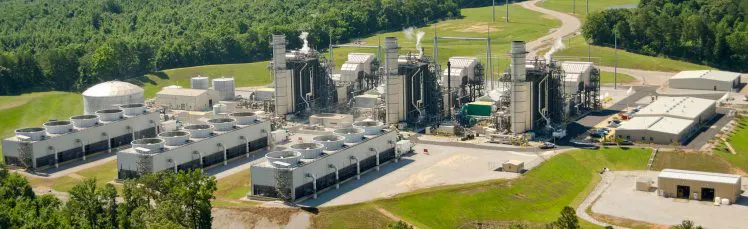
Has the time has come for the reign of methane to end? That’s the case made in a new report by the Institute for Energy Economics and Financial Analysis, “The Misguided Stampede to Build Gas Power Plants.”
IEEFA analyst Dennis Wamsted writes, “The stampede to build new gas-fired power generation is real; one recent U.S. estimate showed that 133,000 megawatts (MW) of new capacity is on the drawing board. But those planned projects overlook several major financial risks, both for utility customers and investors.”
Natural gas price volatility is too often ignored when generators are planning projects. Utilities, Wamsted notes, “generally pass fuel costs directly through to consumers, which effectively eliminates the companies’ financial risk from gas price spikes. Customers are not as lucky, as was evident clearly in 2022 when Russia’s invasion of Ukraine sent gas prices soaring, pushing electricity costs from gas-fired power plants up sharply.”
Weather can significantly impact gas prices, as the U.S. has seen in recent years, as deliverability problems and power plant freezes push up consumer prices. The result is “ significant unexpected costs being pushed onto U.S. consumers, as happened just this past winter.”
The rise of the lucrative, international market for liquefied nature gas, in which the U.S. has become a major player, can also play havoc with the cost of gas for power generation. IEEFA notes that “the growth of U.S. liquefied natural gas (LNG) exports could result in more persistent and long-term increases in gas costs, and further boost price volatility.”
Supporting that observation, the financial web site FinancialContent, Inc.,earlier this month (Apr. 1) reported that the “U.S. natural gas market has officially entered a new era of scarcity and global dominance. Following a winter defined by record-breaking export volumes and a rapid succession of new liquefaction facilities coming online, prices at the Henry Hub are tracking their strongest levels since the global energy crisis of 2022.”
IEEFA’s analysis also cites the escalating cost of gas-fired generating plants, including the long supply chain bottleneck for turbines. Writes Wamsted, “The cost for new gas-fired generation has jumped over the last couple years. The price of the newest combined-cycle plant proposals is now at least $2,500 per kilowatt (kW) installed, or $2.5 billion for a 1,000-megawatt (MW) unit. This is roughly triple the cost of projects built in the early 2020s and generally does not include financing costs for the plant or costs associated with building or expanding a gas pipeline to supply the generator.”
He adds that “the major turbine manufacturers have essentially sold out their combined-cycle capacity through 2030.”
What does it all mean for gas at the bottom line? “Consumers are clearly in the crosshairs, but there are significant risks in this gas stampede for developers, utilities, and investors as well. The sharply higher infrastructure costs for new gas capacity pose significant stranded-cost risks, particularly given the availability of cheaper, quicker-to-market renewable energy and dispatchable battery storage. In addition, the uncertainty of future demand growth makes high-cost, long-lived investments in gas capacity particularly risky.”
What to do? Turn to solar and wind, augmented by battery energy storage for new generation, suggests IEEFA: “Solar, wind, and dispatchable battery storage can be built much more quickly, at lower cost, and at a scale that matches actual demand growth rather than optimistic AI-driven projections.
Renewables and battery storage are also better for consumers, providing protection against rising, volatile fuel costs and shielding them from the high cost of new gas-fired capacity. The stampede for gas makes no sense, for consumers, investors, or utilities.”
Will IEEFA’s message resonate? DOE’s Energy Information Administration predicts solar, storage, and wind will account for 93% of generation added in 2026.
On the other hand, In a fossilized administration where anything “green” is viewed as tainted, it’s going to be difficult. A case in point: on March 31, PacifiCorp, based in Portland, Ore., unveiled its latest integrated resource plan, an update to its 2025 plan for its operations through 2031.
The company’s update includes its Rocky Mountain Power subsidiary, serving Idaho, Wyoming, and Utah. The updated plan will eschew new wind and solar going forward in those states and in California, the Associated Press noted. The utility says changes in the plan “are largely driven by the July 4, 2025, repeal of major portions of the Inflation Reduction Act (IRA). The repeal was enacted through the H.R.1 – the One Big Beautiful Bill Act (OBBBA), which, significantly, phases out or eliminates highly impactful tax benefits, primarily for renewable solar and wind generation resources.”