


By Kennedy Maize
In an eye-watering 1,600 pages, the U.S. Department of Interior has given the western state parties battling over a replacement to the 1922 Colorado River Compact’s stalled update five alternative solutions. In a draft environmental impact statement, DOI offers its choices for divvying up the flow of the crucial river when the current, 2007-vintage plan expires.
If the divided states — with the four water-collecting “upper basic states” of Colorado, Wyoming, Utah, and New Mexico at odds with the three “lower basin” consumers of Nevada, Arizona, and California — can’t agree by October, Interior threatens to impose one of the alternatives before the existing plan dies. The factions have been badly split for over a year.
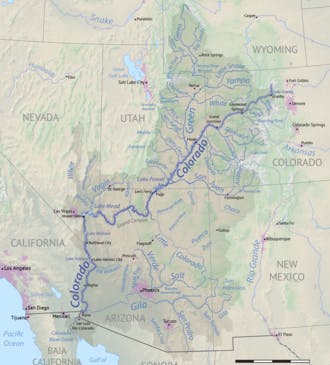
In offering its plans, DOI’s Bureau of Reclamation, which oversees the river compact, said, “Prolonged drought conditions over the past 25 years, combined with forecasts for continued dry conditions, have made development of future operating guidelines for the Colorado River particularly challenging.”
With the river and its accompanying reservoirs — Lakes Mead and Powell — running low, the stakes are running high. The giant river system spans two Mexican states, seven U.S. states, and 29 Indian tribes. The federal government owns the U.S. portion of the river system, including two large hydroelectric plants behind Glen Canyon Dam and Hoover Dam. It is an economic and personal boon for over 40 million Americans, managed through the Interior Department’s Bureau of Reclamation. The river provides drinking and irrigation water, recreation, and electricity.
DOI’s alternatives all revolve around water levels in Lake Powell, where the Glen Canyon Dam is the first impoundment on the river, driving river supply to Hoover Dam’s Lake Mead, which supplies the lower basin. DOI’s five river control alternatives include:
The standard “no action” choice required in all EIS analyses under the National Environmental Policy Act. DOI says. This would mean “a minimum release of water from Lake Powell of 8.23 maf [million acre-feet].” Under the standpat plan, “Shortages to the Lower Basin would be based on priority and reach a maximum of 600 thousand acre-feet.
Basic coordination. DOI says, “This alternative is designed to be implementable absent new agreements among Basin water users.” Lake Powell releases would be “8.23 maf, with some releases above and below 8.23 maf, and minimum releases of 7.0 maf.” That would mean that releases from Hoover Dam, the last major impoundment, determining the supply to the lower basin states, would mean that “shortages up to 1.48 maf. would be triggered based on Lake Mead elevation and distributed consistent with priority….”
Enhanced Coordination, “based on concepts from Basin Tribes, federal agencies, and other stakeholders to achieve protection of critical infrastructure while benefitting key resources (e.g., natural, hydropower and recreation) through an approach to distributing storage between Lake Powell and Lake Mead.” It would feature “shared contributions to the system, including Upper Basin conservation that would be stored in Lake Powell and Lower Basin shortages starting at 1.3 maf, approximately the average annual evaporative and system losses at and below Lake Mead, and reaching a maximum of 3.0 maf. Shortages would be triggered based on combined storage in Lake Powell and Lake Mead and distributed pro rata.”
Maximum Operational Flexibility “submitted by a consortium of conservation organizations and incorporates proactive responses, targeted reservoir management strategies, and innovative and flexible tools to address an increasingly variable set of future hydrologic conditions.” Lake Powell releases would range from 11.0 maf to 5.0 maf. If Lake Powell’s water level is at 3,510 feet or lower, releases would switch to “run-of-river,” bypassing the dams and the hydro plants.
Supply Driven, where “Lake Powell releases are determined based on a 65 percent of 3-year-average natural flow at Lees Ferry” Ariz., in the Glen Canyon National Recreation Area. According to BuRec, “This alternative would include new delivery and storage mechanisms for Lake Powell and Lake Mead. Lower Basin shortages up to 2.1 maf would be triggered based on Lake Mead elevation. This alternative analyzes two approaches to shortage distribution: state-based combined with Lower Basin-wide priority and state-based combined with Lower Basin-wide pro rata.”
Scott Cameron, BuRec acting commissioner, said, “Given the importance of a consensus-based approach to operations for the stability of the system, Reclamation has not yet identified a preferred alternative. However, Reclamation anticipates that when an agreement is reached, it will incorporate elements or variations of these five alternatives….”
Whether the new BuRec plan can bring the skirmishing parties together is unclear. Basic divisions remain. The Denver Post reported, “The proposed Upper Basin cuts outlined in the draft document drew criticism from the Colorado River District, an agency created by the Colorado legislature that’s based in Glenwood Springs and advocates for Western Slope water needs. ‘We do not see how that is a realistic alternative given the natural availability of water in the Upper Basin, especially in dry years,’ the district said in a statement.”

On the user’s side, the Metropolitan Water District of Southern California, which supplies Los Angeles, said, “None of the five alternatives analyzed by the Bureau of Reclamation are endorsed by any of the Basin States. The various alternatives highlight the significant risks we could face if we don’t reach an agreement. And implementation of any alternatives would likely lead to lengthy litigation.”
