


Industries are trying to save energy and cut pollution, so using renewable energy in their current systems is becoming more important. The era of traditional power systems, which heavily dependent on fossil fuels, is no longer.
This article covers the reasons behind this transition, explores technical integration aspects, and outlines real-world examples. It also covers reliability issues, benefits, and challenges to help energy managers and plant engineers plan their transition.
Why Industries Are Moving Toward Renewables
The industrial sector is currently shifting from traditional energy sources to renewable ones for several reasons:
· Cost Savings
Renewables are economically viable due to the falling prices of solar panels, wind turbines, and battery energy storage systems (BESS). Companies can significantly reduce operational costs by adopting proper energy optimization.
· Emission Reduction Goals (ESG)
New environmental regulations and ESG commitments have companies become eco-friendly by pushing them to reduce their carbon footprint. Companies make use of renewable resources to fulfill these sustainability targets.
Unstable Grid Supply
Infrequent power supply in various regions is causing the industrial sector to increase capacity of independent systems. During power outages, microgrids and distributed energy resources (DERs) help keep the system stable and fix voltage changes. Common renewable energy sources used include solar power, wind energy, and batteries for balancing and handling peak electricity demand.
Key Global Trends Shaping Renewable Energy Growth
Below are some of the key global trends that are shaping the ever-increasing renewable energy growth:
· Massive Investment in Wind and Solar Power
The worldwide new energy projects clearly show wind and solar power to be the major sources at present and in the coming years.
The International Energy Agency (IEA) states in its recent report that solar will be the direct cause of almost 50% electricity demand growth globally from 2021 to 2025.
Moreover, the wind sector is growing even faster, particularly the offshore wind farms in Europe, China, and the United States.
As estimated, wind and solar energy will lead 60%–80% of the electricity mix generation that is most cost-effective in 2035, and the total generation capacity will increase by about three times the 2020 level by 2035, with approximately 2 terawatts of wind and solar energy each.
· Decline of Fossil Fuels in Electricity Generation
The persistent cost-effectiveness and accessibility of renewable energy sources are the main reasons that are leading to the decline of fossil fuels dominance. Authorities are holding off on launching new coal-fired power plants to favor the environment by opting for clean power generation technologies.
Natural gas power generation used to be the next vital and progressive energy source, but now, in the context of augmented methane emissions and supply risks, it is less and less transitional.
Integration of Renewable Energy into Power Grids
One of the major global trends that are reshaping the energy industry is the adoption of renewable energy as part of traditional energy systems. Utilities are expanding the grid so that they can accept energy as it comes in because it is not always there.
Merging services with computer technologies and installing real-time storage systems and other advanced measures enhances the grid’s reliability and resilience. The supply of electricity can be more flexible due to the resilience of the grid system as well as new generation strategies.
· Energy Storage as a Catalyst for Renewable Growth
Renewable energy sources are used more widely, the same in the innovation of energy storage solutions. The widespread use of lithium-ion batteries, hydrogen storage, and other similar technologies has given the market the capability to store extra energy; it is a new opportunity for the market to store energy.
· Industrial Adoption of On-Site Renewable Solutions
Businesses are also taking part in the transition to clean energy. Manufacturing facilities, data centers, and economic zones are now implementing self-generation energy systems such as solar panels or wind turbines to reduce the utility grid's reliance and control expenses.
Load growth from cleantech manufacturing plants, which could add 11 GW of demand by 2030, is an anticipated long-term trend resulting from supply chain reshoring to meet domestic energy needs. (Deloitte)
This change of direction is helping businesses to decrease their carbon footprints, boost their operational effectiveness, and reinforce their energy reserves. The movement is most profound in the energy-intensive sectors, namely cement, steel, and chemicals industry.
· Electrification of Transportation
The switch to electric transportation is indeed expected to raise the electricity demand drastically, a phenomenon that will concomitantly lead to the necessity in renewable resources provisioning in order to secure the green power supply.
Electric cars play a key role in smart grid integration, made possible through vehicle-to-grid (V2G) technology, which allows them to either draw energy from the grid or supply it back to the grid or homes when needed.
Experts predict that by 2025, the electric vehicle industry will have grown significantly, making electric vehicles a regular part of everyday life. The growth of EV infrastructure, such as charging points, represents a very significant part of this change.
The EV sector is expected to surge in 2025, with electric vehicles becoming increasingly mainstream. A major driver of this growth is the expansion of EV infrastructure, particularly the widespread deployment of charging stations.
Global Renewable Energy Market Size
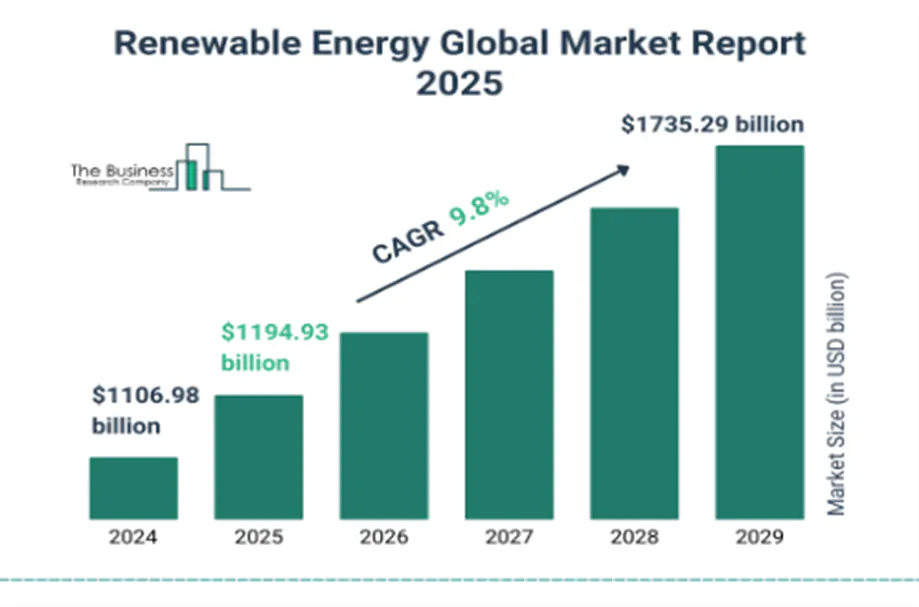
The renewable energy market has seen impressive expansion recently as evidenced by a growth of $1,106.98 billion (about $3,400 per person in the US) in 2024 that is increased to around $1,194.93 billion (about $3,700 per person in the US) in 2025, the result of a CAGR of 7.9%.
This growth trajectory shall persist as the market is anticipated to be valued at $1,735.29 billion (about $5,300 per person in the US) (about $5,300 per person in the US) by 2029, which implies a consistent CAGR of 9.8% throughout the forecast period.
Technical Considerations for Integration
Integration of renewables in industrial settings comprises of a list of technical calculations:
· Load Analysis and Demand Mapping
You have to be aware of the power utilized on average and the time that the highest peak of the power is required. This process ensures accurate system sizing and enables timely planning of the response during peak demand.
· Compatibility with Existing Infrastructure
The renewable energy system must take into account the existing fossil backup system, grid connection, and facilities limitations. This ensures that the system becomes more efficient and does not encounter work issues.
· Smart Systems Deployment
Control systems like SCADA, energy management systems (EMS), renewables, and automation are essential for real-time monitoring and load redistribution. This software interacts with conventional energy sources to optimize the overall process.
· Regulatory Compliance
Protocols like IEEE 1547 set out the basic rules for connecting distributed energy resources to the grid.
Examples of Hybrid System Designs
Hybrid models are a popular choice of industries and are frequently used to diminish inset from grids and to limit the consumption of conventional energy sources. The following are two hybrid models:
· Case 1: Solar + Diesel Backup System
In places where the power supply from the grid is not consistent but there is an abundance of sunlight, photovoltaic (PV) solar systems are merged with the diesel generator thereby are able to provide electricity 24/7.
The system directs sunlight to the panels during the day and automatically switches to diesel fuel at night or when dark clouds block the sunlight.
· Case 2: Wind + Battery + Combined Heat and Power (CHP)
For regions with a consistent wind, wind turbines can be employed to harness energy of which the wind power is then superimposed with BESS and CHP systems for energy storage and backup of electricity.
The system’s benefits include the flowing of both electrical and thermal loads as well as the use of stored energy to keep electric power reliable and the grid in a balanced state.
These configurations demonstrate the feasibility of a combination of energy sources in the power system, which can withstand possible stresses and failures in the original source of power.
Ensuring System Reliability
Reliability is a top concern for industrial facilities. Renewable systems must match or exceed the dependability of traditional sources:
· Predictive Maintenance
Technologies like AI-based analytics monitor equipment such as inverters, turbines, and battery modules. Early warnings help prevent unplanned downtimes.
· Smart Load Controls
Using SCADA and EMS, facilities can automatically curtail non-essential loads or shift demand during peak hours to maintain system balance.
· Real-Time Monitoring
Continuous diagnostics and performance tracking allow energy managers to make informed adjustments, improving power system reliability and operational continuity.
Key Benefits of Renewable Integration
Deploying renewable energy in industrial setups brings multiple advantages:
· Energy Cost Savings
After initial investment, renewable sources like solar and wind have low marginal costs, reducing overall energy spend.
· System Resilience
On-site generation through microgrids and DERs mitigates risk from grid outages or energy price volatility.
· Lower Fossil Fuel Dependency
Using less diesel or natural gas aligns with global decarbonization efforts.
· Sustainability Metrics
Integration enhances ESG performance and may qualify businesses for green financing and incentives.
Common Challenges & Practical Solutions
Despite the benefits, integrating renewable energy isn't without hurdles:
· High Upfront Costs
Capital investments in solar arrays, batteries, and smart controls can be significant. However, staged rollouts and financial modeling help mitigate this.
· Technical Complexity
Merging renewables with legacy systems requires detailed engineering. Simulation tools and pilot projects can help validate system design.
· Organizational Resistance
Change management is crucial. Educating stakeholders and showing ROI through small-scale success stories helps build confidence.
· Automation Support
Investing in robust automation and EMS platforms ensures that the hybrid system functions optimally, even with limited manual intervention.
Conclusion
Integrating renewable energy into existing industrial energy systems represents a transformative step toward cleaner, more resilient operations. Industries can save money and help the environment by learning the technical needs, using smart grid tools, and taking a step-by-step approach.
Leaders in manufacturing, oil & gas, and processing should start with small projects and use what they learn to grow over time. Working with experts and using digital tools like SCADA, EMS, and predictive analytics can make the energy shift even more successful.