


Introduction: Why 2025–2031 Is the Decisive Phase for BESS in India
India’s power system is entering a structurally different phase. Renewable capacity additions are accelerating, peak demand is becoming sharper and less predictable, and grid operators are increasingly constrained by flexibility rather than generation capacity.
Between 2025 and 2031, Battery Energy Storage Systems (BESS) move from being “nice to have” assets to becoming essential grid infrastructure. This period matters because policy intent, tender design, and financing mechanisms are finally aligning with operational realities.
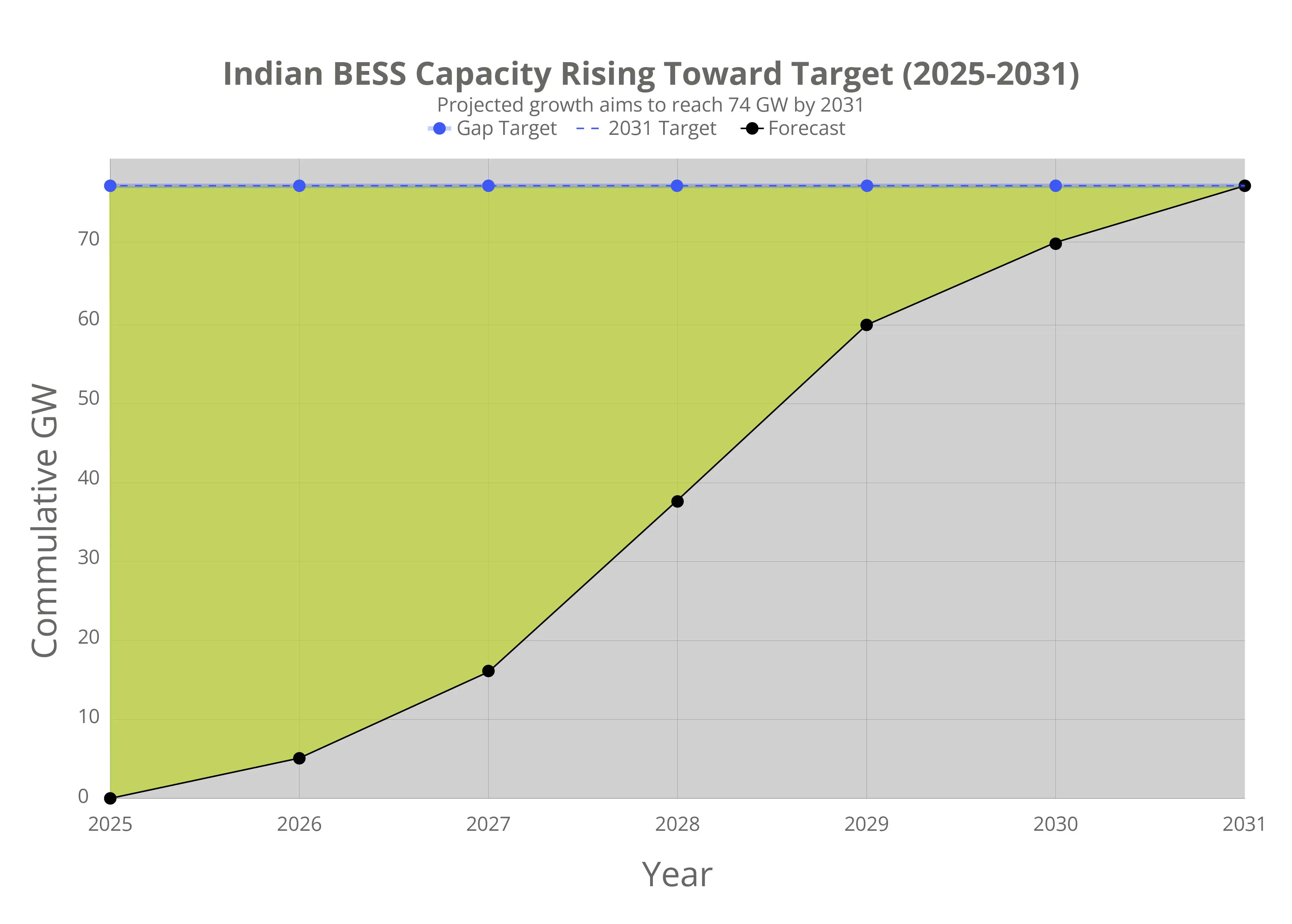
India has articulated a requirement of ~74 GW of energy storage by 2031–32, while current installed BESS capacity remains around 205 MW (Source). The gap is not incremental, it is exponential. How tenders are structured, how risks are allocated, and how projects are financed during this window will determine whether storage scales smoothly or stalls at pilot level.
India’s BESS Policy Roadmap
National targets and system drivers
India’s storage roadmap is being shaped by three system-level drivers:
High solar penetration causing midday surplus and evening deficits
Peak demand growth driven by cooling, EV charging, and urbanisation
Grid stability requirements as coal flexibility reaches its limits
The National Electricity Plan (NEP) and subsequent ministry briefings have made it clear that storage of both pumped hydro and BESS will be required at scale to balance the grid by the early 2030s.
Unlike earlier renewable programs, storage is not being positioned purely as a generation asset. It is increasingly treated as capacity, flexibility, and reliability infrastructure.
Institutional roles shaping tenders
MNRE sets the overall policy direction and enables fiscal support mechanisms
CERC defines how storage participates in markets and ancillary services
SECI and NTPC act as central procurement agencies, issuing large, standardised tenders
State DISCOMs ultimately determine demand through PPAs and state-level RFPs
What has changed since 2023 is that these institutions are no longer operating in silos. Tender documents now reflect coordination between policy intent, grid needs, and financing constraints.
Evolution of BESS Tender Models in India
Standalone BESS tenders
Standalone BESS tenders procure storage capacity independently of renewable generation. These tenders typically compensate projects through a combination of:
Availability or capacity payments
Energy discharge payments
Performance-linked incentives
SECI’s recent standalone BESS tenders signal a shift toward treating storage as dispatchable infrastructure rather than as an appendage to renewables.
Renewable + storage tenders
Hybrid tenders combine solar or wind with co-located storage. Their objective is straightforward: smooth output, firm supply during peak hours, and reduce reliance on grid balancing.
These tenders are particularly attractive where transmission incentives or scheduling benefits apply, but they also introduce complexity in dispatch optimization and degradation management.
Ancillary services and capacity-based procurement
CERC’s ancillary services framework now allows storage to participate in frequency regulation and reserves. While still evolving, these markets are critical for revenue stacking, which is essential for long-term project viability.
Auction Design & Pricing Trends
Capacity versus energy payments
One of the most important design choices in BESS tenders is the balance between:
Capacity-style payments, which stabilise cash flows
Energy-linked payments, which expose projects to dispatch and tariff risk
Early tenders leaned heavily on energy payments. Recent tenders increasingly include capacity-linked components to improve bankability.
Contract tenors and risk allocation
Tenors are lengthening toward 10–15 years, but with tighter clauses on:
Degradation assumptions
Availability guarantees
Penalties for under performance
This reflects a more mature understanding of battery behaviour over lifecycle operation.
Benchmark pricing (contextual, not absolute)
Tariffs and capacity charges vary widely by state, grid condition, and tender design. What matters more than headline numbers is risk-adjusted pricing how much volatility a project can absorb without eroding equity returns.
Viability Gap Funding (VGF): Why It Matters for BESS
What is VGF in the context of BESS?
Viability Gap Funding is fiscal support provided to bridge the gap between market-acceptable tariffs and the actual cost of delivering a project at bankable returns.
For BESS, VGF is not a subsidy for inefficiency. It is a transition tool that recognises that early storage deployments deliver system-wide benefits not fully monetised by current markets.
How VGF improves bankability
Properly structured VGF:
Lowers upfront capital burden
Improves debt service coverage ratios
Reduces tariff pressure on DISCOMs
Encourages standardisation and scale
Recent SECI tenders have demonstrated how capped VGF, linked to commissioning milestones, can accelerate deployment without distorting incentives.
Project Bank ability & Developer Economics
Revenue stacking is no longer optional
A bankable BESS project in India today must combine multiple revenue streams:
Peak-hour energy arbitrage
Capacity or availability payments
Ancillary services participation
Demand response or grid support services
Single-revenue models are fragile in India’s evolving power market.
Key risks developers must model realistically
Tariff volatility, especially during peak hours
Battery degradation, which reduces usable capacity over time
Dispatch uncertainty, particularly in nascent ancillary markets
Projects that fail typically do so because these risks were underestimated, not because technology failed.
Why multi-cycle dispatch improves economics
Multi-cycle operation charging from solar during the day and discharging across multiple peak windows materially improves asset utilisation.
However, this only works when:
PCS efficiency is high
Thermal management is robust
EMS logic is optimised for real grid conditions
Several Indian solution providers, including GoodEnough Energy, have been deploying BESS systems like StorEDGE with a focus on multi-cycle operation, thermal efficiency, and dispatch optimisation. These deployments are valuable not because of branding, but because they generate operational data that financiers and tendering agencies increasingly demand.
Outlook: 2025–2031
Expected scale-up trajectory
India’s BESS market is expected to move from hundreds of megawatts to multiple gigawatts annually by the late 2020s. Centralised tenders will dominate early volumes, followed by greater state-level and private procurement. (Source)
Policy gaps still to be addressed
Long-term clarity on transmission charges post-waiver period
Standardisation of degradation and availability clauses
Faster grid interconnection approvals
What developers and investors should prepare for
Conservative, scenario-based financial models
Strong EMS and system integration capabilities
Clear warranty, O&M, and performance recourse
Evidence from pilot or operating assets
Conclusion
India’s BESS tender landscape between 2025 and 2031 will define the country’s ability to integrate renewables reliably and affordably. The opportunity is large, but so are the execution risks.
Projects that succeed will not be those that bid the lowest tariffs, but those that combine sound policy understanding, realistic economics, and operational discipline. Storage in India is no longer about experimentation it is about building infrastructure that works, scales, and lasts.