


In his campaign rhetoric, California Governor candidate Tom Steyer says he will reduce California Investor-owned utility (IOU) electric bills by 25%. Can he really achieve that?
The simple answer is YES. But it will be hard, and require a lot of gubernatorial, judicial, and local government action to make it happen.
First, we need to look at the scale of the problem. Total IOU revenue requirements are on the order of $57 BILLION. Reducing rates by 25% requires reducing this by $15 BILLION. No single solution can deliver those savings at that scale.
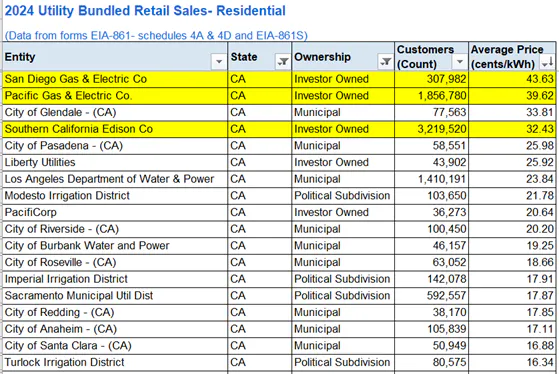
Here’s a comparison of IOU residential rates for California’s largest electric utilities. Many are providing service for approximately half the cost of high-cost IOUs like San Diego Gas and Electric and Pacific Gas and Electric. Many of the low-cost utilities are quite small – there is no evidence of “economies of scale” in this group. Other utilities provide reliable service for 25% less (as promised by Steyer) or even 50% less than the IOUs.
So, how could Steyer reduce IOU rates by 25%?
One way is to impose much stricter regulation on the private utilities: lower allowed return on equity, lower executive compensation, and lower construction budgets for new and replacement distribution system construction.
Executive compensation is a frequent target of consumer advocates. Currently, the executives of California’s investor-owned utilities are paid as much as 20 times as much as the executives of California’s consumer-owned utilities like those in Los Angeles, Sacramento, and others receive.
Chief Executive Total Compensation from 2025/26 Proxy Statements and other sources:
Sempra Utilities (SDG&E):
$21,513,802
Pacific Gas and Electric: PG&E):
$19,812,481
Edison International (SCE):
$16,544,559
Sacramento Municipal Utility District:
$982,000
Los Angeles Department of Water and Power:
$750,000
But executive compensation – including dozens of VPs paid more than $1 million/year -- is only a small part of the problem. Executive compensation comprises only a fraction of one percent of the total revenue requirements.
Wildfire mitigation costs, including very expensive undergrounding of distribution lines, is a major cause of recent rate increases. Total wildfire spending across the three IOUs was $6 to 8.5 billion in 2024 depending on the accounting basis.
Undergrounding lines for sparsely-populated areas wildfire protection is costing as much as $200,000 per customer, to be recovered in rates to all customers. Evidence shows that building solar/battery micro-grids, eliminating the need for long distribution lines for some areas entirely, may be cheaper. But the current form of regulation rewards utilities with a 10% return on the equity investment in undergrounding, creating a perverse incentive for the higher-cost solution.
Another major cause of high rates for California IOUs is the subsidy provided to low-income consumers under the CARES program. This provides discounts of up to 33% to nearly one-third of residential consumers. There are also favorable rates for some large industrial customers. Other causes include lower sales due to energy efficiency investments and installation of rooftop solar systems, reducing the “denominator” in the rate equation – revenue requirement divided by sales.
But the big ticket item is the cost of capital for the private utilities. The private utilities receive about a 10% shareholder return on their investments in utility plant, which total in the tens of billions of dollars for each of the large California IOUs. This affects the cost of distribution system improvements, wildfire response investments, and also applies to ordinary costs like office buildings and vehicles.
Probably the most promising key action will be to replace the private utilities with local public power utilities. Public utilities finance those same type of new facilities with bonds that typically carry interest rates below 5%. Think about what cutting your home mortgage interest rate in half would do for the cost of housing; the same principle applies to electric utility finance.
That’s what explains much of the difference between the IOU rates and the municipal utility rates in California.
The most certain way for Governor Steyer to achieve his goal to reduce rates by 25% is to mobilize an effort for public utilities to take over the distribution service from the private utilities.
This is made easier in California by virtue of the fact that Community Choice Aggregators (CCAs) are already procuring the power supply for most areas of the state. So that part of the business is already in public hands. The remaining task is to shift the distribution function over to the cities, nearly all of which already operate water, sewer, and other utilities.
The fact that cities like Riverside, Redding, Anaheim, Burbank, Palo Alto and others can provide this service at lower cost is instructive. There is no reason that the communities served by the private utilities cannot do this. Operating an electric distribution system IS engineering, but it is NOT rocket science. And financing it with municipal debt on a non-profit basis is much less expensive for consumers.
I have worked professionally on several public power conversion efforts. In most of these, the acquiring utility paid the private utility a premium of 30% to 50% over the book value of their assets. This premium was necessary to secure an orderly transition. But with the financing advantages of public utilities and their lower-cost management and taxation structures, each of these has been able to provide better service at lower rates than the private utilities they replaced.
In Kauai, before the Kauai Island Utility Cooperative took over from the private utilities, Kauai had the highest rates of the four major Hawaiian systems (Oahu, Hawaii, Maui, Kauai). Today it has the lowest rates. The service is more reliable. The consumers elect the board of directors. The same is true for recently created public power utilities in Hermiston, Oregon, for the Oregon Trail Electric Cooperative. and for the Emerald and Columbia People’s Utility Districts in Oregon.
When PG&E filed for bankruptcy in 2019, the City and County of San Francisco made an offer to buy the PG&E distribution system in the City at a premium over its value. The California PUC (appointed by the Governor) rejected this offer, instead granting PG&E much higher rates to move out of bankruptcy. That action denied the citizens of San Francisco the ability to control their own energy destiny.
A Governor Steyer could appoint a PUC that considers the public interest as their most important guiding principle. That PUC could approve sales of the private utility systems to public operators. And in time, after some initial start-up costs, customer rates would almost certainly be much lower.
Bottom line: YES, Governor Steyer could keep this promise. But it requires a level of political courage and commitment to the public interest much greater than that of the current Governor.
Jim Lazar is an economist living in Olympia, Washington. He is the author of Electricity Regulation in the US: A Guide, and several other books on the electric power industry. Over a 45 year career, he consulted on projects in 35 states and 24 countries.