


Electrification power struggles are intensifying in the energy octagon.
Resilience and agility will separate winners from losers. But not before buckets of political blood have been spilled.
First, to the grid, where we have a spike in energy security concerns.
Respondents to DNV’s survey of more than 1,000 senior energy executives and engineers point to several major challenges affecting their ability to manage disruption and meet demand.
Key theme in the 2026 findings of the global risk management company’s annual poll: resilience required.
More specifically, resilience in energy security, resilience in grid infrastructure, and resilience in energy system organizations.
The DNV report found examples of threadbare resilience across all three categories.
For example, 69% of the survey’s respondents said that dependence on imported energy sources has increased the vulnerability of their energy grids.
Energy demand is also outpacing supply, especially in North America, where 78% of survey respondents waved supply and infrastructure red flags.
Less than half of the respondents (44%) said their government is doing enough to secure long-term energy security. In North America, that percentage dropped to 37%.
What about greening the grid and the decarbonization din?
On the energy security side, it remains audible, but predictability and balance now have the ear of the market.
They are efficiency fundamentals.
“The energy industry,” as the DNV report notes, “benefits from long periods of stable prioritization and policy certainty.”
Not much of that today on any front. Instead, we have political policy uncertainty and prioritization instability on all fronts.
And that short-circuits energy business efficiency.
Simen Moxnes, a senior new energy systems adviser at Equinor, a Norway-based energy company, underscored that in the DNV report.
“Within the energy trilemma [energy security, energy affordability, and environmental sustainability], we cannot bounce from corner to corner,” he said. “We need a long-term strategy aiming for balance. If you chase one dimension too hard and ignore the others, you inevitably create new problems.”
So, we need a multi-dimensional approach. That means mixing old with new and resisting political pressures to replace old with new before new is ready for prime time.
The DNV survey respondents agree.
They support the wisdom of combining old with new to bolster energy security rather than eroding it with ill-advised bouncing “from corner to corner.”
While 79% said expanding renewable energy capacity improves energy security, 74% added that oil and gas will be critical to ensuring that security over the next decade.
When it comes to energy security, the European Union is at a critical crossroads, magnified by the Strait of Hormuz crisis.
That energy security intersection is among the issues discussed in the Carnegie Endowment’s Grand Strategy for Europe’s Clean Industrial Future.
The EU’s ambitious embrace of renewable energy at the expense of fossil fuel reliability has left it a power pauper dependent on other regions and vulnerable to geopolitical disruptions and disputes.
“Europe’s energy and foreign policies are not yet suited to today’s harsh geopolitical environment,” the Carnegie report points out. “Since the 2019 European Green Deal, the European Union (EU) has cut emissions by reducing fossil fuel consumption. But it has created new dependencies by swapping them for energy technologies and imported fuels.”
Energy realities have also recalibrated commercial shipping’s green ambitions.
As the Substack Shipping News has documented, the International Maritime Organization’s Net Zero Framework goal of net-zero commercial shipping emissions by 2050 is drifting further off course.
Electrification infrastructure and alternative fuel technology initiatives in the maritime goods-moving network remain marginal at best.
Consider, for example, that, according to DNV, only 4% of the global shipping fleet is equipped with high-voltage connections to access port shore power, and only 3% of the 3,400 ports that service ships of more than 5,000 gross tonnes provide electric shore power connections.
DNV estimates that implementing widespread use of electrical shore power could reduce fuel oil demand for large commercial freighters by approximately 3.5%, which equates to “an estimated annual reduction potential of 9.24 Mtoe (million tonnes of oil equivalent) fuel and 29 million tonnes of carbon dioxide emissions.”
While an estimated 51% of orders for new container ships include dual-fuel technology, only around 3,000 ships in the world’s 121,000 commercial-vessel fleet are equipped with the technology to burn anything other than heavy marine oil.
That is a mere 2%.
Small wonder then that DNV recently revised its outlook for transportation’s prime driver.
It originally forecast that oil, which currently provides 90% of global transportation’s energy needs, would reduce its share to 67% by 2040; DNV has revised that to 76%.
So, energy octagon winner and still champ: oil.
www.linkedin.com/in/timothyrenshaw
@timothyrenshaw
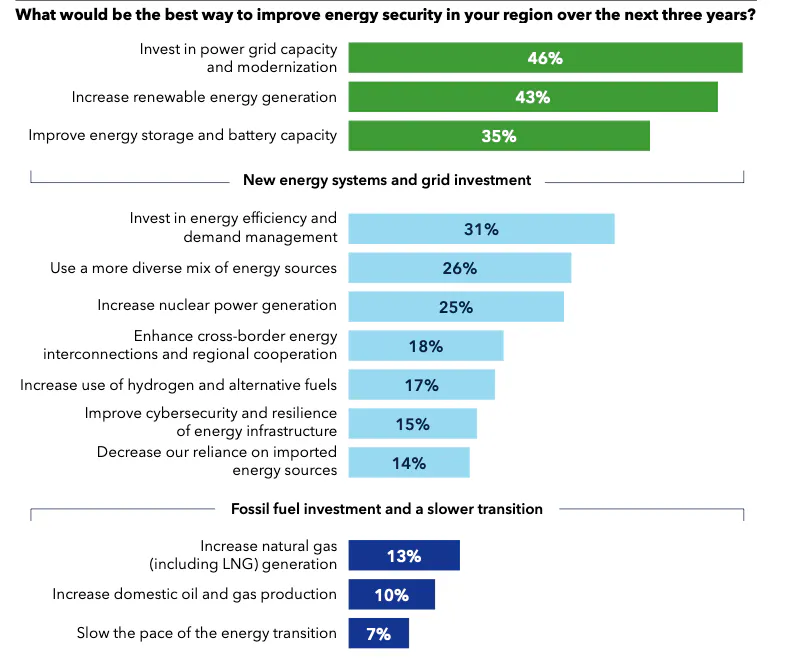
Power grid capacity and modernization investment is atop the energy security priority list for energy executives and engineers, according to a DNV energy system resilience survey | DNV Energy Industry Insights 2026