


By Kennedy Maize
Fuel cells, a proven way to make electricity without combustion, fission, or gravity, are making serious inroads into the red-hot market for producing power for artificial intelligence data centers.
Last Tuesday (June 30), fuel cell vendor Bloom Energy (NYSE:BE) announced what they described as a “$25 billion” deal with Canadian financial holding company Brookfield (NYSE,TSN:BN) that is a five-fold increase in Brookfield’s initial investment last October in the San Jose-based solid-oxide fuel cell developer. In a news release, Bloom said, “The expanded partnership reflects strong and sustained demand from hyperscalers and AI infrastructure developers for fast, reliable, and community-friendly power.”
Aman Joshi, Bloom’s chief commercial officer, said, “When we formed this partnership, we said it was the first phase of a much larger vision. Today’s commitment reflects the momentum we are seeing in the market, as evidenced by recently announced large-scale deals. Bloom is uniquely positioned to address the urgent need for clean, reliable power to support the rapid growth of AI.”
Brookfield, with a trillion-dollar diversified portfolio that includes real estate, infrastructure, renewable energy, private equity, and insurance, is one of the world’s largest financial holding companies. In late 2022, it spun off private equity investor Brookfield Asset Management (NYSE,TSX:BAM), which relocated to New York City in 2024.
The Bloom-Brookfield compact was the second major AI coup for Bloom. In April, Texas-based technology giant Oracle Corp. announced a deal with the company to develop a behind-the-meter 2.45-GW artificial intelligence data center in the New Mexico desert, dubbed Project Juniper, powered by Bloom’s fuel cells.
At the time, Oracle explained its choice of fuel cell technology: “Fuel cells generate electricity without combustion, meaning the Bloom microgrid is highly efficient with low emissions and water use. Compared to its previously planned gas turbines, Project Jupiter with the Bloom microgrid will reduce NOₓ emissions by approximately 92% and will use a negligible amount of water.”
A week before the Bloom-Brookfield deal (June 24), Connecticut-based FuelCell Energy (Nasdaq: FCEL) and Fit Energy USA LP of Boca Raton, Fla., a “Foreign Limited Partnership” formed in February under Florida law, announced a “strategic agreement for up to 380 megawatts (MW) of clean, baseload on-site power for data centers using FuelCell Energy’s utility-scale fuel cell technology. The agreement includes an immediate deposit for an initial 30 MW of power scheduled to begin delivery later this year.”
Jason Few, FuelCell Energy president and CEO, said, “This agreement further validates our decision to scale our operations to 500 MW, preserving our ability to serve a broad and growing pipeline of customers.” Fit Energy CEO Joel Leonoff, said, “Today’s announcement marks a critical step in building the power foundation required for the next generation of AI infrastructure. FuelCell Energy’s technology aligns with our growth objectives and our goal of delivering behind-the-meter power solutions to data centers at gigawatt scale.”
According to a joint news release, the two companies said that “under the arrangement, Fit Energy will be eligible to receive warrants tied to future deployment milestones of up to 380 MW. The warrant structure is designed to align long-term value creation with successful project execution and customer deployment.”
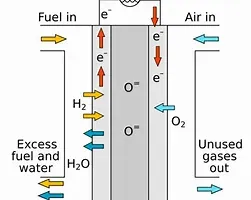
Fuel cells generate electricity through electrochemical reactions between a fuel (often pure hydrogen) and an oxidizing agent (typically oxygen) without combustion. As the Department of Energy describes it, “A fuel cell consists of two electrodes—a negative electrode (or anode) and a positive electrode (or cathode)—sandwiched around an electrolyte. A fuel, such as hydrogen, is fed to the anode, and air is fed to the cathode….The electrons go through an external circuit, creating a flow of electricity.”
In the middle of the new fuel cell announcements, Norwegian energy consulting firm Rystad Energy issued a very bullish report on the fuel cell-data center connection, predicting “a tenfold increase in fuel cell market revenues by 2030, rising from around $2.8 billion in 2025 to roughly $30 billion, as AI computing demand drives unprecedented growth in data center construction.”
Backing up that prediction, says Rystad, is a “contracted order book of approximately 9 gigawatts (GW), including framework agreements with Oracle, AEP, Equinix, and Brookfield, points to growing confidence among major operators in fuel cells as a viable long-term power source.”
Fuel cells are particularly well suited for what the consultants see as a decided move to “on-site power generation rather than grid connection. Unlike conventional grid connections or large gas plants, fuel cells can be deployed quickly and run on natural gas today, transitioning to biogas, renewable natural gas or hydrogen as supply matures, while producing lower on-site emissions than combustion alternatives.”
Rystad’s Lein Mann Bergsmark said, “Power availability has become one of the defining constraints on data center growth, and operators are increasingly looking beyond the grid for solutions. Fuel cells have moved from a niche application to a measurable part of the firm power mix. The question now is whether the supply chain can scale at the same pace as demand.”
The Quad Report, covering energy policy and politics