The best ability is availability. Yesterday’s pro sports hot take is today’s shipping hot take because availability in the maritime bunkering business is under duress.
And that, my friends, is more than a game-day challenge. It’s a big problem that is about to get bigger – bigger than fuel cost spikes; bigger than a host of geopolitical complications that are rattling the global supply chain.
Without that bunker fuel availability ability, the reliable flow of trade upon which global economies depend will be blown off course.
How far off course, you ask?
Cue lifeboat drill in the wake of Gisele Widdershoven’s recent compass reading.
The international maritime energy transition analyst sees the Iran-Strait of Hormuz crisis as “not merely an energy shock anymore … [it is] now growing into a systemic disruption of the logistical backbone that underpins maritime commerce.”
Her recent analysis of the Middle East mess adds that, “Bunker fuel markets are the first transmission channel through which geopolitical instability translates into global economic stress.”
Widdershoven points out, for example, that the United Arab Emirates (UAE) Port of Fujairah is the world’s second-largest ship bunkering facility. The Persian Gulf is also more than a top oil-producing region; it is the world’s leading oil refining and product export hub.
An extended disruption there will trigger a global domino effect of bunker fuel availability inability.
Widdershoven also notes that the heavy fuel oil that powers 90% to 95% of the global shipping fleet is a cocktail of crude oil, distillates and other ingredients. A protracted interruption in the flow of any one of them will further destabilize global bunker fuel availability.
Consider also that, while temporarily eased U.S. sanctions have boosted Russian oil revenue, Ukrainian drone attacks have seriously damaged Russian oil infrastructure. That reduces the flow of another oil stream into the global market.
Expect freight cost increases to accelerate – but not just due to compromised bunker fuel availability abilities.
U.K.-based shipping consultancy Drewry notes that oil is also a critical component in lubricants and other technical equipment used in commercial shipping operations and spare parts manufacturing.
It adds that the cost of dry docking, which is one of the largest recurring expenses for shipowners, is also closely tied to energy prices.
However, maritime shipping is not alone in the energy volatility storm.
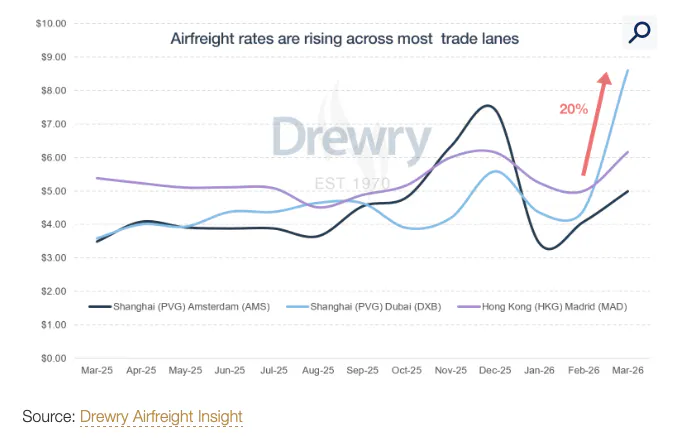
According to Drewry Airfreight Insight, month-over-month (MoM) air freight rates on roughly half of the international air freight routes it monitors jumped 20% or more in March. MoM rates on Asia-to-Middle East routes spiked as much as 95%.
Fuel and security surcharges, coupled with a capacity squeeze resulting from Middle East airlines reducing operations during the Iran war hostilities, are driving air freight rates skyward.
Drewry notes that air freight routes connected to the Middle East constitute 15.6% and 18.2% of air freight traffic and capacity, respectively.
Meanwhile, according to Xeneta, 56% of global trade touches ports in the regional ecosystem outside the Persian Gulf.
So, the Middle East conflict’s erosion of bunker fuel availability ability has widespread negative economic implications, because as Widdershoven observes, “The global economy does not run on cargo, but on fuels.”
Her Iran war-Hormuz crisis analysis also points out that a major obstacle to its expeditious resolution is that “there has been a clear lack of co-ordination between Western and regional forces. It is no longer a physical-risk environment but a commercial-denial environment.”
She is dead right on that point.
Cleaning up the Middle East mess will take time and patience.
However, the West’s inability to unite over the need to eliminate the Iranian theocracy’s global nuclear and terrorist threats has raised serious doubts about the integrity of Islamic terrorist opposition and the resilience of Western values and alliances.
www.linkedin.com/in/timothyrenshaw
@timothyrenshaw