


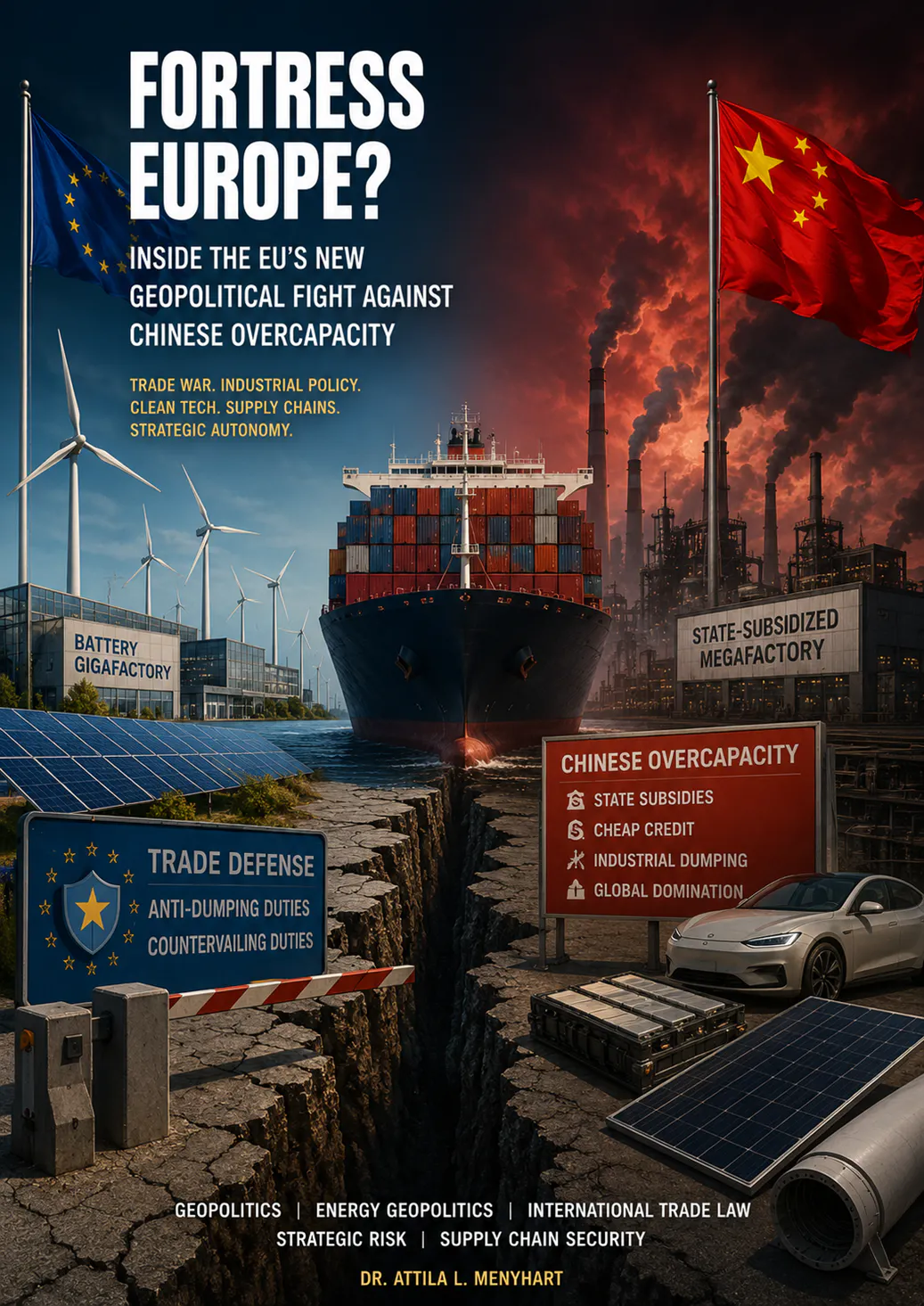
Fortress Europe? Inside the EU’s New Geopolitical Fight Against Chinese Overcapacity
Author: Dr. Attila L. Menyhart
Category: Geopolitics, Energy Geopolitics, International Trade Law, Strategic Risk, Supply Chain Security
I. Executive Summary
For nearly three decades, the foundational consensus of the European Union’s trade policy toward the People’s Republic of China (PRC) was anchored in the neoliberal paradigm of Wandel durch Handel (Change through Trade). It was assumed that deep economic integration, supply chain interdependence, and shared market structures would lock Beijing into a rules-based, multilateral trading order governed by the World Trade Organization (WTO).
By 2026, this consensus has decisively shattered. Faced with systemic Chinese industrial dumping driven by state-directed credit allocation, vast non-market subsidies, and severe domestic under-consumption, the European Commission has transitioned from a policy of defensive "de-risking" to active economic retaliation.
This study analyzes the structural mechanics of the EU’s defensive trade pivot, focusing on the geopolitical and geostrategic implications of Brussels' aggressive anti-dumping measures. It evaluates the structural asymmetries in clean technology supply chains (EVs, solar PV, wind components, and lithium-ion battery architectures) and highlights how the European continent has become the primary battleground for global industrial hegemony. Finally, it outlines the strategic risks of Chinese retaliatory counter-measures and maps out the policy imperatives required for Europe to secure its industrial sovereignty without triggering an inflationary energy transition shock.
II. The Anatomy of Chinese Overcapacity: The "Second China Shock" and the Subsidy Matrix
The current geopolitical friction between Brussels and Beijing is not a cyclical trade dispute; it is the mathematical consequence of a structural imbalance within the Chinese macroeconomic model. To understand the root of the problem, we must dismantle the myth that Chinese enterprises possess a competitive edge solely due to manufacturing efficiency or lower labor costs. The phenomenon is driven by a state-directed, market-distorting ecosystem.
1. The Asymmetry of Capital Allocation: The Near-Zero Cost of Capital
In a market economy, corporate financing is tethered to commercial risks and central bank interest rates. In the PRC, however, the banking sector is overwhelmingly state-owned. Under the explicit directives of the Chinese Communist Party (CCP), these financial institutions operate not on short-term project profitability, but on long-term geostrategic imperatives.
For sectors designated as the "New Three" (Xin San Yang)—Electric Vehicles (EVs), Lithium-ion Batteries, and Solar Photovoltaics (PV)—capital is provided at near-zero real interest rates. These state-backed loans are continually rolled over, effectively eliminating bankruptcy risks due to implicit sovereign guarantees. This creates a disconnect where Chinese firms can operate at sustained financial losses that would bankrupt any Western competitor.
2. The Real Estate Reallocation Vector
The acute overcapacity facing global markets in 2026 is the direct result of a major domestic macroeconomic pivot. Following the systemic collapse of the Chinese property sector, Beijing deliberately redirected massive amounts of capital away from real estate speculation and flooded it into advanced manufacturing. This sudden capital injection generated industrial capacities that vastly exceed what any organic market can absorb.
3. The Matrix of Hidden and Indirect Subsidies
Direct cash grants, which are easily discoverable and punishable under WTO rules, represent only the surface of Beijing's support apparatus. The Chinese state utilizes local governments and Local Government Financing Vehicles (LGFVs) to deploy a highly sophisticated matrix of indirect subsidies:
Subsidized Infrastructure: Local authorities routinely provide free or nominally priced industrial land, while state funds construct bespoke logistics and grid connections.
Cross-Subsidized Energy Inputs: Cleantech production is highly energy-intensive. Chinese gigafactories, polysilicon refiners, and component manufacturers receive electricity and coal from state-owned energy monopolies at a fraction of true market rates.
Closed-Loop Domestic Mandates: Receipt of state aid is frequently conditioned on purchasing components from domestic supply chains, generating a closed-loop multiplier effect that systematically excludes foreign technology.
4. The Paradox of Structural Under-Consumption
The systemic compulsion to export this overcapacity stems from a fundamental imbalance within China's domestic economy. The CCP's economic model intentionally suppresses household consumption in favor of industrial production. Due to the lack of a robust social safety net, comprehensive pensions, and universal healthcare, Chinese citizens maintain extraordinarily high precautionary savings rates.
Unsurprisingly, domestic consumption as a share of GDP remains drastically below global averages. Because the domestic market cannot absorb the output of these state-subsidized mega-factories, exporting the surplus at artificially low prices is not an operational choice; it is a structural necessity for the preservation of the regime's economic stability.
III. Visual Evidence of Structural Distortions
To contextualize the scale of this macroeconomic asymmetry, we can analyze the structural data compiled by multilateral institutions regarding state ownership and capital distribution.
1: Structural Imbalance of the Chinese Macroeconomic Model. Observe the disproportionate allocation of capital toward manufacturing assets relative to household consumption indicators, necessitating the export of surplus capacity. The IMF datasets underscore the vast gap between high state-directed industrial investment and suppressed domestic household consumption.
IV. Geopolitical Dimensions: The Failure of Multilateralism and WTO Paralysis
The escalation of EU defensive trade instruments marks the formal acknowledgement that global multilateral trade governance has become dysfunctional.
1. Weaponization of the WTO and the Appellate Body Crisis
The WTO framework was fundamentally designed for market-driven economies where price discovery is determined by supply and demand, not state-backed industrial planning. Beijing has successfully exploited the legal loopholes of the WTO, utilizing the prolonged dispute settlement process to entrench its market dominance before anti-dumping or countervailing duties can be legally validated.
Furthermore, with the WTO Appellate Body remaining functionally paralyzed, Brussels has been forced to rely on unilateral, domestic trade defense instruments (TDIs). The European Commission is increasingly deploying the Foreign Subsidies Regulation (FSR) and the International Procurement Instrument (IPI) to investigate and disqualify state-subsidized Chinese entities from participating in European public tenders, ranging from rail infrastructure in the V4 to solar installations in Western Europe.
2. The Transatlantic Strategic Divergence
While both Washington and Brussels agree that Chinese industrial dumping represents a structural threat, their geostrategic approaches diverge significantly:
The US Approach (Geopolitical Absolute): Washington treats Chinese technology as an absolute national security threat. The US strategy relies on blunt, broad-spectrum tariffs (e.g., 100% tariffs on Chinese EVs) designed to decouple supply chains entirely, regardless of the immediate inflationary impact on the green transition.
The EU Approach (Rules-Based Proportionality): Brussels operates within strict legal boundaries. Under EU law and international trade commitments, European countervailing duties must be meticulously calculated based on verified margins of injury and state subsidization. This approach attempts to balance industrial defense with the need to maintain affordable access to clean tech inputs required for European climate mandates.
V. Geostrategic Dimensions: The Clean Energy Sovereignty Nexus
From a geostrategic perspective, the EU's trade defense turn is driven by the realization that the green energy transition must not replace a legacy dependence on Russian hydrocarbons with a total structural dependence on Chinese clean tech value chains.
1. The European Battery and EV Battery Trap
The European automotive industry represents the economic backbone of the continent’s industrial base, accounting for over 7% of the EU’s GDP and millions of highly skilled engineering jobs. The rapid influx of heavily subsidized Chinese battery electric vehicles (BEVs) priced 20% to 30% below European manufacturing costs threatens to permanently hollow out this ecosystem.
The geostrategic risk extends beyond vehicles to the underlying battery architecture. Chinese firms (such as CATL and BYD) control not only cell manufacturing but also the upstream processing of cathode and anode materials, creating a vertical monopoly that leaves European legacy OEMs highly vulnerable to strategic coercion.
2. Solar and Wind: Preserving the Last Industrial Anchors
The European solar manufacturing sector has already been virtually eliminated by Chinese dumping over the past decade. The European Commission is determined to prevent the wind energy sector from suffering the same fate.
Chinese wind turbine manufacturers, leveraging state-backed financing and cheap local steel, have begun underbidding European competitors by up to 50% in Mediterranean and Baltic offshore projects, offering deferred payment structures that no commercial European bank can match. Deploying anti-dumping investigations into these wind consortia is a direct geostrategic intervention to protect Europe's last remaining domestic renewable manufacturing sector.
Fig. 2: The New Geopolitics of Energy and Infrastructure Sovereignty. Strategic mapping of clean energy supply chains, highlighting Europe’s critical need to secure downstream infrastructure and manufacturing anchors against asymmetric external dependencies.
VI. Critical Raw Materials, Mining, and the Green Transition Paradox
The EU’s aggressive trade stance against Chinese dumping exposes a profound internal paradox within Europe's wider climate and industrial security policy.
1. Upstream Realities vs. Downstream Ambitions
Under the Critical Raw Materials Act (CRMA), the EU has set ambitious targets for domestic mining, refining, and recycling of strategic elements like lithium, cobalt, magnesium, and rare earth elements (REEs). However, the physical reality remains that China currently refines roughly 60% of the world’s lithium, 70% of its cobalt, and nearly 90% of all rare earth elements.
Even if Europe imposes high tariffs on finished Chinese electric vehicles or solar modules, European industries remain structurally dependent on intermediate chemical precursors and refined materials controlled by Beijing.
2. The Strategic Weaponization of Mineral Exports
Beijing has already demonstrated its willingness to weaponize this asymmetry. In response to Western restrictions on advanced semiconductors and trade defense measures, China implemented strict export licensing regimes on gallium, germanium, graphite, and antimony—elements critical for defense electronics, fiber-optic communications, and high-energy-density battery anodes.
Any further escalation of European tariffs will likely trigger asymmetric retaliatory export bans from China, targeting the very inputs European factories need to build wind turbines, SMR components, and localized EV battery packs.
3. Value Chain Dependency Mapping
To fully grasp the upstream vulnerability, the table below outlines the structural control exerted over key mineral processing steps required for the green transition.
Table 1: Clean Energy Value Chain Control (Upstream Processing Share)
Material Category
Chinese Global Refining Share
European Domestic Capacity
European CRMA 2030 Target
Rare Earth Elements (REE)
~90%
<5%
40% (Processing)
Lithium Refining
~60%
~0%
40% (Processing)
Cobalt Processing
~70%
<10%
40% (Processing)
VII. Regional Impact: The Strategic Fragmentation of Europe
The escalation of tension between Brussels and Beijing is widening fault lines within the European Union itself, creating deep friction between member states based on their specific economic models and geopolitical alignments.
1. The Franco-German Divide
The French Position (Strategic Autonomy): Paris is the primary driver behind the EU’s aggressive trade defense turn. With limited industrial exposure to the Chinese domestic market and a strong desire to protect its state-supported domestic automotive sector, France views tariffs as an essential mechanism to achieve European "strategic autonomy".
The German Position (Export Vulnerability): Berlin has consistently resisted aggressive trade measures against Beijing. The German economic model is highly exposed due to its premium automotive sector, which derives a massive share of its global revenues and profits directly from the Chinese consumer market. German leadership fears that a full-scale trade war will lead to retaliatory Chinese actions that destroy their premium export margins.
2. The V4 Pivot and the Balkan Hedging Strategy
The Visegrád Four (V4) and neighboring Balkan nations are charting a highly pragmatic path through this Sino-European trade war. While Brussels attempts to erect trade barriers, nations like Hungary are actively positioning themselves as a geographic and regulatory "bridge".
By welcoming massive Chinese foreign direct investment (FDI)—such as BYD’s manufacturing plant in Szeged or CATL’s battery gigafactory in Debrecen—these member states are allowing Chinese firms to bypass EU external tariffs by localizing production inside the European Single Market. This strategic hedging creates deep internal political friction, complicating Brussels’ efforts to maintain a unified, cohesive geostrategic front against economic coercion.
VIII. The Western Mirror: Financialization, Debt, and the Regulatory Trap
To fully comprehend the structural friction between Brussels and Beijing, the analysis must move beyond a unilateral critique of Chinese state-capitalism and examine the systemic vulnerabilities of the Western macroeconomic model. The current trade war is not merely a clash of industrial capacities; it is a fundamental confrontation between two divergent governance architectures: a state-directed command economy versus a hyper-regulated, financialized market system.
1. The Cost of Capital (CoC) Disconnect and the "Hurdle Rate" Asymmetry
In the Western market paradigm, capital allocation is strictly bound to commercial risk and central bank monetary pricing. Western enterprises face a high Cost of Capital (CoC) and are subject to rigid corporate governance mandates that demand high short-term returns.
The Western Hurdle: European and American clean-tech developers must meet steep hurdle rates (often a 10% to 15% Internal Rate of Return) to satisfy institutional shareholders and commercial lenders. If a project cannot clear this bar in a high-interest-rate environment, capital immediately flees.
The Eastern Contrast: Conversely, Chinese state-backed enterprises operate with a near-zero real cost of capital. Because Beijing prioritizes long-term supply chain hegemony over short-term balance sheet profitability, Chinese firms can sustain negative margins for years, effectively leveraging state liquidity to outlast and bankrupt Western competitors who are bound by market discipline.
2. The 285% Debt Trap and Shadow Banking Financialization
The capacity of the West to respond to the Chinese industrial challenge is severely constrained by its own balance sheet liabilities. Today, the aggregate debt of the Western world stands at roughly 285% relative to assets and investments with a perceived or projected return.
This hyper-financialization has distorted the purpose of credit. Instead of funding tangible, long-term re-industrialization or critical infrastructure, Western capital is heavily concentrated in secondary financial markets, complex risk-mitigation instruments, and the non-bank financial sector (shadow banking).
The shadow banking ecosystem operates on highly compressed, speculative timelines, seeking rapid 3-to-5-year exit strategies. This structure is fundamentally unsuited to the green energy transition, which requires patient capital capable of absorbing 15-to-25-year return horizons for highly complex assets like Small Modular Reactors (SMRs), hydrogen grids, or critical mineral refineries.
3. The Bureaucratic Efficiency Paradox
While Western liberal democracies champion the merits of the free market, their operational reality is choked by a hyper-regulated legislative framework. The administrative burden of ESG compliance, complex public procurement litigation, and fragmented state-aid rules has turned Western bureaucracy into a primary driver of declining industrial efficiency.
In the PRC, when the central government designates a strategic industrial node, a multi-gigawatt battery plant can be cleared, constructed, and brought online within 12 to 18 months.
In Europe, an identical greenfield industrial project faces an extensive permitting process that routinely takes 5 to 7 years due to environmental impact litigations and overlapping local, national, and European regulatory layers. This regulatory inertia acts as a hidden, compounding tax on time and capital efficiency.
4. The Consumption-Driven Electoral Stimulus vs. Sovereign Long-Termism
The ultimate asymmetry lies in political time horizons. Western macroeconomic policy is structurally tethered to short-term electoral cycles (typically 4 years), which naturally incentivize debt-financed consumer stimulus and immediate public gratification over painful, long-term structural investment. Western leadership faces immense political resistance when asking voters for consumption restraint to fund capital-intensive, sovereign industrial strategies.
Beijing’s model, by contrast, intentionally suppresses domestic consumption and household disposable income to channel national wealth directly into global industrial dominance. Until the West addresses its internal dependency on debt-driven consumerism and excessive regulatory friction, trade tariffs will remain a superficial solution to a deeply rooted structural crisis.
5. Comparative Structural Matrix
The following matrix visually codifies these conflicting economic structures to illustrate why trade tariffs alone cannot solve the Western competitiveness crisis.
Table 2: Macroeconomic and Governance Asymmetry Matrix
Strategic Dimension
The Western Model (EU / US)
The Chinese Model (PRC)
Primary Economic Driver
Debt-driven household consumption and immediate welfare.
State-directed manufacturing asset accumulation and global dominance.
Cost of Capital (CoC)
High (Market-priced). Tied to strict commercial hurdle rates (10-15% IRR).
Near-Zero (State-subsidized). Strategic position prioritized over short-term ROI.
Aggregate Macro Debt
~285% relative to productive investments (High financialization).
Concentrated in state-owned banking/LGFV vehicles to fund industrial dumping.
Regulatory/Time Drag
High bureaucratic friction (ESG, permitting takes 5-7 years for greenfield projects).
Hyper-expedited (Multi-gigawatt plants cleared and operational in 12-18 months).
Capital Horizon
Short-term speculative (3-5 year private equity/shadow banking exit strategies).
Sovereign long-termism (15-25 year value chain integration and scaling).
IX. Author’s Perspective & Expert Commentary
The trade friction between Brussels and Beijing is the mathematical end-state of asymmetric globalization. Brussels is entirely correct that unchecked Chinese industrial dumping represents a systemic threat; allowing state-subsidized overcapacity to dismantle our automotive and wind sectors would mean sacrificing Europe's long-term sovereign autonomy for short-term consumer deflation.
However, we cannot build a protected "Fortress Europe" if our industries remain structurally uncompetitive, choked by a 285% macro-debt burden and regulatory permitting timelines that take seven years to approve a single lithium refinery. Relying on commercial banks and shadow banking structures to fund high-interest, short-term ventures will only deepen our vulnerability. Trade defense must be paired with radical internal deregulation, a disciplined shift from consumption stimulus to long-term capital allocation, and a massive reduction in bureaucratic drag—otherwise, Western protectionism will simply result in stagflation and a stalled energy transition.
X. Professional Discussion Points & Provocative Questions
The Tariff vs. Localization Paradox: If the EU's defensive trade instruments successfully compel Chinese green-tech giants to build localized gigafactories within Europe (e.g., in Hungary, Poland, or Spain), has Brussels actually secured industrial sovereignty, or has it simply imported Chinese technological and labor-management dominance directly into the Single Market?
The Supply Chain Asymmetry: In the event that Beijing retaliates against EU anti-dumping measures by placing a total embargo on refined battery-grade lithium and rare earth permanent magnets, what viable, mid-term alternative supply chains can European OEMs access to prevent immediate factory shutdowns?
The Capital Cost Conundrum: Can European green-tech manufacturers truly compete against Chinese state-backed entities when European companies face high capital costs and strict ESG compliance mandates, while Chinese state champions operate with near-limitless subsidized credit from state-owned commercial banks?