


By Kennedy Maize
The Federal Energy Regulatory Commission last week (Jan. 22) issued a 40-year license to the Goldendale energy project to build and run a 1.2-GW closed-loop hydroelectric pumped storage plant in south-central Washington state’s Klickitat County. The site is about two miles north of the Columbia River, which separates Washington and Oregon.
According to FERC data, the last time the agency awarded a major new pumped storage license was 12 years ago for the controversial $1.4 billion, 1.3-GW Eagle Mountain closed loop project at an abandoned iron mine in the California desert. The project has not yet gotten underway and now says it hopes to start construction in 2028.
The Goldendale project developer is Rye Development, a partnership of French-owned EDF and Climate Adaptive Infrastructure, an investment firm focusing on low-carbon projects founded by veteran investor Bill Green, along with Denmark’s Copenhagen Infrastructure Partners. Rye Development specializes in closed-loop hydro systems, which are not located on an existing water supply. As FERC notes, Goldendale will “receive fill and replacement water from a non-project pumping station located on an intake pool adjacent to the Columbia River.”
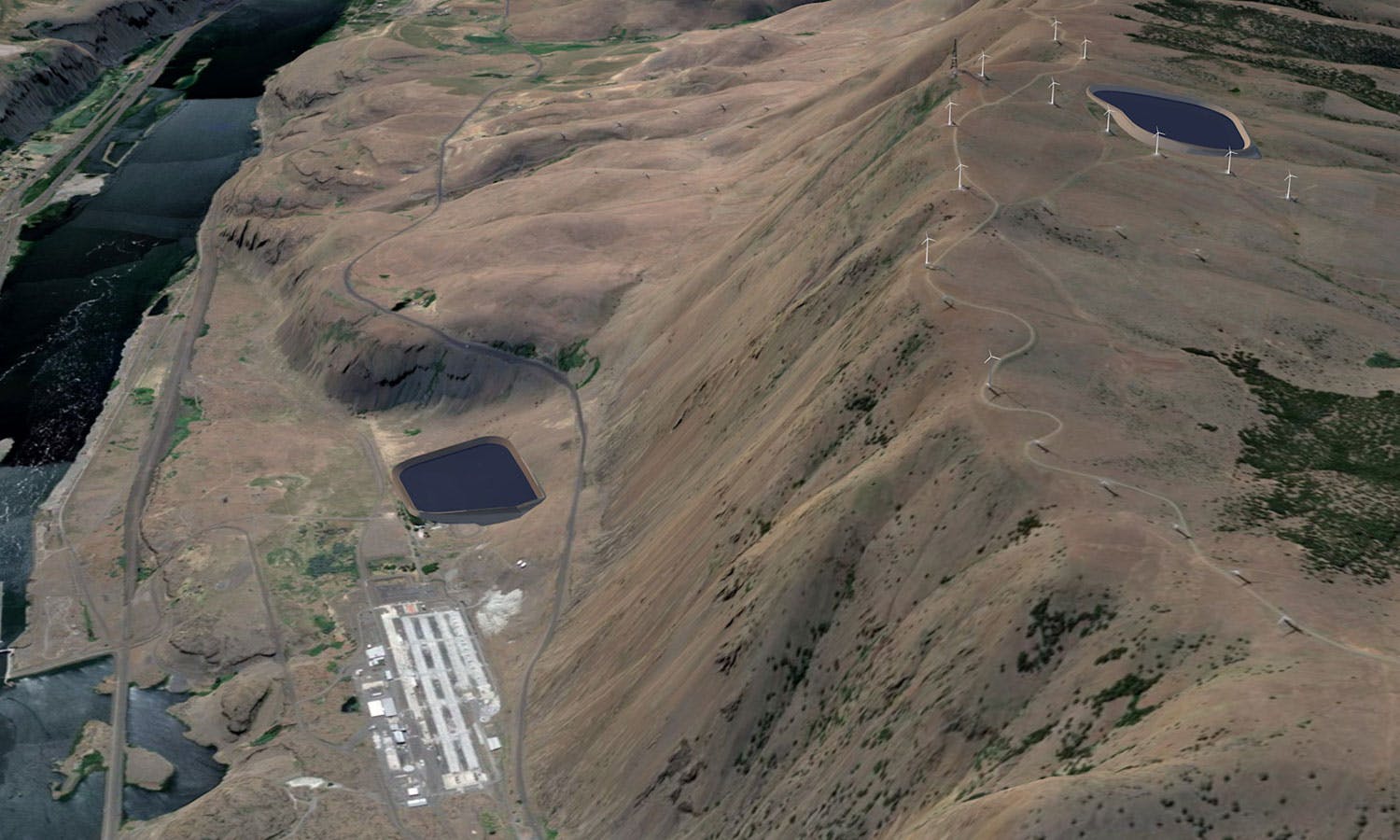
Rye Development says it expects to start construction next year and have the project in operation in 2032. A video is available on YouTube.
Because the river is a navigable waterway and a small portion of the project is located on federal land, it requires a federal license. It will be sited on 529.6 private acres that once housed a major aluminum smelter, 18.1 acres owned by the Army Corps of Engineers and administered by the federal Bonneville Power Administration as part of its transmission system, and 133.9 acres of state and other private lands.
The land housing the shuttered aluminum smelter, where the lower pond will be located, FERC notes, “is a Resource Conservation and Recovery Act (RCRA) contaminated site that is the subject of ongoing investigation and clean-up by the potentially liable parties (i.e., NSC Smelter and Lockheed Martin Corporation)” and the Washington state Department of Ecology.
According to Rye Development, Goldendale is also located near an existing wind farm, so it could use “existing roads and transmission lines. The entire project area is located within Klickitat County’s Energy Overlay Zone—a designation aimed at streamlining energy development.”
Adding to the complicated land for the project, FERC notes it will be built “within the traditional territory of the Yakama Nation, the Umatilla Tribes, the Confederated Tribes of the Warm Springs Reservation of Oregon (Warm Springs Tribes), and the Nez Perce Tribe on land ceded to the United States by the Yakama Nation.” The tribes have invoked their “rights to exercise their treaty and reserved rights on these lands, including the ability to hunt, fish, and gather resources.”
The path to a FERC hydro license is necessarily complex and time-consuming, culminating with an environmental impact statement under the 1969 National Environmental Policy Act. The commission in December 2020 accepted the project’s application for filing and setting a mid-February 2021 deadline for “motions to intervene and protests.”
Among those filing, earning a place in the review line: Washington Department of Fish and Wildlife, Bonneville Power Administration, the U.S. Commerce Department’s National Marine Fisheries Service, U.S. Department of the Interior, Washington Department of Ecology, Oregon Department of Fish and Wildlife, California’s Turlock Irrigation District, American Rivers, Friends of the White Salmon River, Columbia Riverkeeper, Sierra Club, and Klickitat County.
In March 2022, FERC said the application was ready for environmental analysis, setting May as the deadline for filing “comments, recommendations, terms and conditions, and prescriptions.” FERC got comments from Washington DFW; Interior; NMFS; American Rivers; Turlock; the Confederated Tribes and Bands of the Yakama Nation; Klickitat County Public Works; jointly, Columbia Riverkeeper, Sierra Club, and Washington Environmental Council; U.S. Environmental Protection Agency (EPA); and NSC Smelter. Rye Development filed reply comments.
FERC issued a draft EIS in March 2023 and published a notice in April, setting a June deadline for comments. The usual suspects complied. The commission issued a final EIS in July 2024 addressing “all substantive environmental comments received on the draft EIS.”
A new round of comments flowed into the commission, including new comments “regarding Commission staff’s analysis in the final EIS of the impacts of the project on communities with environmental justice concerns.” Those comments, the commission noted, were “based on Executive Orders 12898 and 13985, which were revoked in January 2025,” the advent of the Trump administration. In last week’s order, the commission dryly noted that it “continues to fulfill its NEPA responsibilities by considering impacts to all potentially affected communities.”
When the project is readying to go online, it will buy 7,640 acre-feet of Columbia River water from the Klickitat Public Utility District and 360 acre-feet annually to make up for evaporation and seepage. Goldendale says the initial fill will take seven months.