


Since 2022, the EU has been running four energy transitions simultaneously: phasing out Russian oil, gas and coal, scaling renewables, and building hydrogen infrastructure from near-zero. Here is where each one actually stands.
For decades, European energy policy was built on a comfortable assumption: that stability and affordability could be secured through interdependence. Import from wherever it's cheapest. Diversify suppliers. Trust the market.
The war in Ukraine ended that assumption decisively. Since 2022, Europe has been engaged in the most consequential energy transformation in its postwar history. Understanding where we actually stand requires setting aside both the optimism of policy documents and the pessimism of headlines.
OIL - The quiet success story — with one unfinished chapter
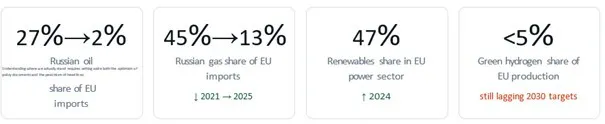
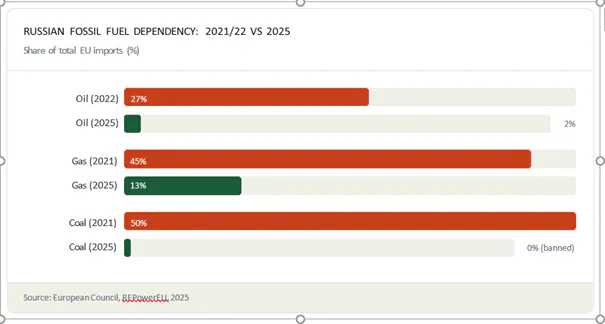
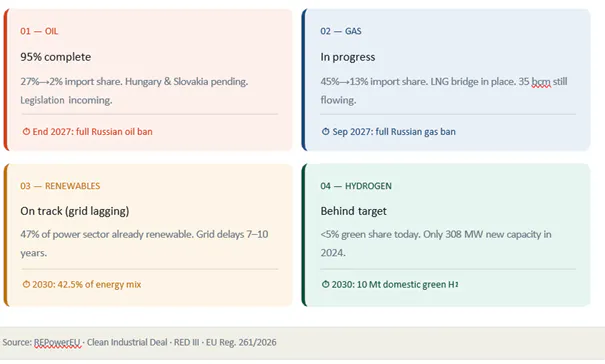
Of the three fossil fuels, oil has seen the most dramatic reduction in Russian dependency — and the least public attention for it. At the start of 2022, Russian oil accounted for 27% of EU imports. By 2025, that figure had fallen to below 3%, driven by the seaborne import ban on Russian crude introduced in late 2022. Coal imports from Russia, once at 50% of EU supply, have been banned entirely.
One chapter remains open. Hungary and Slovakia continue to depend on Russian pipeline oil, exempted due to their landlocked geography. The Commission has committed to full Russian oil ban legislation by end 2027.
The oil lesson for European energy policy: market structure matters. The fungibility of global oil markets gave Europe more options, faster, than gas or hydrogen infrastructure ever could. That flexibility is an asset — but it is not the same as strategic autonomy.
2. GAS - Progress made, risks remain
In January 2026, the EU formally adopted legislation for a permanent, stepwise ban — LNG by end 2026, pipeline gas by autumn 2027. But the EU has traded one concentrated dependency for a set of new dependencies, with all the geopolitical exposure that implies. Some 35 billion cubic metres of Russian gas still made their way into the EU system in 2024, worth an estimated €10 billion.
"Europe is more resilient than it was in 2021 — but resilience built on LNG imports is not the same as energy independence. It is a bridge. And bridges need to have a destination."
3. Renewables - The foundation is being laid, faster than expected
Solar capacity reached 406 GW in 2025. Wind produced more electricity than gas as early as 2023. Renewable energy reached 25% of gross final energy consumption in 2024, with the power sector achieving nearly 47% renewable penetration. These numbers would have seemed implausible a decade ago.
And yet the bottleneck has shifted. The technology is not the constraint. The grid is. Connection delays now run 7–10 years in some member states. Permitting processes remain fragmented and slow. The EU's Electrification Act and Grid Package will be among the most consequential pieces of legislation of this decade.
4. HYDROGEN - The ambition gap is real, and it matters
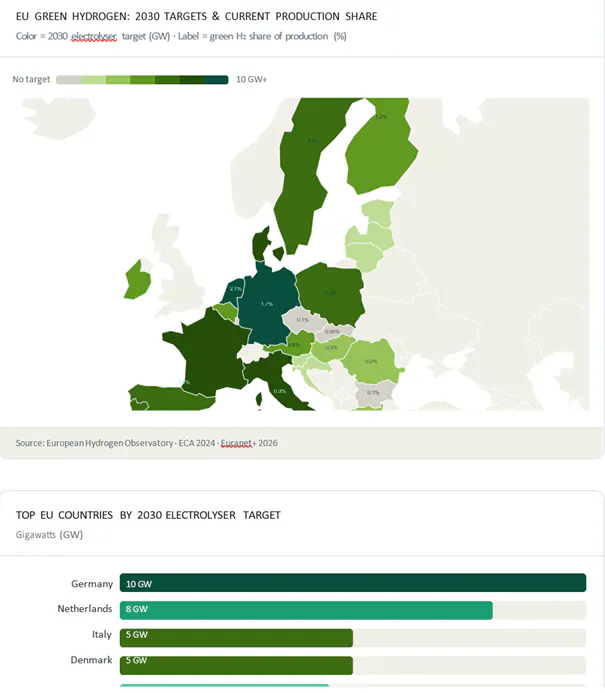
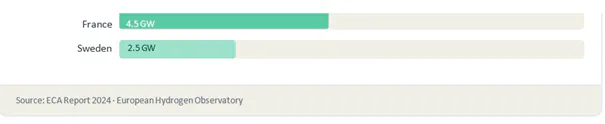
REPowerEU set a target of producing 10 million tonnes of green hydrogen domestically and importing another 10 million tonnes by 2030. Green hydrogen still accounts for less than 5% of EU production capacity. Only 308 MW of new electrolyser capacity was installed across the entire EU in 2024. Germany — the bloc's most ambitious member state — had just 0.19 million tonnes of green hydrogen production capacity last year.
The geographical distribution is equally uneven. A cluster of central and eastern European member states have yet to publish binding 2030 targets. By October 2025, only Denmark and Ireland had fully transposed RED III hydrogen provisions into national law.
6. SYSTEM - The integration challenge nobody talks about enough
The most underappreciated dimension of EU energy security is not any single technology or fuel. It is the system integration question: how do oil markets, gas networks, electricity grids, and hydrogen infrastructure interact, reinforce each other, and where possible share assets?
Research published in Nature Communications in early 2026 found that wind and solar expansion combined with green hydrogen could theoretically displace up to 61% and 37% of EU gas consumption respectively. The actual outcome depends entirely on whether the policy, regulatory, and infrastructure environment is coherent enough to let these systems work together.
6. CONCLUSIONS - What this means for policy and investment
Four conclusions follow from this picture.
Oil: The phase-out of Russian oil is largely complete, but the final 2–3% represents a political test as much as a supply challenge. The Commission's forthcoming oil ban legislation will determine whether the EU closes this chapter cleanly or leaves it to drag on.
Gas: The LNG bridge is necessary but not permanent. The EU needs robust supplier diversification, LNG market monitoring, and a credible timeline to reduce overall gas demand — not just switch its source.
Renewables: The next wave of policy energy must flow toward grid infrastructure and permitting reform. Unglamorous work — but it will determine whether the clean energy build-out actually lands at scale.
Hydrogen: Credibility as an energy security asset depends on closing the ambition-execution gap in the next 24 months. Consistent implementation across all 27 member states and a supply chain that scales faster than project cancellation rates — that is the ask.
Europe has demonstrated, since 2022, that it can move faster on energy transformation than most analysts believed possible. The question now is not whether the direction is right. It is whether the institutional coherence exists to sustain that speed across an increasingly complex, interdependent system — covering every fuel, every sector, and every member state.
That is the work of this decade. And it is not yet done.
At the end, I would like to raise two questions for discussion.
We have the mandates, the financing, and the technology. If Europe still falls short of its 2030 energy targets, what will be the real reason - political fragmentation, infrastructure lag, or market failure?
The hydrogen map tells a stark story: western Europe is racing ahead while central and eastern member states are still without binding targets. Is a two-speed EU energy transition a manageable transition problem — or a structural fracture in the making?