


When we look at the weather from one day to the next, it often seems that rain, droughts, or storms are purely local phenomena. Yet some events occurring thousands of kilometers away can influence the climate of almost the entire planet. One of the most important is called ENSO (El Niño–Southern Oscillation), a natural phenomenon that originates in the tropical Pacific Ocean and alters temperatures, rainfall, and winds across many regions of the world.
To understand ENSO, we must first understand the role of the trade winds.
Trade winds are steady winds that blow near the equator. In the Pacific Ocean, they generally blow from east to west, that is, from the coasts of South America toward Asia and Australia. These winds can be imagined as a giant hand constantly pushing the ocean’s surface waters. Because this pushing continues throughout the year, a large volume of warm water accumulates in the western Pacific, near Indonesia and Australia.
A simple example helps explain this mechanism. Imagine a bathtub filled with water. If you continuously blow across the surface in one direction, the water will gradually pile up on the opposite side. This is exactly what the trade winds do in the Pacific: the warmest waters become concentrated in the west, while colder waters rise from the depths near Peru and Ecuador.
Under normal conditions, the trade winds blow steadily from east to west along the equator in the Pacific Ocean. By continuously pushing surface waters, they cause warm water to accumulate in the western Pacific, particularly around Indonesia, Papua New Guinea, and northern Australia. In this region, sea surface temperatures often exceed 28°C, forming what climatologists call the Western Pacific Warm Pool.
This very warm water heats the air directly above it. The warm air becomes lighter and rises into the atmosphere, triggering intense evaporation. The resulting water vapor condenses at higher altitudes, forming thick clouds and tropical storms. This is why the western Pacific is an extremely humid region that receives abundant rainfall throughout the year. The lush tropical forests of Indonesia and Papua New Guinea exist largely because of this plentiful moisture.
In contrast, near the coasts of Peru and Ecuador in the eastern Pacific, the trade winds push surface waters westward. To replace this displaced water, deep ocean waters rise to the surface—a process known as upwelling. These waters come from the ocean depths and are much colder than tropical surface waters. They cool the air above them, limit evaporation, and reduce cloud formation. As a result, the atmosphere is more stable and drier, which helps explain why some coastal regions of Peru and northern Chile are among the driest places on Earth.
This system can be imagined as a gigantic loop. In the western Pacific, warm, moist air rises; at high altitude, it moves eastward; then it descends over the cooler waters of the eastern Pacific before returning westward under the influence of the trade winds. This atmospheric circulation, known as the Walker Circulation (Figure below), is closely linked to the distribution of ocean temperatures.
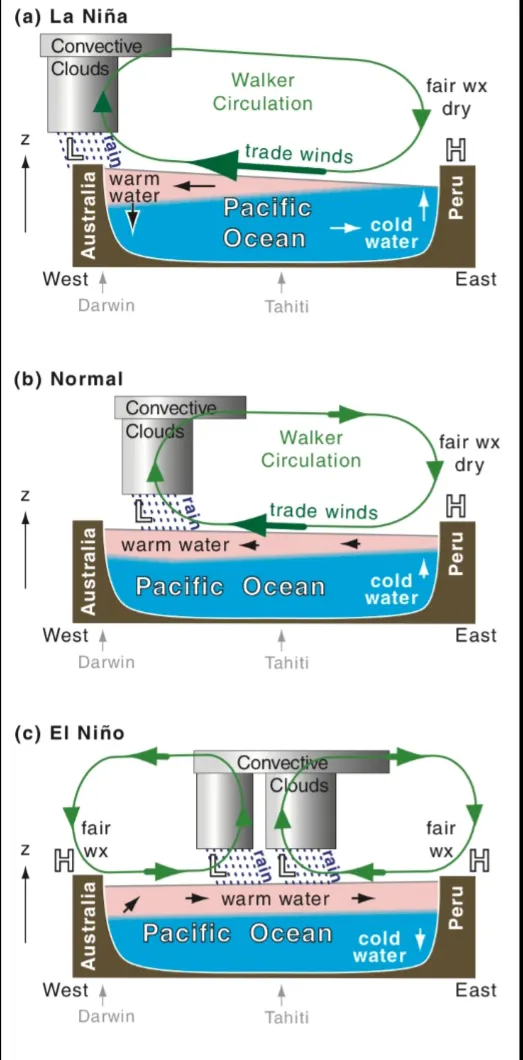
Thus, under normal conditions (Figure above, panel (b)), the ocean and atmosphere function together in a balanced state: the trade winds keep warm waters in the west, cold-water upwelling persists in the east, heavy rainfall remains concentrated over Indonesia and Australia, and the eastern Pacific stays relatively cool and dry. This balance represents the normal state of the tropical climate system. It is precisely when this balance is disturbed---through a weakening or strengthening of the trade winds---that El Niño and La Niña develop.
When the trade winds weaken significantly, they push less water westward, and warm water begins moving back toward the central and eastern Pacific. This marks the beginning of a phenomenon called El Niño (Figure above, panel (c)).
During an El Niño event, the warm waters that are normally concentrated near Asia shift toward the coasts of South America. This movement completely alters the distribution of rainfall and cloud cover.
Consider a concrete example. Under normal conditions, Indonesia receives abundant rainfall because warm waters promote evaporation and cloud formation. During El Niño, part of this heat leaves the region. Rainfall then declines sharply, and some areas may experience severe droughts. Forests become more vulnerable to wildfires, and water supplies diminish.
At the same time, Peru and Ecuador may receive much more rainfall than usual. Floods, landslides, and damage to infrastructure can occur. Thus, a simple change in the temperature of the Pacific Ocean can have enormous economic and human consequences.
El Niño also affects fisheries. Because warm waters suppress the normal upwelling of nutrient-rich deep waters, fish have less food available. Some species migrate elsewhere, while others experience population declines. As a result, fishermen may catch far fewer fish than under normal conditions.
Therefore, El Niño is not merely an increase in ocean temperature. By disrupting the upwelling of nutrient-rich waters, it alters the very foundation of the marine ecosystem, triggering cascading effects on fish, marine mammals, and the human populations that depend on fishing.
The opposite phenomenon is known as La Niña (Figure above, panel (a)).
During La Niña, the trade winds become stronger than usual. They push even more warm water toward the western Pacific. As a result, cold-water upwelling near South America intensifies, and sea surface temperatures in that region become cooler than normal.
The climatic effects are often the reverse of those associated with El Niño. Australia and Indonesia generally receive more rainfall, sometimes increasing flood risks. Certain regions of South America may become drier. In parts of North America, winters can be colder and snowier.
To better understand the difference between El Niño and La Niña, imagine a conveyor belt carrying warm water across the Pacific. When the belt slows down, warm water shifts back toward the east: this is El Niño. When it speeds up, warm water is pushed even farther west: this is La Niña.
The term Southern Oscillation, which completes the name ENSO, refers to the atmospheric pressure variations associated with these oceanic changes. Scientists discovered that when ocean temperatures change, atmospheric pressure and winds change as well. The ocean and atmosphere therefore operate as two parts of a single system. This is why the phenomenon is called El Niño–Southern Oscillation (ENSO).
These events do not occur every year. They generally happen every two to seven years and can last several months, sometimes more than a year. Between episodes, the Pacific is often in a so-called neutral state, where temperatures and winds remain close to normal.
Finally, it is important to distinguish ENSO from global warming. ENSO is a natural phenomenon that has existed for thousands of years. Global warming, by contrast, refers to the gradual increase in Earth’s average temperature, driven primarily by human activities. However, when a strong El Niño occurs, it can temporarily make the planet even warmer. Conversely, a strong La Niña can temporarily moderate this warming. ENSO therefore acts as a natural fluctuation superimposed on the broader trend of global warming.
In summary, ENSO is a vast mechanism of interaction between the Pacific Ocean and the atmosphere. The trade winds play a central role by moving warm waters across the Pacific. When these winds weaken, El Niño develops; when they strengthen, La Niña emerges. Although these changes occur in a specific region of the globe, they can influence rainfall, droughts, harvests, water resources, and ecosystems across much of the world.
The United Nations, through the World Meteorological Organization (WMO), recently issued an important warning about ENSO (El Niño–La Niña), explaining that the Pacific is entering an El Niño phase that could significantly disrupt the global climate. The impacts could be more dangerous than usual because they are occurring in a world already warmed by climate change. Specifically, when El Niño develops, Pacific waters become warmer than normal, altering winds, rainfall patterns, and temperatures around the globe. This can increase the likelihood of droughts, floods, heatwaves, and wildfires occurring simultaneously in different regions of the world. This phenomenon directly affects many aspects of daily life: agriculture (too little or too much rainfall for crops), drinking water supplies (shortages or flooding), energy production (greater demand or reduced hydropower generation), and even food prices.
This highlights the importance of early warning systems: By understanding in advance that El Niño is forming, countries can prepare more effectively (for example, by storing water, protecting crops, and anticipating natural disasters).
ENSO is much more than a simple oceanic phenomenon localized in the tropical Pacific. In reality, ENSO acts as a global climate regulator. When Pacific Ocean temperatures change significantly during an El Niño or La Niña episode, this alters the exchanges of heat between the ocean and the atmosphere. These disturbances then propagate through the major atmospheric circulation patterns that connect different regions of the globe. As a result, an abnormal warming of Pacific waters can shift rainfall zones, modify storm tracks, influence Asian monsoons, increase the risk of drought in southern Africa, cause flooding in South America, intensify heat waves in certain regions, and even affect winter temperatures in North America or Europe.
It is not that El Niño directly controls the weather of every country, but rather that it modifies certain fundamental parameters of the global climate system. Each region then responds differently according to its geographical location and the other climatic mechanisms that influence it.
For example, let us imagine that a strong El Niño develops in the Pacific:
- In Indonesia and Australia, rainfall may decrease significantly, promoting droughts and forest fires.
- In Peru and Ecuador, rainfall may become excessive, causing floods and landslides.
For Morocco, ENSO's influence is much less direct than in Pacific countries, but it can nevertheless be felt through a complex chain of atmospheric mechanisms. During an El Niño episode, the abnormal warming of Pacific waters alters the regions where warm air rises into the tropical atmosphere. This change subsequently disrupts global atmospheric circulation. These disturbances can ultimately influence the configuration of weather systems over the North Atlantic and the western Mediterranean, two regions that play a crucial role in Morocco's climate. In practical terms, Morocco depends heavily on Atlantic winter depressions to receive most of its annual precipitation. If disturbances associated with El Niño contribute to shifting these depressions farther north toward Europe or weaken their passage across North Africa, some Moroccan regions may receive less rainfall than normal. This does not happen systematically, but the probability of a precipitation-deficient winter may increase during certain El Niño episodes.
A decrease in winter precipitation has several cascading consequences. Dams, which constitute the country's main water reserves, receive less inflow from rivers and runoff. Groundwater aquifers are replenished less effectively. Agricultural soils retain less moisture, directly affecting so-called rain-fed crops, that is, crops that depend mainly on natural rainfall rather than irrigation. This is particularly true for wheat, barley, many legumes, and grazing lands used for livestock farming. When rainfall is insufficient, agricultural yields often decline, production costs increase, and livestock breeders may face shortages of fodder for their herds.
Furthermore, an El Niño episode tends to slightly increase the global average temperature. When this global increase is added to the effects of climate change, some regions of Morocco may experience warmer-than-normal periods. Higher temperatures increase the evaporation of water from soils, reservoirs, and vegetation. Thus, even if the decrease in precipitation is moderate, available water resources may decline further because of increased evaporation. This combination of insufficient rainfall and higher temperatures favors drought conditions.
However, it is important to emphasize that the relationship between ENSO and the Moroccan climate remains statistical rather than deterministic. An El Niño does not automatically cause drought in Morocco, just as a La Niña does not guarantee a rainy year. Other climatic factors often exert a more direct influence on the country, particularly the North Atlantic Oscillation (NAO), Atlantic sea surface temperatures, Mediterranean circulation patterns, and regional weather conditions. ENSO should therefore be viewed as an additional factor that can increase or decrease certain climatic probabilities, rather than as the sole cause of droughts or heavy rainfall observed in Morocco.