


By Kennedy Maize
The giant PJM Interconnection has been inundated by data centers — some real, some probably not — seeking to connect their load to the regional transmission organization’s high-voltage transmission grid. PJM’s independent market monitor — Monitoring Analytics — reported on January 5 that PJM’s 2027-2028 capacity auction for electricity supply, held in early December, was the first ever “to clear less capacity than the target reliability requirement.”
According to the report, “The basic conclusion of this analysis is that data center load growth is the primary reason for recent and expected capacity market conditions, including total forecast load growth, the tight supply and demand balance, the significant shortfall in cleared capacity, and high prices.”
Monitoring Analytics said, “It is misleading to assert that the capacity market results are simply just a reflection of supply and demand. The current conditions are not the result of organic load growth. The current conditions in the capacity market are almost entirely the result of large load additions from data centers, both actual historical and forecast.”
The analysis warned that data center load impacts are “unique and unprecedented and uncertain and require a different approach than simply asserting that it is just supply and demand. The extreme uncertainty in the load forecasts based on uncertainty about the addition of large data center loads is also unique and unprecedented and raises questions about the meaning of clearing a capacity auction based on those forecasts.”
Electricity costs across the country have been soaring, driving affordability anxiety that threatens Republicans in this year’s national elections. Data center cost shifting to retail customers is a contentious phenomenon, as a study last year by the Union of Concerned Scientists and regulatory proceedings in Illinois revealed.
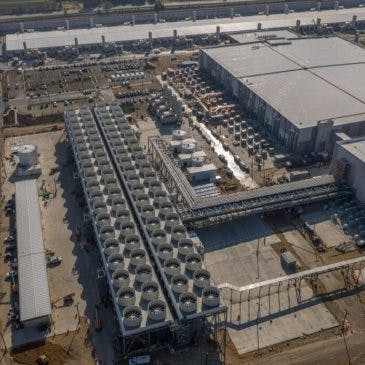
The Associated Press reported earlier this year (Jan. 3), “Tech companies and developers looking to plunge billions of dollars into ever-bigger data centers to power artificial intelligence and cloud computing are increasingly losing fights in communities where people don’t want to live next to them, or even near them.”
Virginia has been head-over-heels for data centers. Loudoun County in the northern suburbs of Washington is colloquially known as “data center alley.” In Frederick County, Va., directly north of Loudoun County, and Frederick County, Md., north of D.C., proposed data centers have become a source of heated political controversy. Growing data center opposition in Maryland features a rift between local elected officials, mostly Democrats, and the Democratic governor.
A one-day December session of the Maryland General Assembly overrode Gov. Wes Moore’s veto of a bill calling for a study of the impact of data centers. The Department of the Environment, the Maryland Energy Administration, and the University of Maryland School of Business will produce the study.
Data centers are also having an impact on tax revenues in many states. According to the online trade publication Data Center Dynamics, 24 states have tax subsidies designed to attract data centers, ranging from property tax abatements to investment credits to sales tax reductions or elimination. The publication reported, that Virginia “missed more than $1.6 billion in tax revenue in the 2025 fiscal year (FY) due to data center tax exemptions.” According to Virginia’s 2025 “Annual Comprehensive Financial Report”, the sales tax lost revenue increased by 118% over 2024.
The growing data center backlash comes after the Trump administration in November singled out AI as a national priority and race with China, the “Genesis Mission,” codified in Executive Order 14303. The order hyperbolicly proclaims, “In this pivotal moment, the challenges we face require a historic national effort, comparable in urgency and ambition to the Manhattan Project that was instrumental to our victory in World War II and was a critical basis for the foundation of the Department of Energy (DOE) and its national laboratories.”
Sensing a growing backlash against AI, on December 11 Trump issued another executive order (EO 14365, Ensuring a National Policy Framework for Artificial Intelligence), a ukase forbidding states from enacting state AI regulations. The order asserts that to win the AI competition, “United States AI companies must be free to innovate without cumbersome regulation. But excessive state regulation thwarts this imperative.”
It’s not clear that the order has teeth. Florida Republican Governor Ron DeSantis days after the Trump order commented that “an executive order can’t block states. You can preempt states under Article 1 powers through congressional legislation on certain issues, but you can’t do it through executive order.” On January 5, Florida state Rep. Rep. Philip “Griff” Griffitts, Jr., R-Panama City Beach, introduced House Bill 1007, “Hyperscale Data Centers,” with a long menu of state and local regulations on data centers.
In October, DOE proposed that the Federal Energy Regulatory Commission give data centers a fast track to grid connections, bypassing state and regional institutions. FERC issued DOE’s proposal, beginning the regulatory process. DOE told FERC to act by the end of April. That’s unlikely.
The DOE proposal has drawn heavy fire from state regulators, past FERC commissioners of both parties, and regional transmission organizations. PJM’s market monitor commented, “PJM should not permit the interconnection of large new data center loads if they cannot be served reliably.”
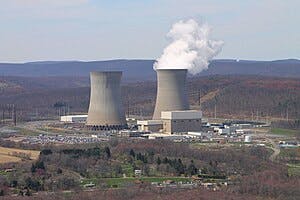
At the end of the year, FERC took up a long-standing issue dating to 2024, coming up with rules for how data centers can co-locate with existing generation and connect to the PJM grid. The commission modified a proposal by Talen Energy to host a Microsoft data center at Talen’s Susquehanna nuclear plant in Pennsylvania.
FERC, with Republicans now in control, likely will face issues of AI and the transmission grid, a central challenge of where artificial intelligence will fit into the U.S. economy. At FERC’s December meeting, Laura Swett, FERC’s new chairman, and new commissioner David LaCerte, Trump appointees, said supporting AI was high on their policy agendas.
Ideas on reconciling data centers’ appetite for power and the aging transmission grid are emerging. The fear is that heavy data center loads can not only shift costs to retail customers, the “affordability” issue in spades, but may exacerbate stressed services such as weather emergencies, contributing to possible blackouts.
One possible solution is a system where the data center agrees to shed load in those circumstances. An industry lobbying group, the Data Center Coalition, pans the idea. In a Wall Street Journal article, the group argued that data centers not only run AI models but serve “other sectors including healthcare and financial services” and need to run continuously.
Then there is the “BYOG” approach. The National Law Journal reported in November, “Governors from Pennsylvania, New Jersey, Maryland and Virginia have proposed a ‘Bring Your Own Generation (BYOG)’ model to fast-track data center approvals and ease pressure on the grid. The proposal calls for developers to supply their own generation in exchange for accelerated interconnection and facility permitting.”
How about getting data centers off the grid? Houston based Advocates for Consumer Regulated Electricity — wants data center developers to eschew the conventional model of electricity production and distributtion. Last August, New Hampshire passed House Bill 672, allowing for “off-grid electricity providers” exempt from state public utility regulation.