Below are the results from the CPUC's December 4, 2025 voting meeting. Additional coverage is available here.
Undergrounding of Electrical Equipment
Resolution SPD-37 updates the CPUC’s Senate Bill 884 undergrounding program by expanding and tightening review, cost-justification, and audit requirements. These requirements were established under Resolution SPD-15 and aligned with Energy Safety’s 2025 guidelines for 10-year Electric Undergrounding Plans.
The resolution standardizes:
Project data submissions;
Revenue-requirement models; and
Decision-making metrics.
The resolution also requires utilities to justify work outside high-fire-threat areas and limits eligibility to projects with benefit-cost ratios of at least 1 that meet defined risk thresholds. Additionally, Draft Resolution SPD-37 conditions cost recovery on:
Outperforming alternative mitigations;
Adhering to approved cost and benefit limits; and
Meeting Energy Safety performance standards...
...while introducing annual Electric Undergrounding Plan audits and a cumulative memorandum-account cap to guard against uncontrolled cost transfers.
Commissioner Remarks from the Dais
Commissioner John Reynolds added the following remarks prior to the resolution carrying 5-0.
...the hard truth is that the only way out is through. There are investments we need to make. There is physical risk reduction today to reduce the risks of catastrophic costs tomorrow. Delay ultimately doesn't save money, it just shifts the risk forward. Because the stakes are so high, we spent years working on how to mitigate wildfire risk strategically and cost effectively. Many proceedings tackle these issues, including General Rate Cases, wildfire and catastrophic event applications, and this resolution. And the Risk-Based Decision-Making rulemaking (or RDF) also set new rules for how utilities measure, report and plan risk mitigation. I was honored to lead that proceeding, and that we've come to develop this risk-based policy. In building that framework, we've been guided by a fundamental principle: utilities need to make smart decisions with customer dollars to mitigate risk. Ultimately, it's the utility that has to operationalize the policy and funding levels we set.
...some may wonder: 'Why add another step to an already compressed timeline?' and I'll be direct about the reasoning – the costs here are enormous. We are potentially going to be evaluating 10 or 11 figures in capital costs with average monthly customer bill impacts estimated as high as $25.
With stakes that high for a single capital program, we need to get the methodology right. There are multiple methods for reducing wildfire risk, and no party thinks we should underground the entire electric grid. Yet we need further refinement of our funding standard to evaluate which projects justify ratepayer funding, the policy goals haven't changed. We want utilities to make smart, cost effective decisions that genuinely reduce wildfire risk, but the specific metrics and thresholds that will govern billions of dollars in spending deserved for our development with full stakeholder input.
Commissioner Matt Baker offered the following remarks.
We know that undergrounding power lines significantly reduces the risk of catastrophic wildfire conditions and often with clear reliability benefits. However, undergrounding can cost millions of dollars per mile, and in our meetings here and in other forums, we hear directly from the public how we've really got to – not only reduce bills – but also invest in safety measures and increase reliability.
...we need to answer critical questions like: How much should we be spending on safety and undergrounding? What is the optimal mix of risk reduction and undergrounding and the alternatives? And finally, can we achieve any unit cost reductions, either through economies of scale or through new technologies?
...we really want to achieve the highest risk reduction and reliability improvement for the lowest cost over the 10 years of the program, and we expect this process to produce a portfolio of undergrounding projects that cost-effectively mitigates the most risk and gets us the best bang for the buck.
But I have to say...undergrounding and risk reduction efforts that we are funding here will never be able to bring us to zero, so we're always going to have some measure of risk.
INSTANT ANALYSIS: Resolution SPD-37 is a pivot toward risk-based discipline in a program often portrayed as a race against fire seasons. Commissioners point to the sheer scale of capital at stake and the need to distinguish undergrounding from cheaper mitigation alternatives. Their main message: while undergrounding is powerful, it's not automatically cost-effective, and ratepayers cannot be asked to shoulder 10- or 11-figure investments without a defensible methodology. Consequently, Resolution SPD-37 prioritizes methodological certainty over deployment speed.
Ivanpah Controversy Continues
Resolution E-5429 rejects (without prejudice) PG&E’s proposal to buy out and terminate its Power Purchase Agreements with Solar Partners II and VIII (the owners of the Ivanpah solar-thermal facility). This rejection comes even as PG&E and the U.S. Department of Energy argue that ending the contracts would save ratepayers money, accelerate repayment of a remaining $1.6 billion federally backed loan, and potentially allow redevelopment of the site with newer technology.
Resolution E-5429 finds that the contracts were procured fairly, remain aligned with PG&E’s renewable needs, and – given recent federal policy shifts, permitting uncertainty, and rising statewide load growth — cannot be terminated without risking reliability or stranding more than $333 million in ratepayer-funded transmission upgrades.
The rejection leaves the door open for PG&E to return with a future termination plan tied to a concrete replacement resource; meanwhile, if Ivanpah defaults, PG&E may still terminate without paying compensation.
INSTANT ANALYSIS: This resolution effectively concedes that Ivanpah isn’t being preserved because it performs well, but because regulators don't think the state can afford to lose politically permissible megawatts (or risk stranding federally guaranteed debt).
Diablo Canyon 2026 Revenue Requirement
This decision approves PG&E’s 2026 revenue requirement to support the continued operation of Diablo Canyon under Senate Bill 846, authorizing $382.233 million in net costs after accounting for market revenues, with those costs allocated among PG&E, SCE, and SDG&E customers through a non-bypassable charge.
The decision affirms PG&E’s forecasts for operations and maintenance, nuclear fuel, statutory fees, and Resource Adequacy substitution costs, concluding they are reasonable and consistent with past Commission guidance.
A major point of dispute was whether PG&E had improperly shifted transition or preparatory costs (meant to be covered by state or federal funding) into extended-operations O&M. After reviewing challenges by multiple parties, the Commission ultimately upholds PG&E’s time-based framework for distinguishing transition costs from extended-operations costs, while directing PG&E to provide more transparent disclosures in future filings whenever expenditures previously identified as transition or license-renewal work appear in extended-operations requests.
The decision adopts PG&E’s proposal to escalate the statutory Fixed Management Fee using the Consumer Price Index rather than the capital-cost escalator the CPUC approved last year, finding CPI-U to be more stable, transparent, and appropriate for a statutory financial payment rather than a capital expenditure.
The decision also approves PG&E’s 2026 Volumetric Performance Fees, its $75 million request for liquidated-damages funding, and its proposed updates to Diablo Canyon’s balancing-account structure.
Below are some commissioner remarks from the dais.
Commissioner John Reynolds: "I appreciate that this decision creates a pathway for using the Volumetric Performance Fees from Diablo in 2026 and I continue to see value in reviewing more detailed plans for the VPFs in future years to ensure there's no shareholder benefit. This decision strikes an appropriate balance between these policy goals. And ultimately...the tracking of these costs is going to continue to be very important to ensure that there's no double recovery at a later date. Tracking costs for incrementality can be challenging in forecast ratemaking regulatory structures where management typically has discretion to move funding around. Regarding the Fixed Management Fee escalation – it's definitely a complicated process that can be addressed using multiple methods, and I recognize the benefit here of moving to a consistent methodology using the more predictable CPI view in its proceeding and future applications under this under the provision of law."
President Alice Reynolds: "I did want to just take a moment to address the escalation factor for the Fixed Management Fees. It was something that I had questions about in oral argument, and I did need to go back and review the statute and speak with staff. And I think for me, it was really helpful to look at the actual numbers and understand the true up process. And once I reviewed those, I understood that the decision actually is as required by statute. It's not double-counting, and it takes the annual escalation from 2022 using the new methodology and recognizes the fact that it's trued up each year to actuals."
Commissioner Darcie Houck also provided the following remarks.
...I have had mixed feelings about where to go with this case, and to the extent that we approve the proposed decision, I would ask that, as we move forward into the next annual review, that we take a hard look at the process that was applied here and consider ways that could streamline the process and ensure that there's clarity as to the requirements for PG&E so that it's understood by all parties what they need to provide for each application. And clarity for the other parties to understand the limits on what will (or will not) be considered in making future determinations.
...There's parts of this decision that are not necessarily where I would have landed. That said, I do not believe there is only one right potential outcome that could be reached here, and the outcome here is not inconsistent with SB 846, or the process that was previously adopted by the Commission for review of these annual applications.
...with that, I have mixed feelings regarding the proposed decision, but I do believe it is in compliance with the law in our process...but I will be able to vote in favor of it.
INSTANT ANALYSIS: The Diablo Canyon 2026 decision reflects a Commission that is confident in its statutory mandate under SB 846 but increasingly aware that the annual review framework it created needs refinement.
By approving PG&E’s $382 million revenue requirement, adopting CPI-U as the ongoing escalator for the Fixed Management Fee, and accepting PG&E’s time-based distinction between transition and extended-operations costs, the Commission effectively stabilizes the core mechanics of Diablo Canyon cost recovery while also tightening expectations for transparency and incrementality.
Commissioner John Reynolds emphasized the need for strict tracking of Volumetric Performance Fees and warned against double recovery, while President Reynolds’ remarks revealed that the Commission’s comfort with the CPI method crystallized only after a closer look at true-up mechanics and statutory language.
Commissioner Houck, despite voting yes, registered notable procedural discomfort, and called for clearer filing requirements, better-defined limits on party arguments, and a more disciplined framework going forward.
In sum, Diablo Canyon's cost-recovery regime is settling into place, but the Commission is preparing to recalibrate the process in future cycles.
Sunset of the Ratepayer-Funded Portion of the Self-Generation Incentive Program
This decision establishes the full framework for shutting down the ratepayer-funded portion of the Self-Generation Incentive Program (SGIP) while implementing/defining the closeout process for the Greenhouse Gas Reduction Fund (GGRF)–supported SGIP.
The decision sets deadlines for new applications, fixes the point at which funds are considered allocated, and creates a schedule for returning unallocated and canceled-project funds back to ratepayers through existing utility true-up mechanisms.
The decision restructures administrative budgets; shortens the Performance-Based Incentive period for future non-residential projects; and allows additional extensions for non-residential equity projects facing external delays, provided they meet progress and demand-response participation conditions.
The decision also grants low-income Residential Solar and Storage Equity customers relief from the current demand-response enrollment requirement, given uneven statewide access to qualified Demand Response programs.
Last, the decision outlines pathways for updating the SGIP Handbook via advice letters, adopts a consolidated measurement-and-evaluation plan, and sets final timelines for the GGRF program (including the June 30, 2028 closure to new applications and 2033 return of remaining funds) while ensuring project compliance through the end of each system’s permanency period.
INSTANT ANALYSIS: This decision finalizes the glidepath toward the SGIP wind-down while carving out room for equity installations to conclude without being crushed by tariff redesigns. The Commissioners broadly agree that forcing tribal, school, and local-government equity projects onto the Net Billing Tariff would jeopardize their viability, even as some opine that both Net Energy Metering and NBT create cross-subsidies borne by non-participating customers. Retaining the Demand Response requirement while removing the Net Billing Tariff condition represents a negotiated compromise: securing grid benefits without destabilizing project economics.
SDG&E Procurement Costs
This decision approves SDG&E’s 2026 electric procurement revenue requirement, sales forecast, and greenhouse-gas related forecasts, adopting an updated total revenue requirement of $824.1 million, which is a major increase from the current $122.3 million authorization. This increase is driven by higher above-market portfolio costs reflected in SDG&E's Portfolio Allocation Balancing Account (PABA) and updated market price benchmarks.
The decision authorizes SDG&E’s forecasts across its Energy Resource Recovery Account (ERRA), PABA, the Competition Transition Charge, Local Generation, the Modified Cost Allocation Mechanism, Disadvantaged Communities – Green Tariff, Bioenergy Market Adjusting Tariff, Tree Mortality Non-Bypassable Charge, and greenhouse gas allowance returns. The decision also adopts updated Power Charge Indifference Adjustment rates and a 2026 electric sales forecast derived from the California Energy Commission’s 2024 demand outlook.
The decision finds SDG&E’s modeling and updates reasonable, while correcting course on one contested issue:
Because the proceeding's Joint Community Choice Aggregators were not able to fully litigate SDG&E’s late-breaking claim that banked Renewable Energy Credits may be needed for 2026 compliance, SDG&E must first use post-2018 banked RECs and must file a separate application before using any pre-2019 RECs.
The decision also fixes the treatment of 2019-banked RECs, adopts no new GTSR rate components given program closures, and directs SDG&E to file tariffs implementing the new rates effective January 1, 2026.
INSTANT ANALYSIS: The headline here is the extraordinary escalation in the PABA, a swing driven almost entirely by October's market price benchmarks. The shift turns what had been a credit position in 2025 into a major cost driver for 2026, and reshapes bundled and unbundled customer bills.
The Commission’s posture here is procedural rather than interventionist: it accepts SDG&E’s accounting and modeling across ERRA, Local Generation, GHG returns, and sales forecasting with little friction, while drawing a hard boundary around REC banking.
In short, 2026 rates will reflect a procurement cost structure dominated by benchmark volatility and legacy portfolio obligations, not operational surprises. For market participants, compliance with revised market price benchmark methodology is now normalized.
Wildfire Non-Bypassable Charge
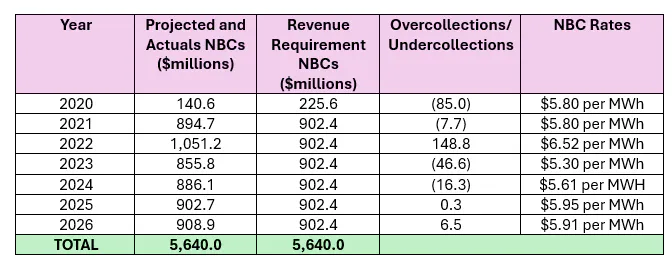
This decision sets the 2026 Wildfire Fund Non-Bypassable Charge at $0.00591/kWh, which enables collection of $908.9 million over the 2026 calendar year.
This amount covers the statutory annual revenue requirement of $902.4 million established under Assembly Bill 1054 and a seminal 2019 decision (D.19-10-056), plus a projected $6.5 million undercollection accumulated through 2025.
The decision recounts the legislative foundation of the Wildfire Fund and the Commission’s prior annual determinations of the non-bypassable charge since 2020, emphasizing that the charge must be recalculated each year to ensure the fund remains fully financed.
For 2026, the Department of Water Resources supplied updated sales forecasts, load classifications, and collection-curve modeling showing how the proposed rate would recover the needed revenue, accounting for billing lags and uncollectible amounts.
For reference, here NBC rates dating back to 2020.
INSTANT ANALYSIS: This decision offers a straightforward continuation of the Wildfire Fund financing framework, reflecting how routine the annual non-bypassable charge determination has become under AB 1054. The Commission once again accepts the Department of Water Resource’s calculations wholesale, reinforcing the de facto technocratic handoff:
Utilities supply load forecasts;
The Department of Water Resources models collections and variances; and
The CPUC ratifies the rate to keep the $902.4 million annual requirement whole.
The slight decrease from the 2025 non-bypassable charge is driven by prior-year true-ups rather than any structural change in load or cost conditions. For retail providers, this charge will continue to move annually in narrow bands based on over/undercollections, with no indication the Commission intends to revisit the methodology, exemptions, or statutory structure. The Wildfire Fund remains a fixed layer of the cost stack, insulated from broader affordability debates and treated as a mechanical annual adjustment.
Transportation Electrification Reporting
This decision revises how Transportation Electrification data is gathered and reported, streamlining numerous legacy reporting obligations into a single annual compliance report that will consolidate Senate Bill 350, Vehicle Grid Integration, electric vehicle cost/load, and other data.
The decision eliminates the annual VGI “stocktake” requirement and shifts a yearly VGI Forum to the first quarter to allow coordinated refinement of VGI reporting questions. The Commission also maintains a Technical Assistance Program (allocating $36 million over three years) and formally separates it from the paused "Funding Cycle One Behind-the-Meter" rebate program (FC1), directing utilities to develop a standalone handbook and focus Technical Assistance Program services on supporting timely customer energization.
Utilities may recover implementation costs they incurred before the FC1 pause, with cost recovery recorded in their Transportation Electrification balancing accounts. For Funding Cycle Zero medium- and heavy-duty programs, the decision removes the requirement that each charging port be tied to a vehicle purchase, finding this creates barriers for charging-as-a-service providers.
However, the Funding Cycle Zero programs will not be extended and must stop accepting new customer agreements after December 31, 2026.
INSTANT ANALYSIS: The goal of this decision is to trim and consolidate Transportation Electrification oversight by replacing years of scattered reporting with one annual compliance framework and dropping the VGI stocktake as unnecessary overhead. The Technical Assistance Program survives the FC1 pause and is repositioned as the Commission’s practical tool for easing energization bottlenecks. The Funding Cycle Zero tweak shows the CPUC aligning with modern fleet business models, but the refusal to extend FC0 deadlines signals waning patience with slow uptake.
Clean Energy Grants
Resolution M-4881 approves $581,824 in Clean Energy Access: LA County TECH (CEA-LAT) grants for three community organizations:
These grants are meant to enable outreach on heat pumps, electrification, and healthy homes in Los Angeles County. Funded by Assembly Bill 157 through the Aliso Canyon Recovery Account, the program prioritizes San Fernando Valley and Aliso Canyon–impacted communities.
INSTANT ANALYSIS: Resolution M-4881 shows the CPUC doubling down on community-based outreach as its primary lever for expanding heat-pump adoption and decarbonization awareness in the Aliso Canyon/San Fernando Valley region. These grants don’t move markets directly but build the social and educational infrastructure the Commission believes is necessary for TECH participation to scale.
Delayed Action
The Commission delayed until December 18 its consideration of the following items.
ON-BILL FINANCING: A proposed decision approving with modifications a Tariff On-Bill financing pilot advanced by SCE. The PD rejects similar proposals from SDG&E, SoCalGas, and Silicon Valley Clean Energy. The Tariff On-Bill concept allows customers to install clean-energy upgrades (e.g., heat pumps and efficiency measures) with no upfront cost, paying instead through a fixed charge on their utility bill tied to the property, not the individual. President Alice Reynolds wanted additional time to review this item.
BIOMAT SUNSET: A proposed decision denying a petition for modification filed by the Bioenergy Association of California to alter a 2020 CPUC decision (D.20-08-043), which had extended the Bioenergy Market Adjusting Tariff program through December 31, 2025. Commissioner John Reynolds requested additional time to review this matter.
UNION ISLAND PIPELINE: A proposed decision denies a request of California Resources Production Corporation for a Certificate of Public Convenience and Necessity to operate the 35-mile Union Island natural gas pipeline as a public utility gas corporation. The PD finds that CRPC does not currently qualify as a “gas corporation” or “public utility” under California law because it no longer holds valid franchise rights in Antioch and Brentwood (those expired in 2021), and it stopped transporting gas in May 2023. Staff requested the hold on this item.