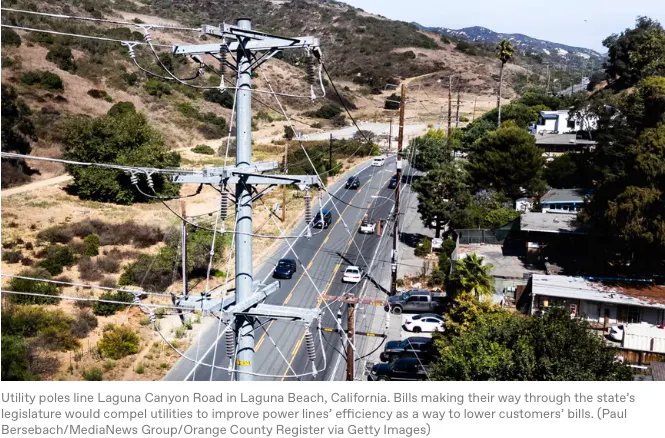
CanaryMedia: “Two California bills would push utilities to get more out of their grids.” A set of bills introduced this year would order Pacific Gas & Electric [PG&E,] Southern California Edison [SCE] , and San Diego Gas & Electric [SDG & E] to measure + improve how they’re utilizing [their] hundreds of thousands of miles of power lines. The central question is the way utilities handle peaks in electricity demand that happen a few times per yr—because historically the solution was overbuild fossil methane gas peaking plants.
“Assembly Bill 1975, introduced by Assembly Member Nick Schultz, a Democrat, would require utilities to measure grid utilization and find ways to improve it over time.” A complementary measure, “Senate Bill 905, a wide-ranging utility cost-containment package, includes a provision that would mandate ’additional reporting on how effectively utilities are using existing distribution grid capacity, particularly during off-peak periods,’ when grids have more headroom to deliver power.”
So-called ‘demand reduction,’ or “ load flexibility programs….help relieve temporary grid constraints by paying customers to reduce the amount of power they use via smart thermostats and other devices, or to share the electricity they’ve stored in plugged-in electric vehicles and home batteries charged with rooftop solar.”
“A 2023 study commissioned by the California Public Utilities Commission found the state’s 3 major utilities could need to invest up to $50 billion by 2035 to meet growing power demand. Alternatively, this “load shift” approach could cut costs passed on to California customers by up to $13.7 billion through 2030, according to a 2025 analysis prepared for think tank GridLab by grid analytics startup Kevala.
I like this idea, in fact I’m signing up for transient use of the backup batteries in both our primary residence as well as a nearby rental home in Washington State. These batteries can be accessed for only about 1% of charge, a wonderful distributed, ancillary service to the grid, + definitely reimbursable as such. So our batteries can stabilize the grid + make us some money even when we’re sleeping. About the same time bakers somewhere are making our bread.