


Blue Hydrogen Market to Reach US$52 Billion in 2036
Low-carbon hydrogen supports a cleaner energy future. It decarbonizes hard-to-abate sectors such as iron and steel production, chemical manufacturing, and long-haul transport. With less than 1% of global hydrogen supply currently low-carbon, blue hydrogen transitions to scale production and toward a hydrogen-based economy. According to IDTechEx’s latest report, “Blue Hydrogen Production and Markets 2026-2036: Technologies, Forecasts, Players”, the global blue hydrogen market is projected to reach US$52 billion by 2036 with predicted growth at a CAGR of 22%.
Blue hydrogen is produced from fossil fuels using conventional methods combined with carbon capture, utilization, and storage (CCUS) technologies. Conventional hydrogen production releases CO2. Blue hydrogen captures, stores, and utilizes CO2, using established production infrastructure and mature CCUS technologies to reduce emissions.
Turquoise hydrogen is produced through methane pyrolysis. This process does not require CO2 capture. It generates solid carbon as a by-product, used across industries such as tire manufacturing and energy storage materials. Turquoise hydrogen is an important complement to blue hydrogen in the energy transition.
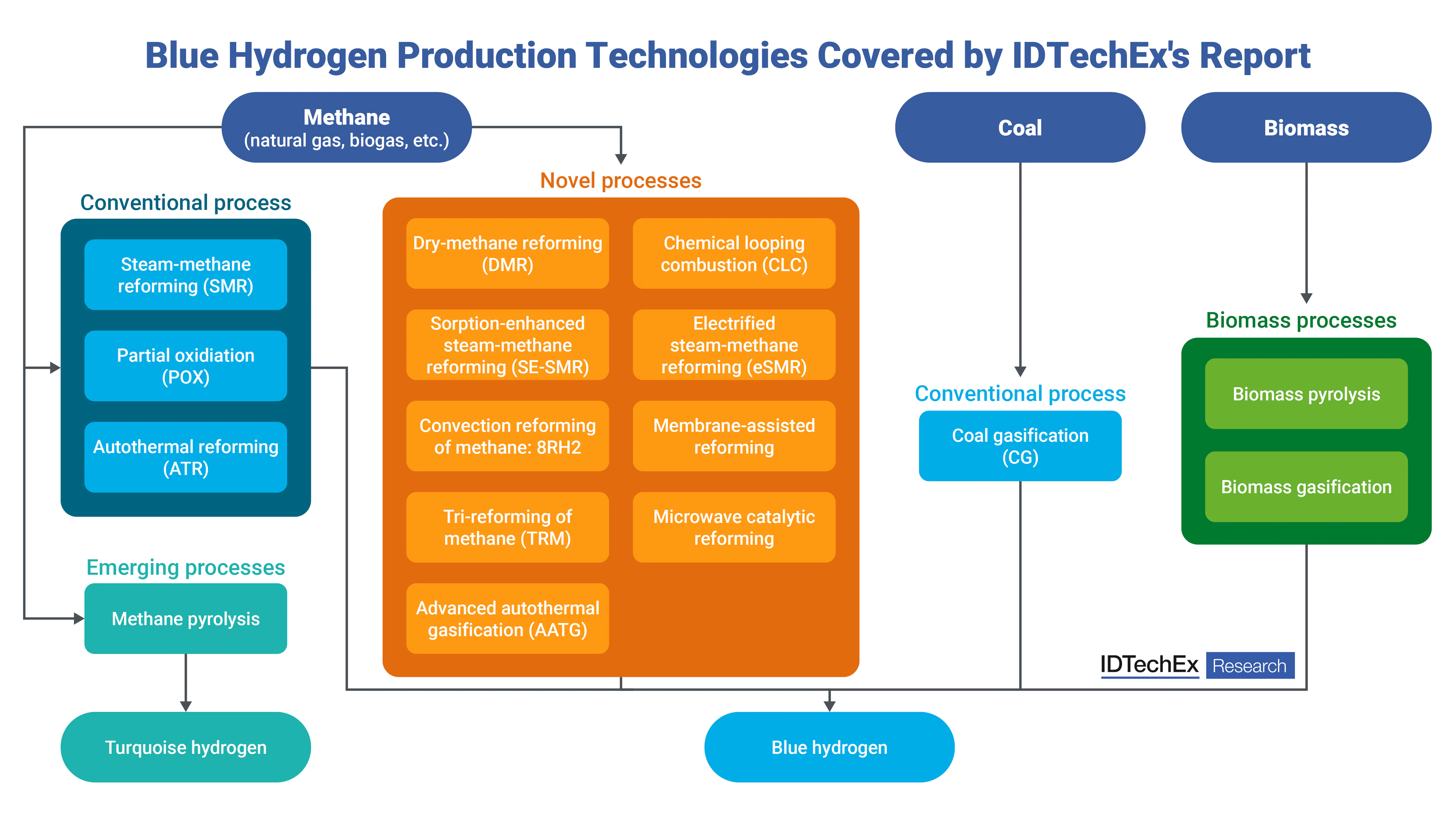
Blue hydrogen can be produced through several pathways. Conventional methods include steam methane reforming (SMR), autothermal reforming (ATR), partial oxidation (POX), and coal gasification (CG). SMR with CCUS is the incumbent technology in current blue hydrogen production, while ATR with CCUS is emerging. Methane pyrolysis is rapidly gaining attention.
Other pathways include biomass-based hydrogen production and novel blue hydrogen technologies such as eSMR. These processes currently represent a small share of the market.
Blue hydrogen production technologies covered in IDTechEx’s “Blue Hydrogen Production and Markets 2026-2036: Technologies, Forecasts, Players” report. Source: IDTechEx.
Global policies and market developments in blue hydrogen
Over 60 governments worldwide have hydrogen energy transition strategies, such as those of the United States, Canada, and the Netherlands. In the US, growth is supported by 45V clean hydrogen and 45Q CCUS tax credits, with the recent One Big Beautiful Bill Act (OBBBA) further promoting blue hydrogen by incentivizing point-source CO₂ capture for industrial applications such as enhanced oil recovery (EOR). In the EU, policies such as the EU ETS, the CCS Directive, and SDE++ (specifically in the Netherlands) provide additional support.
The hydrogen industry is currently experiencing slow growth and mixed political signals. Several large-scale projects have been delayed, paused, or cancelled, primarily driven by high levelized costs of hydrogen (LCOH) and weak offtake demand. Notable examples include ExxonMobil’s Baytown blue hydrogen complex in Texas and BP’s Teesside facility in the UK.
IDTechEx’s report, “Blue Hydrogen Production and Markets 2026-2036: Technologies, Forecasts, Players”, offers a comprehensive analysis of the latest blue hydrogen market trends, regulatory developments, major projects, and key technology suppliers, along with a dedicated section on turquoise hydrogen, including technology benchmarking, key players, and case studies.
The main drivers of the blue hydrogen market support decarbonization, the maturation of CCUS technologies, and the growing adoption of hydrogen across end-use applications. Challenges such as slow growth in the broader hydrogen market and regulatory uncertainties cannot be overlooked. IDTechEx expects the blue hydrogen market to expand, with technological advancements and large-scale projects worth monitoring.
For more information on the "Blue Hydrogen Production and Markets 2026-2036: Technologies, Forecasts, Players" report, including downloadable sample pages, please visit www.IDTechEx.com/BlueHydrogen. The full portfolio of related research is available from IDTechEx. See www.IDTechEx.com.