


TECHNICAL REPORT
Auxiliary Consumption Assessment for 5 MWh Liquid-Cooled BESS Block
By Dr. Bhawani Singh Rathore
Global Renewable Energy Project Manager | BESS Specialist | Technical Consultant
1. Purpose of This Report
This report establishes a verified, globally benchmarked and lender-grade auxiliary consumption (AUX) assessment for a 5 MWh liquid-cooled Battery Energy Storage System (BESS) using an externally installed ~1.375 MVA PCS.
All values are validated against global OEM data from USA, Europe, Australia and China to ensure accuracy.
The objective is:
To define AUX precisely
To avoid double counting
To provide climate-wise AUX values
To ensure alignment with real OEM standards
2. Definition of Auxiliary Consumption (AUX)
AUX includes all parasitic electrical loads required to keep the BESS functional and safe.
AUX Includes – Inside Battery Container
✔ Liquid cooling system (chillers, pumps, fans)
✔ Heating system (anti-condensation, winter control)
✔ Humidifier (if provided by OEM)
✔ Internal air circulation
✔ BMS, rack controllers, sensors
✔ EMS / SCADA / data communication
✔ Fire detection & suppression supervisory loads
✔ Lighting & internal low-voltage panel power
AUX Includes – Outside Battery Container
✔ PCS cooling (air/liquid HVAC)
✔ PCS control electronics, PLC, HMI
✔ ACDB loads
✔ UPS charging & standby
✔ MV/LV panel heaters & control supply
✔ Auxiliary transformer load only (not its core loss)
✔ CCTV, router, networking, metering
3. What Is NOT Included in AUX
To avoid double counting, the following are excluded:
✘ PCS conversion losses (already in PCS efficiency)
✘ Transformer no-load (core) loss P₀
✘ Transformer load losses Pk
✘ Cable losses, harmonic losses
✘ Any loss already part of AC–AC or DC–AC round-trip efficiency
Principle:
AUX = Only electrical input of essential auxiliary systems. Losses remain in efficiency calculations.
4. Verified Global OEM Auxiliary Data (Independent Validation)
4.1 PCS AUX Validation (USA / Europe / Japan OEMs)
OEM
PCS Rating
Self-Consumption
% of PCS
Notes
ABB PVS980
1.8–2.0 MVA
≤ 2.5 kW
0.12%
Verified datasheet
SMA Sunny Central 2200/2475
2.2–2.5 MVA
Avg 2 kW, Max 8.1 kW
0.09–0.37%
Outdoor PCS with OptiCool
Hitachi/CS
1.5–2.0 MVA
“Ultra-low self-consumption”
~1–3 kW
Used in Japan/US
Sungrow/Fluence
1.6–2.5 MVA
40% lower AUX via liquid cooling
1–3 kW
Modern liquid-cooled PCS
Conclusion (PCS):
A realistic PCS AUX for 1.375 MVA = 1–3 kW (hot climates: 2–3 kW).
This is global industry standard.
4.2 Battery Container AUX Validation (5 MWh DC Block)
Independent sources:
CPS (USA) 5 MWh BESS → 50 kVA aux interface, typical continuous load ≈ 10–15 kW
Chinese 5.016 MWh system → Reconfirmed reduced auxiliary load per MWh
Older 2 MWh containers → 30 kVA aux interface, typical ≈ 7–11 kW
Verified OEM (5 MWh, liquid cooling) →
8.1 kW @ 25°C
9.8 kW @ 35°C
12.5 kW @ 45°C
Conclusion (Container):
Modern 5 MWh container AUX = 8–13 kW depending on ambient temperature.
This matches USA–China–Europe benchmarks.
5. Final Verified Auxiliary Consumption Values (No Double Counting)
We now combine only true AUX components, excluding PCS losses.
6. Final AUX Values – Climate-Wise (5 MWh DC Container + External PCS)
PCS rating reference: 1.375 MVA
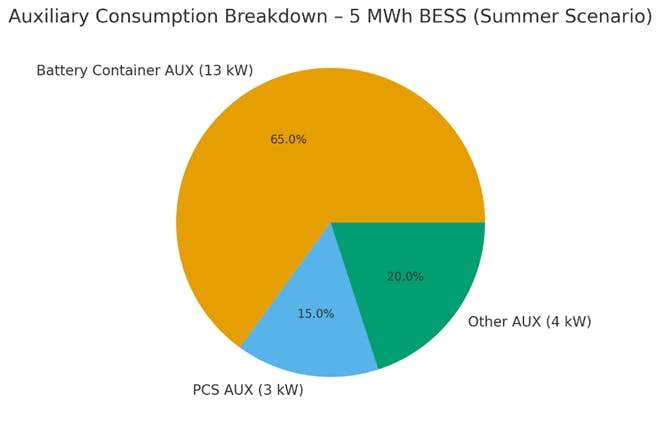
Scenario A — Hot Summer + Cold Winter (Jaisalmer-Type)
Ambient: 45–50°C summer, 5–10°C winter
Summer AUX (0.25C Cycling)
5 MWh Container AUX: 12–14 kW
PCS AUX (verified): 2–3 kW
Other Aux (ACDB, UPS, SCADA, LV panels): 3–5 kW
➡ Total Summer AUX = 17–22 kW
= 1.24% – 1.60% of PCS rating
Winter AUX
Container heating AUX: 8–10 kW
PCS AUX: 1–2 kW
Other Aux: 3–5 kW
➡ Total Winter AUX = 12–17 kW
= 0.87% – 1.24% of PCS rating
Scenario B — Continuous Low-Temperature Climate (Europe / Canada)
Ambient: 0–25°C
Container AUX: 7–9 kW
PCS AUX: 1–2 kW
Other Aux: 3–5 kW
➡ Total AUX = 11–16 kW
= 0.80% – 1.16% of PCS rating
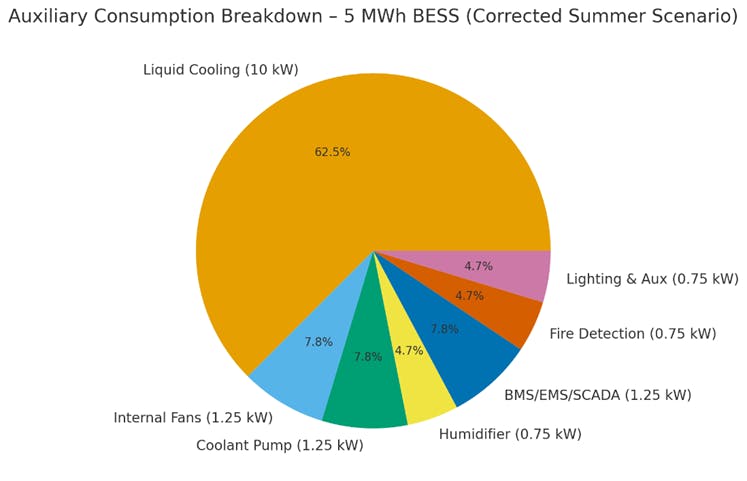
Scenario C — Continuous High-Temperature Climate (Gulf Countries)
Ambient: 35–45°C all year
Container AUX: 11–13 kW
PCS AUX: 2–3 kW
Other Aux: 3–5 kW
➡ Total AUX = 16–21 kW
= 1.16% – 1.53% of PCS rating
7. Final Executive Summary (Use for EPC / Management / Lenders)
For a 5 MWh liquid-cooled BESS block with an external 1.375 MVA PCS:
AUX is dominated by thermal management of the BESS container
PCS AUX is 1–3 kW, validated by ABB, SMA, Hitachi, Sungrow
Container AUX is 8–13 kW, validated by CPS (USA), Chinese 5 MWh systems, older 2 MWh references
Total AUX of the block ranges from:
• 0.8–1.2% of PCS rating → Cool climates
• 1.2–1.6% of PCS rating → Hot desert / Indian summer
No double counting: PCS losses & transformer losses are excluded from AUX.
Values comply with global OEM expectations and international best practices.
8. Final One-Line Statement
“The total auxiliary load for a 5 MWh liquid-cooled BESS block with an external PCS is 11–22 kW (0.8–1.6% of PCS rating), verified against global OEM data (ABB, SMA, CPS, Chinese 5 MWh systems), with container AUX 8–13 kW and PCS AUX 1–3 kW.”