


ATUL Architecture #4 — AI on SAP BTP for Grid Operations
AI on SAP BTP for Grid Operations: How AI Becomes Actionable Inside SAP Processes
Utilities generate massive volumes of operational data every second—from SCADA systems, AMI networks, intelligent electronic devices (IEDs), weather feeds, and grid sensors. While collecting data is no longer the challenge, transforming that data into actionable operational decisions remains difficult. Most AI initiatives stop at dashboards and predictions. However, real business value is realized only when AI insights automatically trigger operational processes inside SAP.
This architecture demonstrates how SAP Business Technology Platform (BTP) combines time-series data, machine learning, event-driven integration, and SAP S/4HANA workflows to create a closed-loop operational model where AI does not simply predict problems—it initiates action.
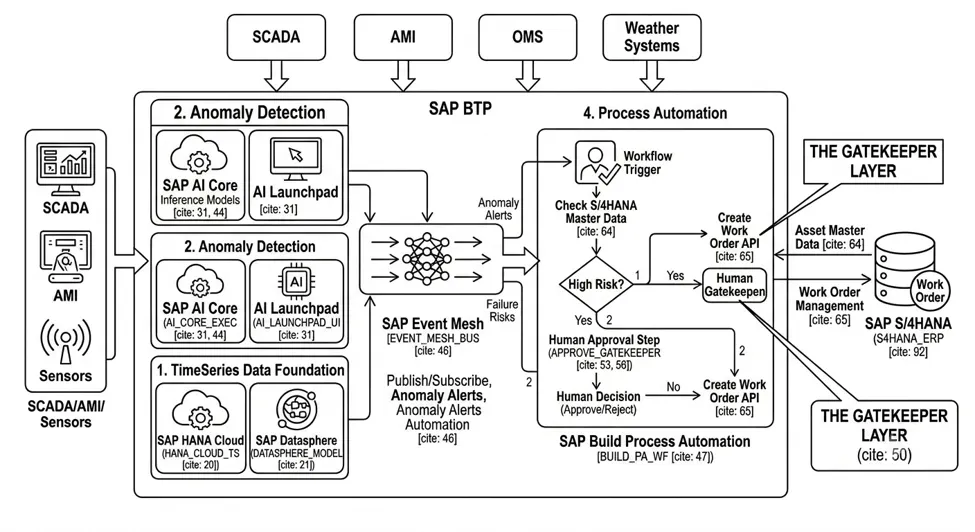
1. Foundation: Timeseries + AI on BTP
Grid operations run on timeseries data, including:
Transformer temperature curves
Voltage fluctuations
Feeder imbalance
Breaker operation frequency
Meter communication patterns
Weather impact signals
SAP BTP provides two strong foundations for this:
SAP HANA Cloud: Native timeseries functions and fast analytics.
SAP Datasphere: Semantic modeling and integration.
Architectural Principle: AI Proximity to SAP Data Matters
When AI models live in the same platform as your master data, you eliminate the ETL lag, data translation errors, and security surface area that come with external AI platforms. The practical implication: your anomaly detection is working on the same asset hierarchy that SAP S/4HANA uses to create work orders, ensuring there is no mismatch between what the AI saw and what the technician gets dispatched to fix.
2. Anomaly Detection and Predictive Maintenance on BTP
Once timeseries data is available, the system evaluates common utility scenarios such as sudden voltage drops on a feeder, transformer overheating patterns, meters not reporting for 48 hours, or unusual load spikes.
SAP AI Core and AI Launchpad support models such as:
LSTM-based anomaly detection
Isolation Forest
Autoencoders
Threshold-based rules for simple cases
In grid operations, the value of anomaly detection lies not in identifying every deviation, but in identifying actionable deviations—those that require operational response within defined time windows. Predictive maintenance shifts operations from reactive repair to risk-based intervention, allowing utilities to prioritize maintenance budgets toward high-impact assets and reduce unplanned outage exposure.
3. The "Gatekeeper" Layer: AI Workflow S/4HANA Integration
AI becomes valuable only when it creates work, but critical infrastructure requires accountability.
The Pattern: When the AI model reaches a low-confidence threshold or identifies a high-risk asset, the workflow automatically pauses.
The Interface: A task is pushed to the supervisor's SAP Build Inbox, displaying the AI’s risk score, supporting technical data, and an "Approve/Reject" option.
The Result: The SAP S/4HANA work order is only generated after human verification, ensuring that the system is an "AI-assisted" tool rather than a fully autonomous one.
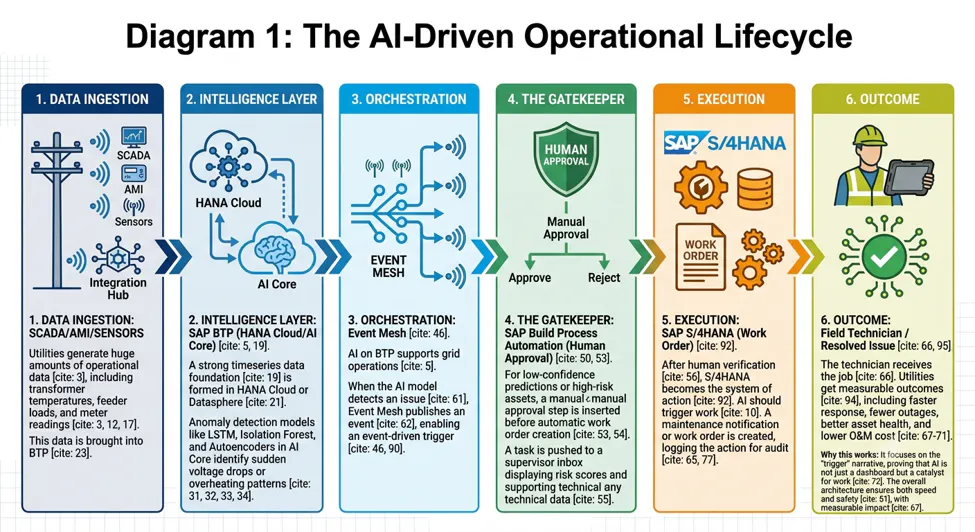
Architectural Principle: S/4HANA Becomes the System of Action
Utilities are regulated industries. Work orders, notifications, and approvals must be traceable, auditable, and defensible to regulators and internal compliance teams. Because SAP S/4HANA is already the system of record for asset management and maintenance, routing AI-triggered actions through it means you do not need a parallel tracking system. The AI's recommendation and the resulting field action live in the same audit trail.
4. Event-Driven Architecture Reduces Operational Latency
In grid operations, the window between early warning and failure can be hours or even minutes. A polling-based batch integration would miss that window entirely.
Using SAP Event Mesh, the moment AI flags an anomaly, the downstream workflow fires instantaneously. Contrasted with the traditional model—where AI generates a report overnight and an analyst reviews it in the morning—event-driven architecture changes the category of what is possible.
5. Practical Architecture Example: "The 3 AM Save"
To visualize how these components work together in real-time grid operations, consider this end-to-end incident flow:
2:58 AM — SCADA Temperature Spike: Transformer T221 shows a sudden 9°C rise in 4 minutes.
3:00 AM — SAP HANA Cloud Detects Abnormal Curve: Rolling window and derivative features show a deviation from normal nighttime cooling.
3:01 AM — SAP AI Core Flags Anomaly: An LSTM model flags the anomaly, and the risk score jumps from 0.18 to 0.74.
3:01:10 AM — SAP Event Mesh Publishes Event: An asynchronous event (
grid->transformer->overheat->predicted) is broadcasted.3:01:12 AM — SAP Build Process Automation Starts Workflow: The system pulls asset master data from S/4HANA, checks transformer age (17 years), reviews last maintenance history, and checks the load forecast.
3:01:30 AM — Supervisor Approval Triggered: A mobile notification appears: "AI predicts overheating in 3–5 hours. Approve pre-failure inspection?"
3:03 AM — Supervisor Taps "Approve": The human-in-the-loop safety layer executes.
3:03:10 AM — SAP S/4HANA Creates Work Order: A high-priority maintenance task is logged to inspect cooling fins, oil level, and the load tap changer.
3:20 AM — Field Technician Dispatched: The technician receives the job on their mobile app and drives to the site before the failure window.
4:40 AM — Issue Cleared: The technician discovers and clears dust, debris, and vegetation restricting airflow. The transformer returns to normal operating range, preventing a costly outage.
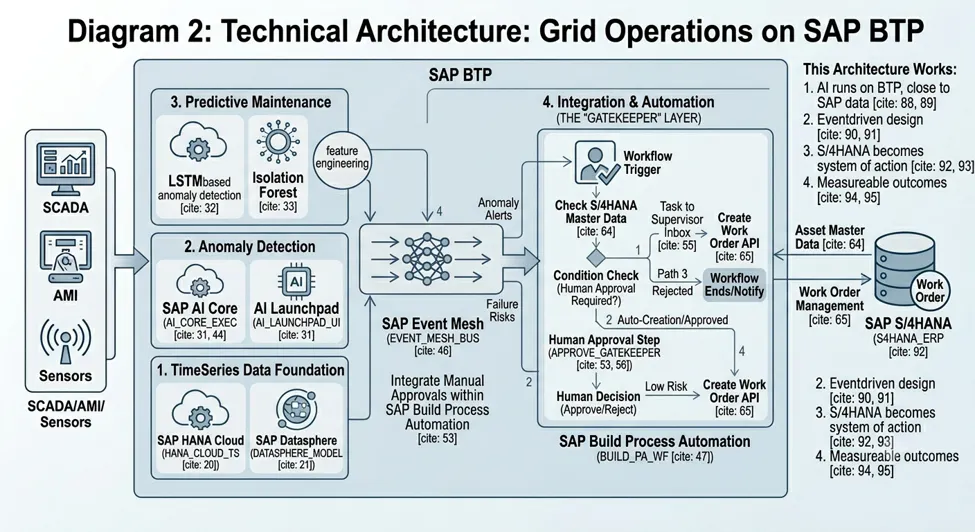
6. Measurable Business Outcomes Define Success
When building an internal business case for leadership, framing success around specific operational metrics is vital:
Reduction in Mean Time to Detect (MTTD) on grid anomalies.
Reduction in unplanned outage minutes per feeder.
Improvement in asset utilization rates as preventive maintenance replaces reactive repair.
Final Thoughts
AI for grid operations is not about deploying fancy models; it is about connecting predictions directly to core SAP processes.
Timeseries Data→AI Model→Event→Workflow→S/4HANA Action
The future of utility operations is not autonomous AI replacing human operators. It is AI-driven workflows that help operators act earlier, with better information, inside trusted SAP business processes. When predictions automatically become notifications, approvals, work orders, and field actions, SAP BTP becomes the operational backbone of modern grid modernization.