


By Kennedy Maize
Democrat Abigail Spanberger, 46, a three-term member of Congress and former CIA undercover agent, became Virginia’s 75th governor and first female chief executive last Saturday (Jan. 17) with a solid mandate to attack skyrocketing electric bills in the state harboring “data center alley.”

While campaigning against high electricity prices helped her achieve a 15% landslide over Republican Lt. Gov. Winsome Earle-Sears, in her inaugural address Spanberger only mentioned power prices in passing.
She touched on the subject lightly, saying that “across the Commonwealth, everything keeps getting more expensive — groceries, medicine, daycare, the electricity bill, rent, and the mortgage. Families are strained, kids are stressed, and so much just seems to be getting harder and harder.”
She added, “We will work to lower energy costs by producing more energy and by ensuring that high energy users pay their fair share.”
Spanberger ran as a centrist and reached out broadly in her address. “I know that some who are here today or watching from home may disagree with the litany of challenges and hardships I laid out,” she said. “Your perspective may differ from mine, but that does not preclude us working together where we may find common cause.”
Under Virginia’s constitution, the governor has far less power than the legislature. The governor serves only one four-year term ending in years with no nationwide election. Spanberger nodded to that political fact: “To my friends in the General Assembly — on both sides of the aisle — I look forward to working with you. I know what it means to represent your constituents, to work hard for your district, and to pursue policies you believe in.”
While Democrat Spanberger eschewed energy and electricity details, veteran Virginia energy regulator at the state and federal level, Republican Mark Christie, director of the College of William and Mary’s Center for Energy Law and Policy, did not shy away from offering her some advice.
In a Linkedin post, Christie proposed “a suggestion for an ‘affordability bill’ for power consumers that is both simple and effective.” labeling it “The Electric Power Reliability and Affordability Act of 2026.”
Christie, 72, spent 17 years on the Virginia State Corporation Commission, the Old Dominion electricity regulator, and five years as a Trump 1 appointee on the Federal Energy Regulatory Commission, including chairman from January to August of last year.
He advised Spanberger to submit new language to Title 56 of the Code of Virginia: ”It shall be in the public interest for all customers of electrical power utilities to receive reliable power service at rates that are just and reasonable, and pay only for such costs that are prudently incurred by the utility. In all proceedings under this title, and notwithstanding any other provision of this title, the [State Corporation] Commission shall act in the public interest.”
Christie said adding this language into state law “would protect consumers from inflated power bills, allow utilities to recover all prudently incurred costs, including environmental compliance costs, and receive a cost of capital consistent with constitutional standards and sufficient for new capital investment in the infrastructure necessary to maintain reliability. Most importantly, the public interest would be defined and made paramount in cases conducted in a neutral, transparent forum (the SCC) based on publicly available record evidence and fact-finding in each individual proceeding.”
Just a day before her inauguration, the U.S. District Court for the Eastern Division of Virginia gave Spanberger and Richmond-based giant utility Dominion Energy a major electricity supply win against the Trump administration’s war on offshore wind. On Friday (Jan. 16), Judge Jamar Walker gave the utility a green light to resume construction of the Coastal Virginia Offshore Wind (CVOW) project, one of five offshore projects the Trump administration had ordered to stop work last December.
Walker granted the utility’s petition for a preliminary injunction on the Interior Department’s order for CVOW. DOI had targeted projects ranging from Massachusetts to Virginia to stop work. While the Trump administration had frequently attacked the other four projects, the administration had exempted CVOW from its anti-wind fury as long as Republican Glenn Youngkin was in power. Spanberger in Congress had backed the project.
Once Spanberger won in November, many expected the administration to add CVOW to its kill list. DOI complied in December.
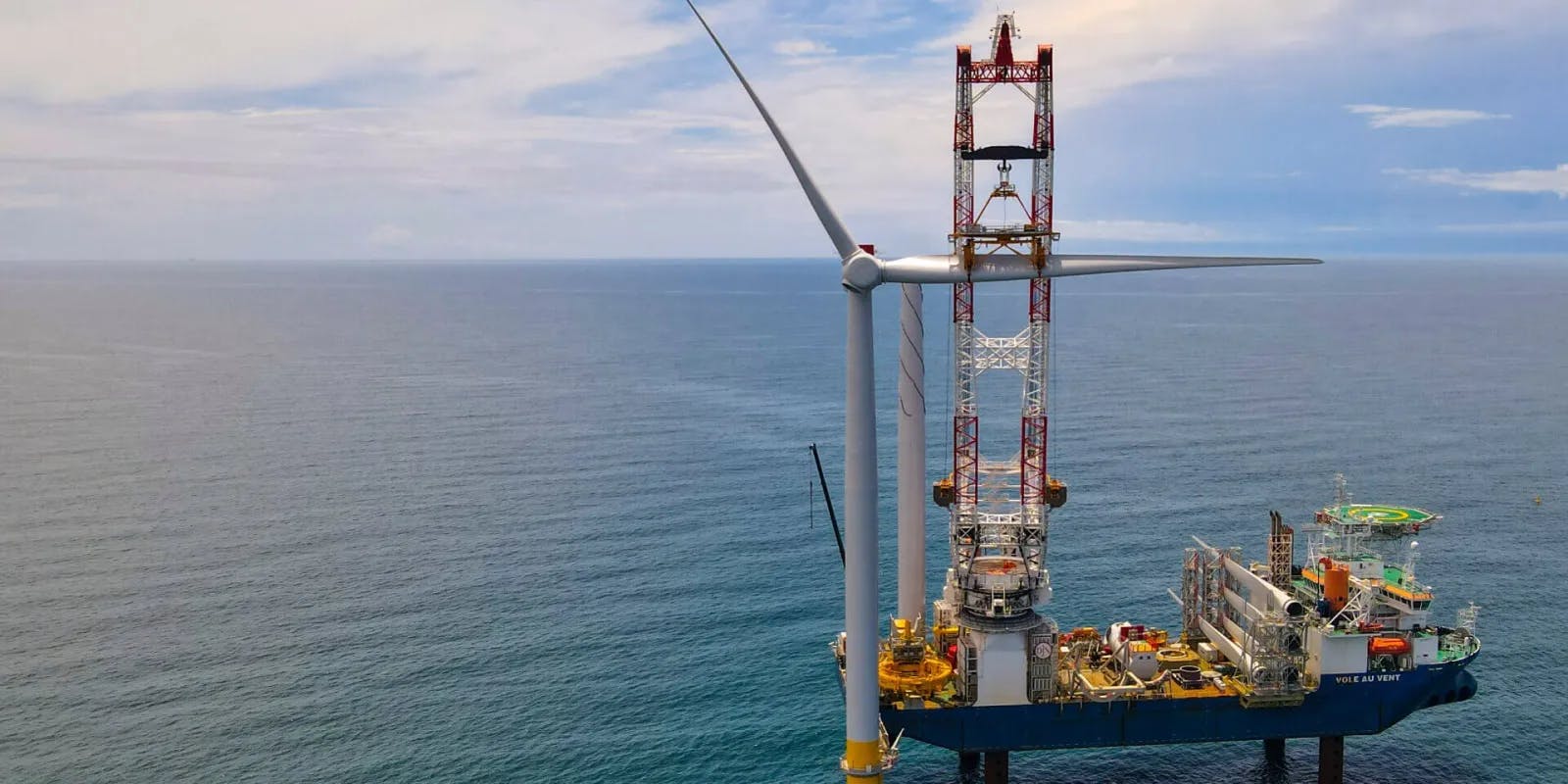
CVOW would be the nation’s largest offshore wind project with 176 turbines producing 2.6-GW of electric power, at a total cost of some $11 billion. According to the utility, the project is 70% complete. The utility expects to finish the project by the end of 2026.
Judge Walker, a Biden appointee, is the third federal district court judge to overturn Trump’s Interior Department stop work order for the five projects. Judges in the U.S. District Court for the District of Columbia have also issued preliminary injunctions stopping the administration’s actions on the Revolution wind project off Rhode Island and the Empire project off New York. The judge in the Revolution Wind case was a Reagan appointee and Trump appointed the Empire Wind judge.
In all three cases, the judges termed the actions by Interior Secretary Doug Burgum “arbitrary and capricious,” a key element of the Administrative Procedures Act, which is consistently tripping up the Trump administration’s helter-skelter approach to policymaking. The administration’s pretext for the wind stop work orders was an allegedly secret “national security” problem and a long debunked claim that wind turbines interfered with military radars.
Dominion noted in its case against Interior that the wind project is located near Norfolk, where the U.S. Navy has one of its most important bases. The utility and the Navy worked together for years to establish that the radar interference issue was bogus.