


So far, the US data center buildout has brought the most computing capacity to relatively wealthy areas—so these communities can handle the energy cost spikes, right? Not exactly.
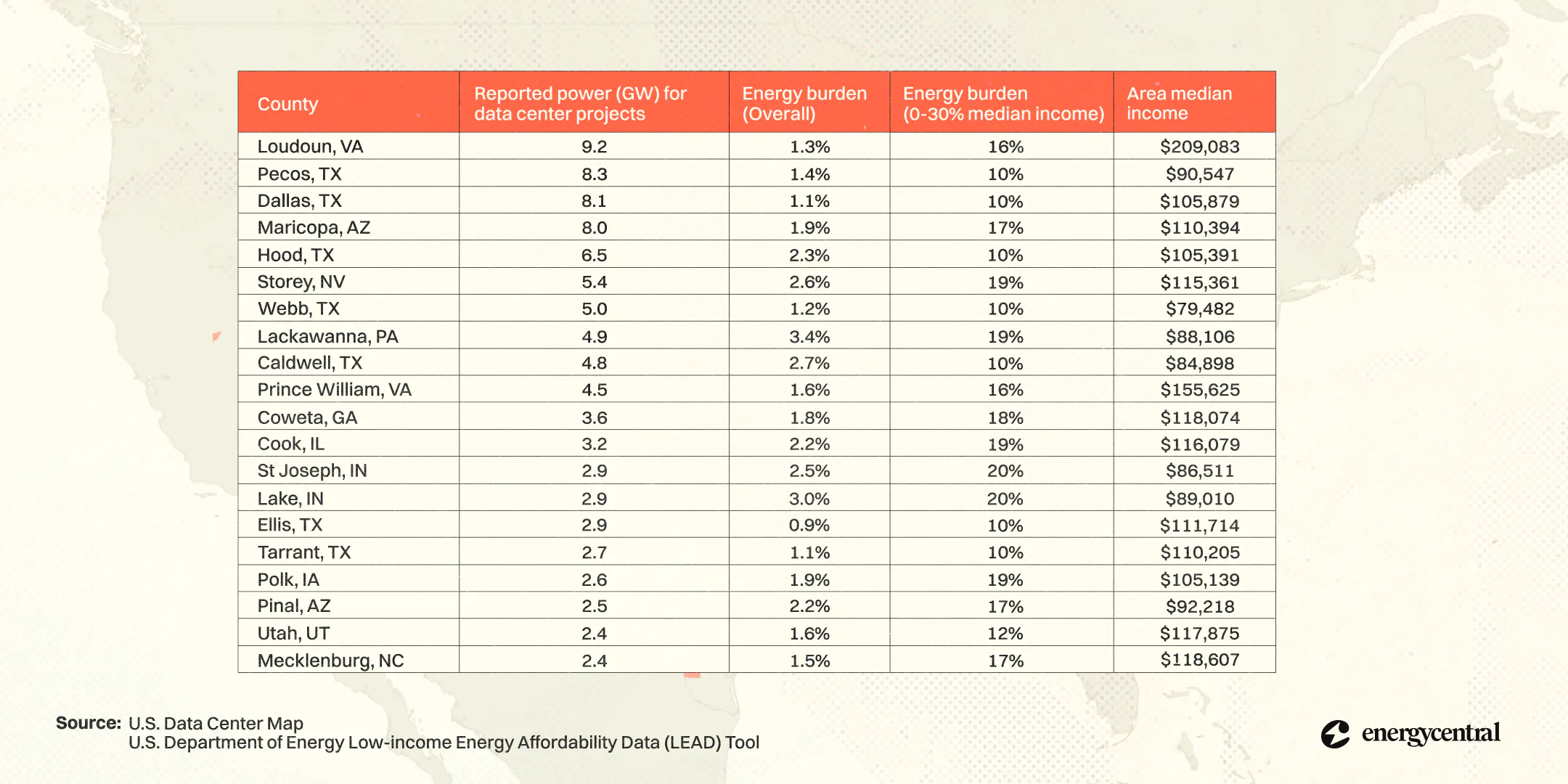
We took a close look at the 20 counties with the most data center capacity, and found that the majority have median household incomes above the country-wide mark. But another stat paints a more complex picture: a county’s energy burden (the average percent of income that households spend on energy).
Digging into the numbers: On this list, households that earn 30% or below median area income have particularly high energy burdens (ranging from 10-20%). For perspective: The DOE considers energy burdens above 6% “high.”
Exhibit A: Take Loudoun County, a wealthy DC suburb that hosts the world’s biggest concentration of data centers.
On paper, it seems like Loudoun would feel minimal sting: The county’s median income (over $200K) is more than double the national level. But those earning 30% or below Loudoun’s median face a 16% energy burden, on average.
How it all ties together: Utilities typically recover costs associated with data center growth through rate hikes. During rate cases, regulators use varying metrics to gauge how bill increases would affect customers. California, for example, tracks affordability with in-depth local data.
But some regulators rely on area median incomes to determine economic risks to local populations—and, in the process, they may underestimate the impacts on households already struggling to make ends meet.
Who’s pushing back: Surveys have found that low-income Americans resist data centers five times more often than high earners. So it’s no surprise that opposition is mounting in hotspots like Lackawanna County, PA, and Lake County, IN, where low-income households face particularly heavy energy burdens.
In Lackawanna County, officials voted to commission what appears to be a first-of-its-kind study on data centers’ cumulative health impacts.
In Lake County, ratepayers protested outside NIPSCO’s headquarters in response to rising bills.
What to watch next: With the midterms looming, officials have unveiled data center moratoriums and cost-protection promises across the country. Meanwhile, senators are squabbling over the Ratepayer Protection Act, which some Dems call “toothless.”
As the elections come and go, we’ll be watching whether politicians actually deliver—or whether the energy burden in data center-dense regions will continue to grow.