


There is a lot of misinformation about data centers today, and as a result, they have become a flashpoint in local debates, often portrayed as energy hogs or industrial intruders. Cities, counties, and states are moving quickly to impose moratoriums on new data center development. The reality is more complicated. Modern hyperscale and AI‑driven facilities are reshaping electricity demand at a pace the grid wasn’t built for, while also raising real questions about land use, water, and community impacts. At the same time, many assumptions about how data centers use power, affect bills, and fit into communities are outdated, oversimplified, or simply incorrect.
Understanding the real impacts is essential as digital infrastructure becomes a defining feature of the modern economy. If the U.S. fails to engage with these issues thoughtfully, other countries will, and the center of innovation will shift to the places that welcome and plan for this growth.
Below are ten of the most common myths shaping public debate, and what the evidence actually shows.
MYTH 1: “Data centers will make everyone’s power bill go up.”
Assessment: Mostly False
FACT: In most U.S. jurisdictions, data centers are required to pay the costs they create, including interconnection, grid upgrades, and large‑load tariffs.
Regulators use cost‑causation principles to prevent residential customers from subsidizing industrial load. In many regions, data centers also expand the tax base, which can ease pressure on local budgets.
Still, the scale and timing of new loads can create planning challenges for utilities, especially when multiple projects cluster in the same area.
MYTH 2: “Data centers are giant energy hogs with no grid value.”
Assessment: Mostly False
FACT: Nationally, data centers used 176 TWh in 2023, or 4.4% of all U.S. electricity.0F[i] For comparison, air conditioning in U.S. homes uses about 12% of household electricity,1F[ii] making data centers a major, but not singular, driver of demand. Data centers are also one of the most flexible large loads on the grid. They can:
Participate in demand response, curtailing load during peaks
Shift computing tasks to off-peak hours
Provide fast, automated load variation that helps integrate wind and solar.
Provide backup power to the grid operator, reducing the need for peaker plants
Of course, this flexibility is not automatic. It depends on tariff design, interconnection agreements, and operator participation. When those pieces are in place, data centers can augment grid reliability rather than strain it.
MYTH 3: “Data centers only strain the grid when they’re using power.”
Assessment: Mostly True
FACT: Large data centers can create real operational challenges if they trip offline suddenly or change load faster than the grid can respond.
NERC recently issued a Level 3 alert after several large facilities dropped offline unexpectedly, causing rapid swings in demand that stressed local systems.3F[iv] AI‑driven workloads can also ramp up and down quickly, creating variability that grid operators can mitigate through joint forecasting of consumption.
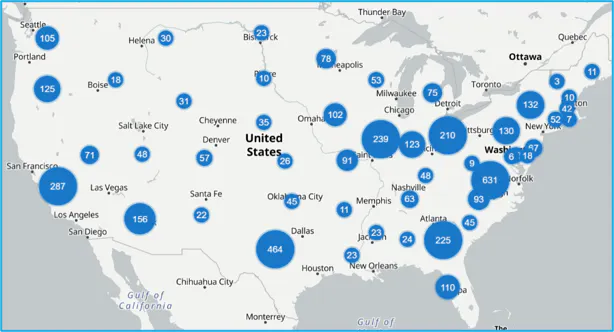
As of June 2026, there are 4,378 data centers in the U.S.[iii]
These risks are manageable, but they require updated interconnection standards, ride‑through requirements, and coordinated controls so data centers behave more like predictable grid assets and less like unbounded loads. As the digital economy grows, integrating these fast, flexible loads is becoming a core part of modern grid operations.
MYTH 4: “Utilities can move at the speed data center developers need.”
Assessment: Mostly True
FACT: Data center developers operate on fast capital cycles — often 18–36 months and are mostly limited by their own supply chain constraints. However, utility infrastructure follows a much slower timeline shaped by engineering, permitting, procurement, and regulatory review.
Even when utilities want to move quickly, interconnection studies, environmental review, community engagement, equipment lead times, and construction sequencing create unavoidable delays.
Developers sometimes assume utilities can “flex” to match their pace, but utilities must follow statutory processes and reliability standards that don’t bend to market urgency.
Transmission and substation upgrades can take 5–10 years, even when fully supported by all parties.
The mismatch isn’t about unwillingness; it’s about the physics, permitting, and public interest obligations that govern utility work. The result is a structural tension: capital moves fast; infrastructure moves slow. Successful projects recognize this gap early and plan around it rather than assuming utilities can accelerate on demand.
MYTH 5: “Data centers fit easily into any community.”
Assessment: Mostly True
FACT: Data centers often trigger significant land use debates, especially when proposed near homes, farmland, or environmentally sensitive areas. They require large parcels, access to transmission, and proximity to substations, which can put them in competition with agriculture, open space, or planned development. Local residents frequently raise concerns about visual impact, loss of rural character, construction traffic, and long-term land conversion. Permitting can become contentious when zoning codes weren’t written with data centers in mind.
Communities that proactively plan for where data centers should go, and where they shouldn’t, tend to experience fewer disputes and more predictable outcomes.
MYTH 6: “Data centers consume/waste enormous amounts of water.”
Assessment: Partially False
FACT: Water use varies dramatically by region and cooling technology. Many modern data centers use air‑cooled or hybrid‑cooled systems that require far less water than older designs or facilities in hot, arid climates. And a growing number of data centers are shifting to using recycled water (treated wastewater) instead of potable water. For example, Google uses reclaimed or non-potable water at over 25% of its data center campuses (one notable example is its Douglas County, Georgia data center, which runs on recycled municipal wastewater).4F[v] Lastly, many of the newer data centers are running water in a closed loop, reusing the water again.
Still, in water‑stressed regions, even modest use can be contentious — and communities increasingly expect transparency about cooling choices and long‑term water planning.
MYTH 7: “Data centers don’t benefit the local community.”
Assessment: Mostly False
FACT: Data centers can provide stable tax revenue and high‑value construction and technical jobs, often with relatively low demand on schools, roads, or social services. Loudoun County is a leading example: data center revenue has helped fund more than $1 billion in road improvements and 36 new schools while allowing the county to maintain the lowest property‑tax rate in Northern Virginia, supported by nearly $900 million in annual data‑center taxes.5F[vi]
These benefits are not universal. Communities with unclear zoning, limited infrastructure, or rapid clustering may experience friction if growth outpaces planning, and tax revenue may not offset concerns about land use, water, or long‑term development priorities. The real question is whether data center benefits align with local goals and whether siting decisions are transparent and well‑planned.
MYTH 8: “Data centers undermine climate goals.”
Assessment: Mostly False
FACT: With the right policies in place, data centers can help accelerate clean‑energy deployment, but this outcome is not guaranteed.
Tools such as renewable additionality requirements, green tariffs, and 24/7 carbon‑free energy commitments ensure that new data center demand is met by new wind, solar, and storage projects rather than by increased fossil-fuel generation.
Many operators already procure renewables at a scale that enables them to bring new projects online faster than utilities typically can.
Still, without strong policy frameworks, large new loads can increase fossil generation in the near term. And when data center development outpaces grid capacity, communities may face increased pollution — a dynamic now prompting legal action in Mississippi, where residents have sued xAI, claiming that its on‑site gas turbines constitute an unpermitted power plant.6F[vii]
MYTH 9: “Data centers create noise and air pollution that harm nearby communities.”
Assessment: False
FACT: Modern data centers are quiet, low‑emission facilities that operate within local environmental standards. Cooling systems are engineered to meet strict noise limits, and the loudest components, such as backup generators, run only during short testing periods or rare outages. Data centers do not emit air pollution during normal operations because their electricity comes from the grid rather than on‑site combustion. Backup generators must meet stringent EPA emissions standards, and many operators are transitioning to batteries and other clean backup technologies.
Still, generator testing schedules, visual impact, and cumulative effects can be legitimate community concerns that require thoughtful mitigation.
MYTH10: “Data centers are a mature, settled technology.”
Assessment: False
FACT: Rapid growth, siting constraints, and grid bottlenecks are pushing the industry toward new and sometimes unconventional models. Investors are exploring ideas like floating, wave‑powered AI data centers that shift the challenge from energy transmission to data transmission.[viii] Other approaches include conceptual orbital data centers, modular micro‑data centers, on‑site clean‑energy systems, advanced immersion cooling, and AI‑optimized load shaping.
These efforts reflect a simple reality: the traditional “build a large facility near a substation” model is becoming harder to execute as land, community support, and interconnection capacity tighten. Not all innovations will succeed, but they show an industry under pressure to adapt as compute demand accelerates.
Bottom Line: The modern world runs on energy, computing, data, and intelligence. The infrastructure behind it is growing faster than many parts of the grid can accommodate. Data centers pose real challenges, from energy demand to siting friction, but they also offer opportunities for investment, jobs, flexibility, and innovation. By separating myths from facts, communities, utilities, and developers can focus on practical steps that ensure new facilities strengthen the entire ecosystem rather than strain parts of it. When done properly, the growth will align with local priorities, long‑term planning, and deliver benefits to all.
[i] https://escholarship.org/uc/item/32d6m0d1
[ii] https://www.energy.gov/energysaver/air-conditioning
[iii] https://www.datacentermap.com/usa/
[iv] https://www.nerc.com/newsroom/nerc-issues-level-3-alert-reliability-guideline-focused-on-large-load-challenges
[v] https://blog.google/company-news/outreach-and-initiatives/sustainability/our-commitment-to-climate-conscious-data-center-cooling/
[vi] https://www.wyedc.org/media/p/item/61886/data-centers-provide-communities-with-increased-tax-revenue
[vii] https://www.reuters.com/sustainability/climate-energy/naacp-sues-musks-xai-alleging-illegal-operation-gas-turbines-2026-04-14/
[viii] https://www.datacenterdynamics.com/en/news/panthalassa-unveils-wave-powered-floating-data-center-platform/