No, I’m not talking about the early birds that get the worms, I’m talking about the earliest ancestors of birds. You may know them as dinosaurs.
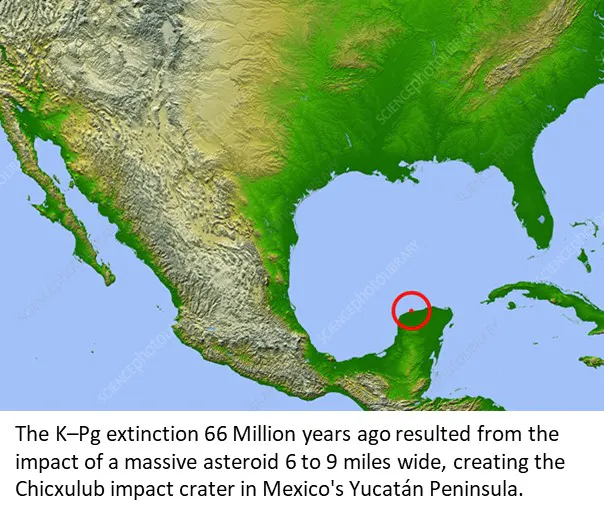
The Cretaceous–Paleogene (K–Pg) extinction event, formerly known as the Cretaceous-Tertiary (K–T) extinction event, was a major mass extinction of three-quarters of the plant and animal species on Earth, which occurred approximately 66 million years ago. The event caused the extinction of all non-avian dinosaurs and most other tetrapods weighing more than 25 kg (55 lb.), with the exception of some ectothermic species such as sea turtles and crocodilians. It marked the end of the Cretaceous period, and with it the Mesozoic era, while heralding the beginning of the current geological era, the Cenozoic Era. In the geologic record, the K–Pg event is marked by a thin layer of sediment called the K–Pg boundary or K–T boundary, which can be found throughout the world in marine and terrestrial rocks. The boundary clay shows unusually high levels of the metal iridium, which is more common in asteroids than in the Earth's crust.