


Strategic Synergy in the Nordic Region: Security, Energy Resilience, and Renewable Innovation toward 2030
1. The Geopolitical Reconfiguration of the Nordic Security Architecture
The Nordic region is witnessing its most profound geopolitical shift since 1945. What was once a landscape defined by military non-alignment has been fundamentally rewritten by Finland and Sweden’s entry into NATO. This is not a minor policy tweak; it is a total overhaul of the European security map.
From "Virtual" to Absolute Defense
For decades, Finland and Sweden operated in a state of "virtual alliance"—cooperating closely with the West but stopping short of formal ties. That era is over. By moving under the Article 5 umbrella, the region has transitioned from loose bilateral cooperation to a unified, integrated command structure.
The Baltic Strategic Shift - The accession of these two nations has fundamentally altered the maritime landscape:
The "Allied Lake" - The Baltic Sea is now effectively surrounded by NATO members, drastically limiting adversarial influence.
Choke Point Contro - NATO now commands both sides of the Danish Straits, ensuring secure passage and operational dominance.
Operational Freedom - The Alliance has gained unprecedented "freedom of maneuver," allowing for seamless defense planning across Northern Europe.
This transformation marks the end of the post-Cold War "gray zone" in the North. By trading traditional neutrality for collective security, the Nordic states have turned the Baltic into a central pillar of NATO’s eastern flank.
This decision, naturally following the law of cause and effect, triggered a fierce Russian response. Russia rebuilt the Leningrad and Moscow Military Districts to strengthen its troop presence along its northwestern borders. Hybrid tactics have also intensified, including ongoing GPS jamming in the Baltic Sea and armed migration along the Finnish border. In addition, Moscow has stepped up its nuclear rhetoric and naval posturing to challenge NATO’s dominance in an area now perceived as an “allied lake.”
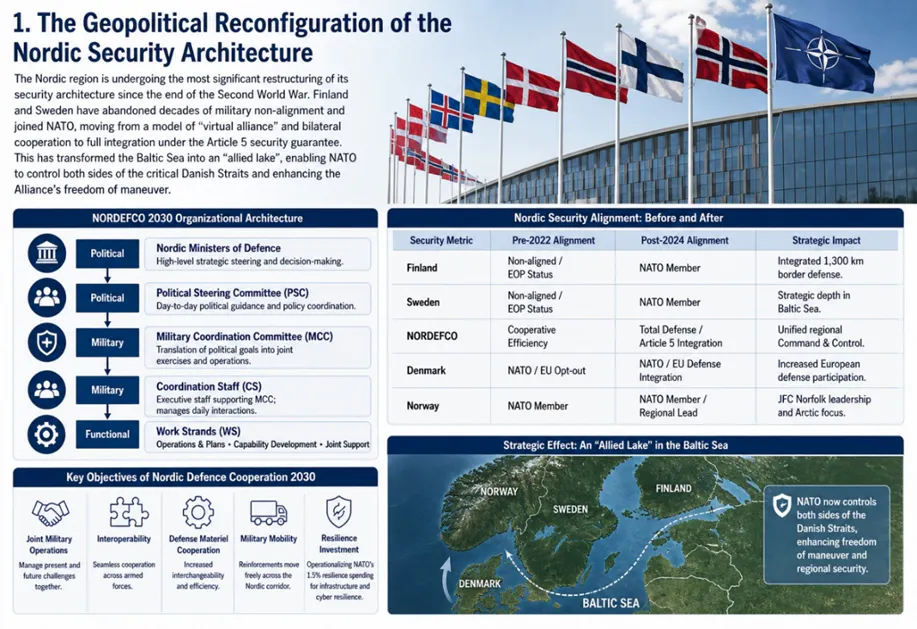
Visual Guide: NORDEFCO 2030 Organizational Architecture
The following diagram illustrates the integrated political and military structure of Nordic defense cooperation following the NATO accession of Finland and Sweden, focusing on the operationalization of Vision 2030.
Level
Entity
Primary Function
Political
Nordic Ministers of Defence
High-level strategic steering and decision-making.
Political
Political Steering Committee (PSC)
Day-to-day political guidance and policy coordination.
Military
Military Coordination Committee (MCC)
Translation of political goals into joint exercises and operations.
Military
Coordination Staff (CS)
Executive staff supporting MCC; manages daily interactions.
Functional
Work Strands (WS)
Operations & Plans, Capability Development, and Joint Support.
Military and Resilience Investments
· Resilience Spending: The Nordic countries are operationalizing NATO's 1.5% resilience spending pillar specifically for infrastructure and cyber resilience.
· Critical Undersea Infrastructure (CUI): New joint monitoring mechanisms and the NATO Maritime Centre for CUI have been established to protect lifelines like subsea cables and pipelines from hybrid threats.
· Unified Posture: The accession of Finland and Sweden has integrated a 1,300 km border defense into NATO and provided strategic depth in the Baltic Sea, which is now managed as an "allied lake".
Historically, the Nordic countries pursued divergent security paths. However, the modern security environment has unified their Deterrence and Defense posture. The "Vision for Nordic Defence Cooperation 2030" focuses on the ability to conduct joint joint military operations to manage present and future challenges together. Key objectives include improving interoperability, defense materiel cooperation for increased interchangeability, and military mobility to ensure reinforcements can move through the Nordic corridor without bureaucratic restrictions. Furthermore, the countries are operationalizing NATO's 1.5% resilience spending pillar to fund defense-relevant infrastructure and cyber resilience.
Security Metric
Pre-2022 Alignment
Post-2024 Alignment
Strategic Impact
Finland
Non-aligned / EOP Status
NATO Member
Integrated 1,300km border defense.
Sweden
Non-aligned / EOP Status
NATO Member
Strategic depth in Baltic Sea.
NORDEFCO
Cooperative Efficiency
Total Defense / Article 5 Integration
Unified regional Command & Control.
Denmark
NATO / EU Opt-out
NATO / EU Defense Integration
Increased European defense participation.
Norway
NATO Member
NATO Member / Regional Lead
JFC Norfolk leadership and Arctic focus.
2. The Nexus of Energy Security and National Resilience
Energy security has evolved into a fundamental pillar of national sovereignty. The Nordic countries, while leaders in decarbonization, remain exposed to hybrid threats against critical subsea energy cables and digital networks. The "Mapping Energy Security in the Nordics" project, scheduled for completion in June 2026, aims to deliver a structured assessment of regional vulnerabilities and enhance cooperation in response to geopolitical and climate risks. This initiative covers all eight Nordic territories and focuses on the resilience of fuel and spare-parts supply chains, particularly for wind and solar infrastructure. The Nordic region is utilizing its high share of fossil-free electricity currently at 96% (78% renewables and 18% nuclear) as a competitive foundation for new industrial sectors.
Economic Metrics
Total Nordic GDP: The combined GDP of the region is €1.7 trillion, representing approximately 1.7% of the global economy.
Intra-Nordic Trade: Regional market integration is exceptionally high, with intra-Nordic trade accounting for roughly 20% of the total.
Corporate Value: The shift toward green energy is reflected in brand values; for example, Equinor's brand value reached €15.6 billion in 2023, surpassing IKEA.
GDP Impacts of Military and Energy Shifts
Decoupling Growth: The region has successfully decoupled economic growth from greenhouse gas emissions faster than the EU average.
Energy Security as a Stabilizer: While the 2026 conflict caused oil prices to exceed $100–$120 per barrel, the Nordic region's 96% fossil-free electricity serves as a buffer, protecting regional GDP from the full impact of global fossil fuel volatility.
Innovation-Driven Growth: The "Triple Helix" model (collaboration between government, industry, and academia) is driving new industries in hydrogen, wave energy, and carbon capture, which are intended to serve as the long-term engines of Nordic prosperity.
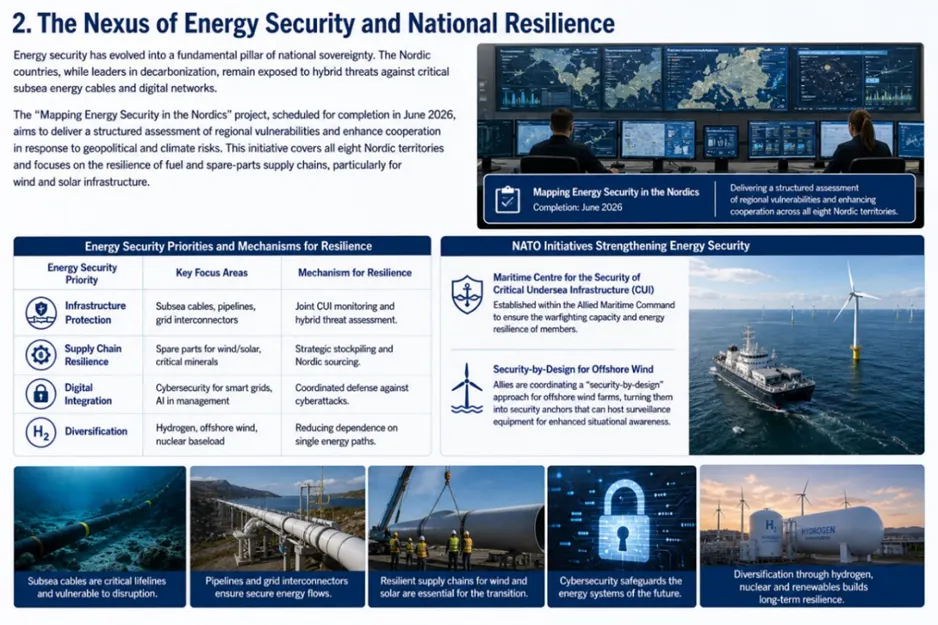
NATO has stepped up its involvement, establishing a Maritime Centre for the Security of Critical Undersea Infrastructure (CUI) within the Allied Maritime Command to ensure the warfighting capacity and energy resilience of members. In the North Seas, allies are coordinating a "security-by-design" approach for offshore wind farms, turning them into security anchors that can host surveillance equipment for enhanced situational awareness.
Energy Security Priority
Key Focus Areas
Mechanism for Resilience
Infrastructure Protection
Subsea cables, pipelines, grid interconnectors
Joint CUI monitoring and hybrid threat assessment.
Supply Chain Resilience
Spare parts for wind/solar, critical minerals
Strategic stockpiling and Nordic sourcing.
Digital Integration
Cybersecurity for smart grids, AI in management
Coordinated defense against cyberattacks.
Diversification
Hydrogen, offshore wind, nuclear baseload
Reducing dependence on single energy paths.
3. Vision 2030: Leading the Global Energy Transition
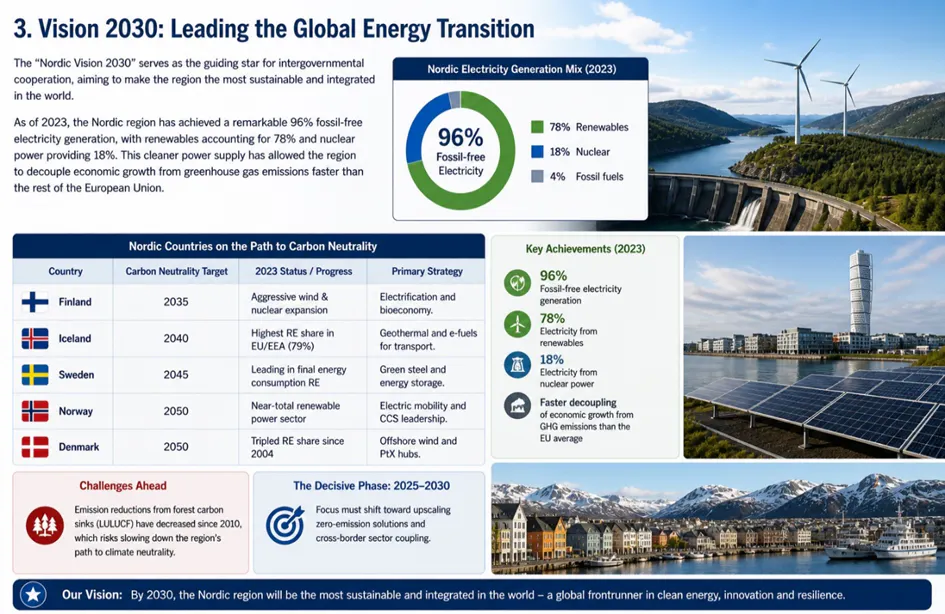
The "Nordic Vision 2030" serves as the guiding star for intergovernmental cooperation, aiming to make the region the most sustainable and integrated in the world.
Country
Carbon Neutrality Target
2023 Status / Progress
Primary Strategy
Finland
2035
Aggressive wind & nuclear expansion
Electrification and bioeconomy.
Iceland
2040
Highest RE share in EU/EEA ($79\%$)
Geothermal and e-fuels for transport.
Sweden
2045
Leading in final energy consumption RE
Green steel and energy storage.
Norway
2050
Near-total renewable power sector
Electric mobility and CCS leadership.
Denmark
2050
Tripled RE share since 2004
Offshore wind and PtX hubs.
Based on the provided strategic documents, here is the detailed breakdown of costs and financial data associated with the carbon neutrality targets of the Nordic nations.
Country-Specific Project Data and Strategies
Finland and Sweden (Targets: 2035 / 2045)
Strategy: Aggressive wind and nuclear expansion, along with green steel production.
Exports: Sweden exports approximately 30 TWh of electricity annually to the European grid.
Export Value: The total value of regional electricity exports reached €5,000 million in 2023.
Marine Innovation: The Swedish firm CorPower Ocean is advancing the 10 MW VianaWave project, expected to commence operations by 2028/2029.
Norway (Target: 2050)
Strategy: Leadership in electric mobility and Carbon Capture and Storage (CCS).
Corporate Shift: Driven by its strategic transformation toward renewable energy, Equinor’s brand value reached €15.6 billion.
Research Infrastructure: The Norwegian Ocean Technology Centre in Trondheim, set for completion in 2028, will host 49,000 sqm of laboratories to advance marine technology.
Denmark (Target: 2050)
Strategy: Offshore wind and Power-to-X (PtX) hubs.
Local Projects: The "Hydrogen Valley" (CONVEY project) in Hirtshals includes a 4 MW production facility serving the maritime sector.
· Wave Energy: Denmark’s Wavepiston signed a 50 MW agreement with Barbados to provide electricity and clean drinking water using pressurized seawater.
Economic Context and Risk Costs
The ongoing conflicts in 2026 (such as the war in Iran) present significant "hidden" costs due to fossil fuel dependency:
· Energy Crisis: Oil prices have risen permanently above $100–$120 per barrel due to threats in the Strait of Hormuz.
· Economic Scale: The combined Nordic GDP is €1.7 trillion, representing roughly 1.7% of the global economy, which provides the necessary stability for the green transition.
Despite this progress, significant challenges remain. Emission reductions from forest carbon sinks (LULUCF) have decreased since 2010, which risks slowing down the region's path to climate neutrality. Consequently, the 2025–2030 period is viewed as the "decisive phase" where the focus must shift toward upscaling zero-emission solutions and cross-border sector coupling.
Grid Reinvestment and Trade
Bottleneck Revenues - In 2022, transmission companies collected €12.5 billion in bottleneck revenues, which are being reinvested directly into grid infrastructure to support future electrification.
Electricity Exports - Sweden currently exports approximately 30 TWh of electricity annually to Europe.
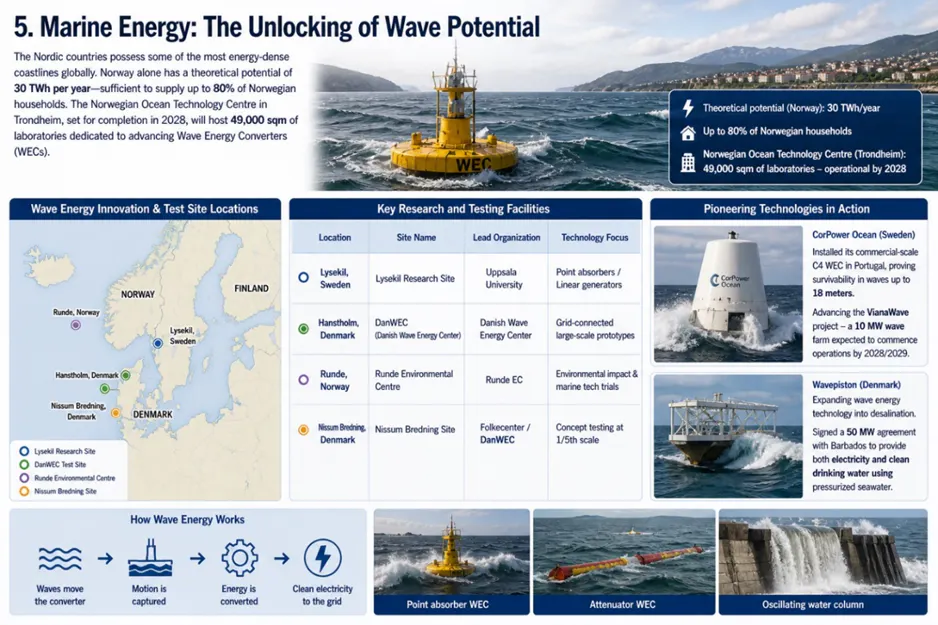
Export Value - Regional electricity exports were valued at €5,000 million in 2023. A major innovator is the Swedish firm CorPower Ocean, which recently installed its commercial-scale C4 WEC in Portugal, demonstrating survivability in waves up to 18 meters. The company is now advancing the VianaWave project, a 10MW wave farm expected to commence operations by 2028/2029. In Denmark, Wavepiston has expanded its technology into desalination, signing a 50MW agreement with Barbados to provide both electricity and clean drinking water using pressurized seawater.
4. The Hydrogen Revolution: Infrastructure and Value Chains
Hydrogen is a cornerstone of the Nordic strategy for deep decarbonization, particularly for hard-to-abate sectors like maritime transport and heavy industry. The region holds the critical mass needed to lead global technology development and facilitate European energy independence by exporting excess green hydrogen.
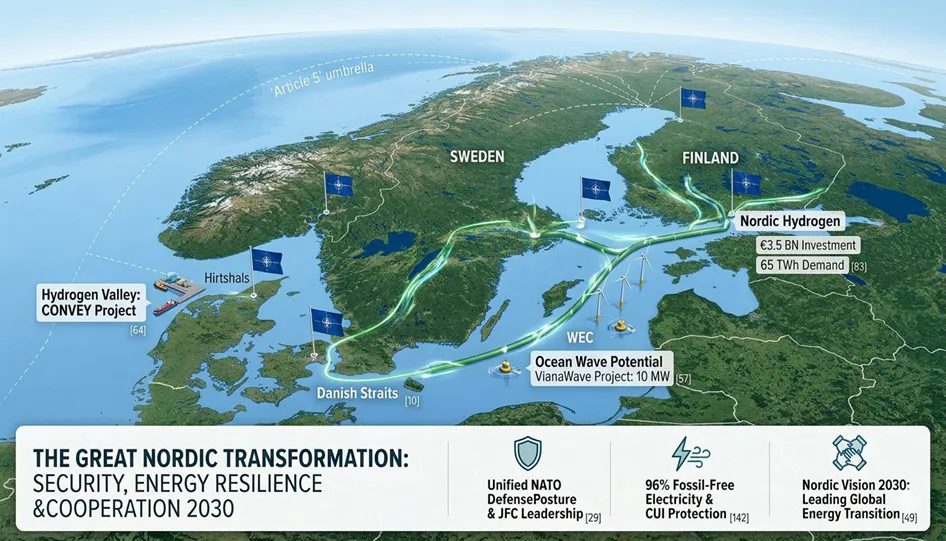
Map: Strategic Hydrogen Corridors & Green Infrastructure
Key cross-border hydrogen projects planned for 2030–2040 provide a dedicated hydrogen backbone for the region.
Corridor Project
Participating Countries
Infrastructure Scope
Projected Capacity/Impact
Nordic Hydrogen Route (NHR)
Finland, Sweden
This project involves a 3.5 billion euro investment in a 1,000 km pipeline along the Bothnian Bay.
65 TWh demand; 20Mt CO savings.
Nordic-Baltic Hydrogen Corridor (NBHC)
FI, EE, LV, LT, PL, DE
Spanning approximately 2,500 km pipeline from Finland to Germany, this "security artery" aims for a throughput of 2.7 million tonnes of hydrogen per year by 2040.
2.7MT year by 2040.
Baltic Sea Hydrogen Collector (BHC)
FI, SE, DK, DE
1,250 km offshore pipeline connecting islands/wind farms
Unlocks offshore wind potential in Baltic Proper.
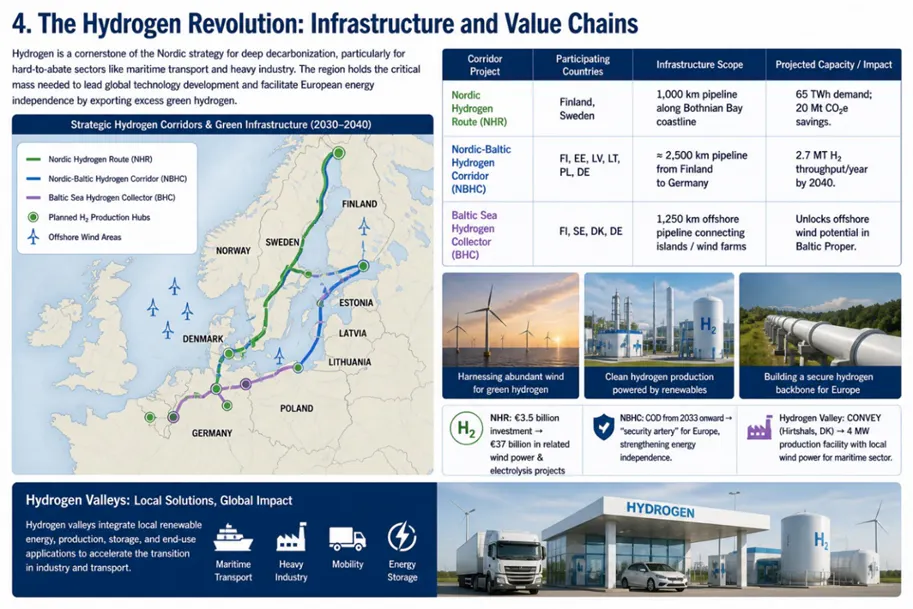
In European plans for energy security and independence, the Nordic Hydrogen Route (NHR) and the Nordic-Baltic Hydrogen Corridor (NBHC) are seen as Europe’s strategic “security arteries”. While the NHR’s €3.5 billion investment is expected to catalyse €37 billion in regional wind and electrolysis projects, the NBHC aims to start in 2033 to stabilise the continent’s energy supply. At the local level, “Hydrogen Valleys”, such as the 4 MW CONVEY project in Hirtshals, Denmark, offer immediate, practical decarbonisation solutions for the offshore sector by integrating local wind energy.
Strategic Expansion & Impact:
· Energy Autonomy: These initiatives are vital for securing European energy independence and permanently ending reliance on imported fossil fuels.
· Storage and Stability: By converting volatile offshore wind into transportable hydrogen, the region can provide a stable, storable green fuel source for Central Europe’s industrial hubs.
· Global Blueprint: These projects serve as a scalable model for transitioning "hard-to-abate" sectors, such as heavy shipping and heavy industry, toward a zero-emission future.
By linking massive infrastructure investments with localized production "valleys," the Nordic region is effectively building a dual-layered energy system that ensures both long-term security and immediate industrial benefits.
5. Marine Energy: The Unlocking of Wave Potential
The Nordic countries possess some of the most energy-dense coastlines globally. Norway alone has a theoretical potential of 30 TWh per year—sufficient to supply up to 80% of Norwegian households. The Norwegian Ocean Technology Centre in Trondheim, set for completion in 2028, will host 49,000 sqm of laboratories dedicated to advancing Wave Energy Converters (WECs).
Map: Wave Energy Innovation & Test Site Locations
Key research and testing facilities driving the transition toward commercial arrays.
Location
Site Name
Lead Organization
Technology Focus
Lysekil, Sweden
Lysekil Research Site
Uppsala University
Point absorbers / Linear generators.
Hanstholm, Denmark
DanWEC
Danish Wave Energy Center
Grid-connected large-scale prototypes.
Runde, Norway
Runde Environmental Centre
Runde EC
Environmental impact & marine tech trials.
Nissum Bredning, DK
Nissum Bredning Site
Folkecenter / DanWEC
Concept testing at 1/5th scale.
6. Academic Excellence and the Triple Helix Model
The Nordic innovation ecosystem is built on the "Triple Helix" model of government-industry-academia collaboration. This is exemplified by the Nordic Five Tech alliance, which creates an "extended Nordic campus" by allowing students and researchers shared access to wind tunnels, test basins, and high-quality laboratories.
Diagram: Nordic Five Tech Academic Synergy
Collaborative focus areas of the region's leading technical universities.
Aalto University (FI): Smart Grids and Bioeconomy.
Chalmers University (SE): Sustainable Transport and Hydrogen.
DTU (DK): Wind Energy and Quantum Technology (Quantum Foundry).
KTH (SE): Power Systems and Advanced Materials.
NTNU (NO): Hydropower, CCS (FME GigaCCS), and Marine Technology.
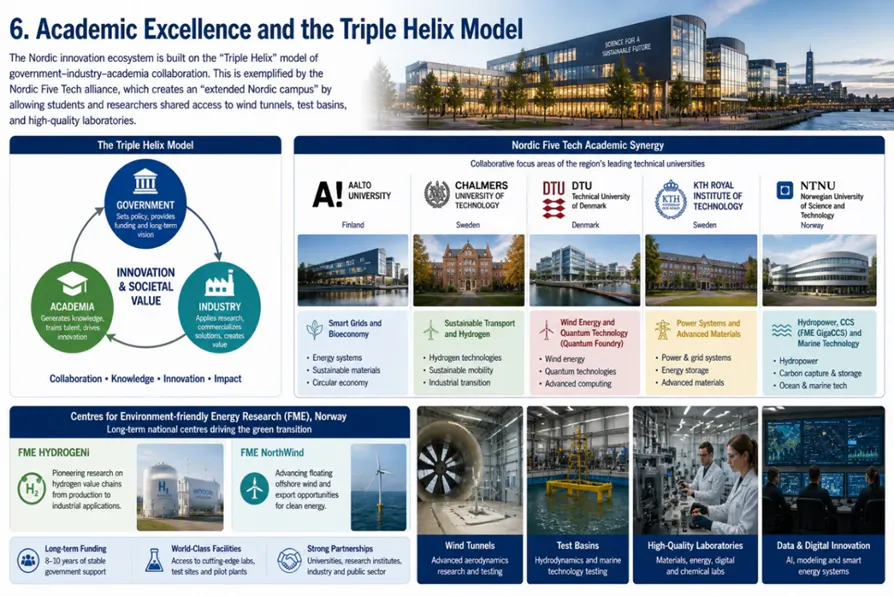
Research is further bolstered by the Norwegian "Centres for Environment-friendly Energy Research" (FME), such as HYDROGENi and NorthWind, which receive long-term funding to spearhead innovations in hydrogen value chains and wind power export opportunities.
7. Economic Integration and Foreign Trade Dynamics
The Nordic countries are highly open economies where trade in goods exceeds one-fourth of GDP. Sweden is the region's largest net exporter of electricity, contributing approx 30 TWh per year to the European grid, while Finland has significantly reduced its imports due to expanded nuclear and wind capacity. In 2022, transmission companies collected 12.5 billion EUR in bottleneck revenues, which are being reinvested into grid infrastructure to support future electrification.
Trade Metric
Value / Share (2023-2024)
Strategic Significance
Total Nordic GDP
1.7$ trillion EUR
approx 1.7% of global economy.
Electricity Exports
5,000$ million EUR (2023)
Integration with UK and Central Europe.
Top Brand (Equinor)
15.6$ billion EUR value
Strategic shift toward renewable energy.
Intra-Nordic Trade
approx 20% of total trade
High degree of regional market integration.
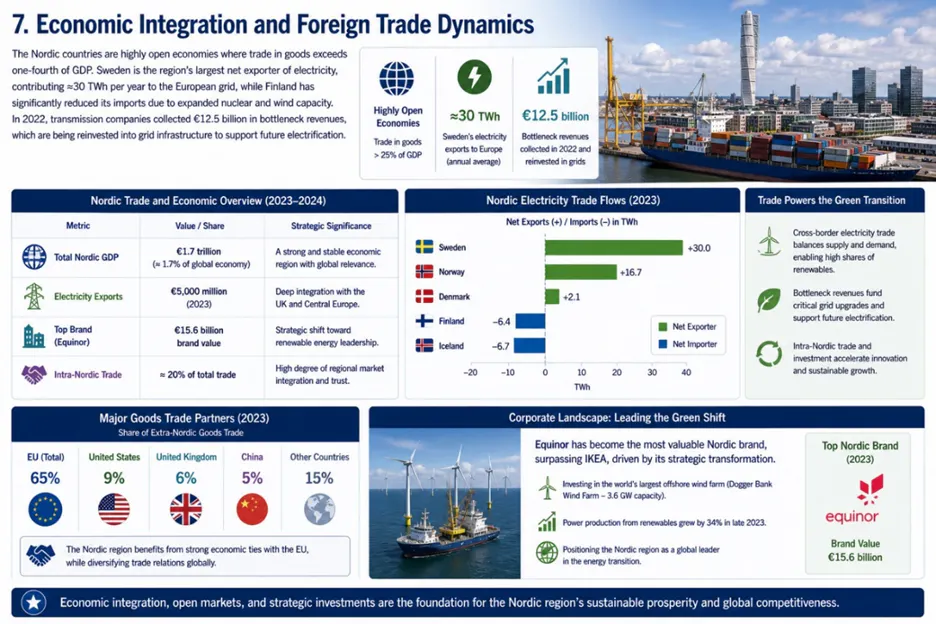
The corporate landscape also reflects the green shift; Equinor has become the most valuable Nordic brand, surpassing IKEA, driven by its investment in the world's largest offshore wind farm (Dogger Bank) and power production from renewables, which grew by 34% in late 2023.
8. Future Strategic Plans and Regional Integration (2025–2030)
As the region enters the crucial, final phase of the Vision 2030 program, the cooperation is planned to evolve into deep technical integration across 14 sectoral policy programs.
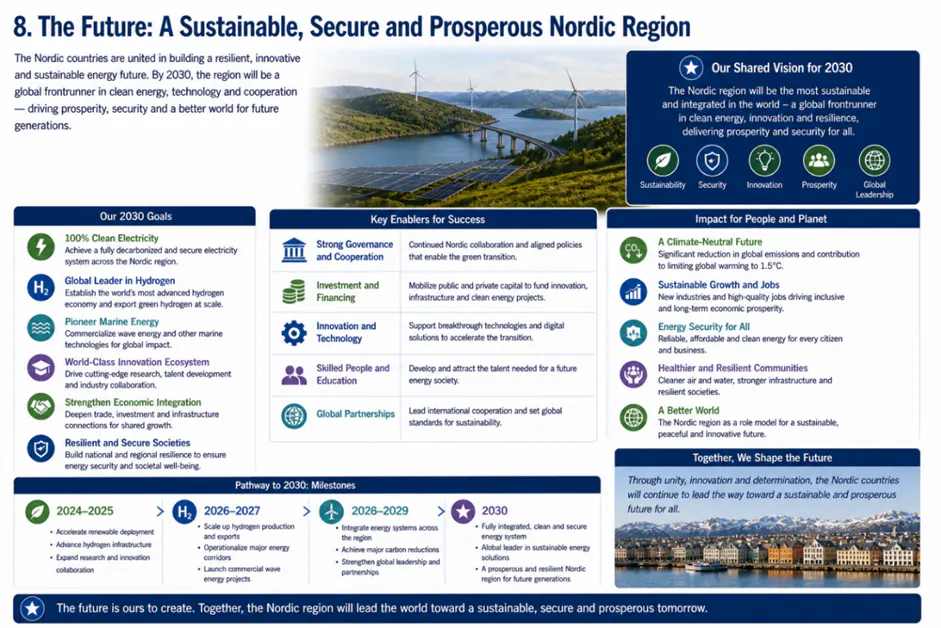
1. Integrated Preparedness and Resource Resilience
The 2025–2030 period prioritizes "Integrated Preparedness," focusing on the joint management and stockpiling of food, energy, pharmaceuticals, and critical raw materials (CRMs). This includes updating maps of Nordic CRM potential to support defense technology needs and the green transition hardware.
2. Digital Integration: The NOBID Framework
The Nordic-Baltic roadmap for Digitalisation 2025–2030 aims to create a seamless digital life for 27 million citizens.
Cross-Border Digital Identity (NOBID): Enabling citizens to use their home-country electronic ID (eID) to access services abroad, such as claiming pensions or healthcare data.
EU Digital Identity Wallet: The region is pioneering the mandatory digital wallet (driver's licenses, degree certificates) to store and use attributes across borders by late 2025.
Identity Matching (IdM): A technical effort to ensure population registries can securely verify identities across national borders.
3. Strategy for Free Movement 2026–2030
To eliminate bureaucratic barriers, the "Free Movement in the Nordic Region 2026–2030" strategy defines seven fundamental rights, including the right to work, study, and conduct business without unnecessary obstacles. A new "Knowledge Bank" and performance indicators will track progress in real-time, ensuring that freedom of movement becomes a practical reality rather than just a political vision.
9. Synthesis and Strategic Conclusions
The ongoing Russo-Ukrainian war that began in 2022 and the Iran war that broke out in 2026 have accelerated the pace of political and economic decisions around the world, but particularly in Europe, that are geared towards security and energy security, and have facilitated the green energy transition, as fossil fuels (especially oil and gas) have become risky and expensive to procure. The conflicts has highlighted the vulnerabilities of the traditional energy system, and countries, especially in Europe, are increasingly pushing for renewable energy and technological change.
The main impacts of wars on the energy transition are:
Green energy boom - Due to high fossil prices, renewable energy sources (wind, solar) have become more competitive, which is accelerating the spread of the technology.
Increased energy security - In order to reduce energy dependence, support for renewable energy and electrical technologies has increased.
Oil and gas price explosion - Due to the threat to the Strait of Hormuz, the price of oil quickly and permanently rose above $100-120 per barrel, causing a drastic energy crisis.
Technological change - European countries are looking for fossil-free solutions more quickly, which is leading to a technological change in transport and industry. Scandinavian countries are leading the way in this area, setting a good example for other regions of the world.
Environmental risks - Armed conflict also causes direct environmental damage by damaging critical infrastructure. As a result of the conflicts, the energy transition has become not only an environmental issue, but also a fundamental security and sovereignty issue.
The Nordic region of Europe stands as a unique laboratory for the integrated pursuit of security, sustainability, and economic prosperity. The successful navigation of the current geopolitical crisis—marked by the accession of Finland and Sweden to NATO—has provided the region with a unified defense posture that is intrinsically linked to its energy resilience. The transition to a fossil-free power sector, now at $96\%$ generation, serves as the competitive foundation upon which the future hydrogen and wave energy economies are being built.
Strategic findings suggest that the "Nordic Added Value" is maximized through cross-border infrastructure like the Nordic Hydrogen Route and the academic synergy of the Nordic Five Tech. By leveraging its tradition of trust and world-class innovation, the region is well-positioned to fulfill its vision of becoming the world's most sustainable and integrated region by 2030, serving as a resilient beacon for the global energy transition.
The countries of the Scandinavian region set an example for everyone by showing how, by moving beyond the grievances and shadows of the past, it is possible to establish and effectively maintain a form of cooperation that takes everyone’s interests into account and serves their common good, thereby strengthening the future and security of the entire region.