


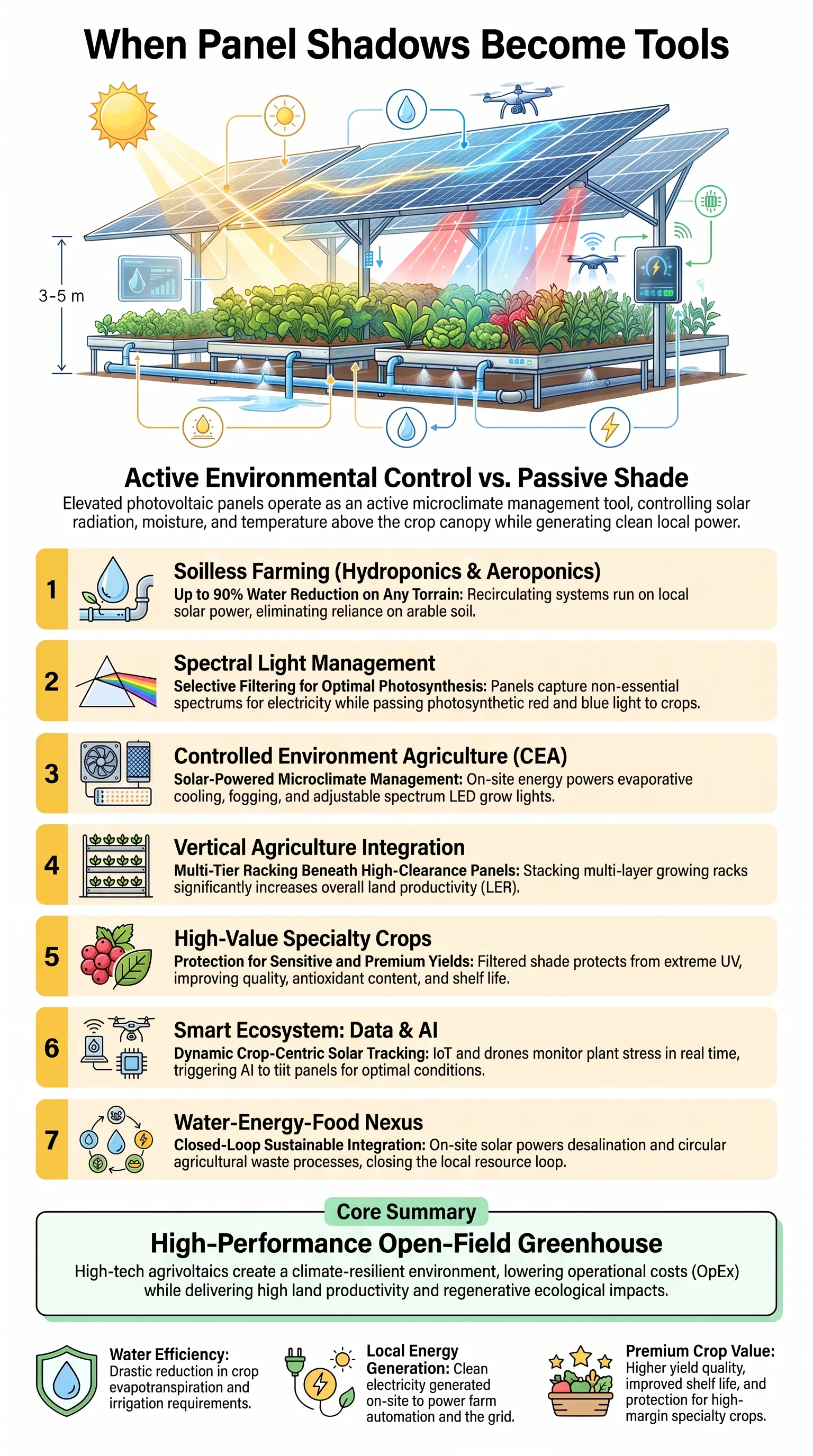
For decades, the shade created by solar panels was viewed as a potential obstacle to agriculture. Less sunlight meant lower photosynthetic activity, lower yields, and greater competition between energy generation and food production.
But what if that assumption is backwards?
What if the shade itself became part of the agricultural technology?
That is the fundamental shift behind the next generation of agrivoltaic systems. Instead of treating photovoltaic modules as structures that simply happen to coexist with crops, we can design them as active environmental-control infrastructure—managing solar radiation, temperature, evaporation, electricity and even water availability while crops grow underneath.
The solar module is no longer just an energy generator. It becomes part of the farm's microclimate.
From Shade to Microclimate Engineering
Traditional agriculture is largely exposed to uncontrolled environmental conditions: excessive solar radiation, heat waves, wind, evaporation, drought and increasingly unpredictable weather.
Agrivoltaics introduces another variable into the equation: controlled shading.
By adjusting module height, spacing, orientation, tilt angle and coverage ratio, engineers can manipulate how much direct and diffuse radiation reaches the crop. The objective isn't necessarily to maximize solar production or maximize agricultural production independently.
The objective is to optimize the combined energy–food system.
In hot and water-stressed environments, moderate shading can sometimes become an advantage. Lower radiation at the crop level can reduce leaf temperature and evapotranspiration, helping plants maintain water status during periods of extreme heat. The result can be a more stable growing environment—even if instantaneous solar radiation is lower.
This is particularly interesting in semi-arid regions, where the limiting factor is often not sunlight but the combination of heat and water availability.
The Farm Becomes an Energy System
The real transformation occurs when electricity generated by the PV array is consumed directly by the agricultural operation.
Instead of exporting all electricity to the grid, a significant fraction can support hydroponic and aeroponic systems, irrigation pumps, fertigation, sensors, ventilation, misters, cooling systems, refrigeration, automation and agricultural lighting.
Controlled-environment agriculture can dramatically reduce water consumption compared with conventional open-field agriculture because water and nutrients can be recirculated rather than continuously lost into the soil.
This creates a powerful feedback loop:
Solar radiation → electricity → water management → controlled cultivation → food production → local economic value.
The PV system effectively becomes the energy backbone of a high-efficiency agricultural ecosystem.
And when storage is added, the concept becomes even more powerful.
A battery can absorb excess midday solar generation and provide electricity during the evening or during periods of low solar output, allowing irrigation, refrigeration, environmental control and other critical agricultural loads to operate when they are actually needed.
High-Tech Crops Change the Economics
Not every crop is equally suitable for agrivoltaics.
The most interesting opportunities may emerge where crop value per square meter is high and environmental control directly influences product quality.
Think about:
🌿 Microgreens
🌱 Culinary and medicinal herbs
🫐 Berries
🌸 Specialty flowers
🌾 Saffron and other high-value spices
🧪 Pharmaceutical and medicinal plants
🍓 Strawberries
🥬 Leafy vegetables
🌿 Seedlings and nursery production
For these crops, the objective isn't simply maximizing tonnes per hectare.
It can be maximizing economic value per unit of land, water and energy.
That completely changes the engineering equation.
A hectare producing a high-value crop under a carefully optimized PV structure can potentially generate revenue from both electricity and agricultural production, while reducing exposure to climatic variability.
The Next Step: Spectral Agrivoltaics
And this is where things become particularly interesting.
Conventional PV modules attempt to convert as much usable sunlight as possible into electricity. But plants don't use the solar spectrum in exactly the same way.
Certain wavelengths are particularly important for photosynthesis and plant morphology.
This opens the door to spectrally selective agrivoltaic systems—technologies designed to simultaneously manage the wavelengths reaching the crop and those converted into electricity.
Instead of simply asking:
"How much sunlight can we block?"
the better question becomes:
"Which photons should go to the plant, and which photons should go to the photovoltaic system?"
This could eventually transform agrivoltaics from simple physical coexistence between solar panels and crops into a form of photonic resource optimization.
AI Could Turn the Solar Structure Into a Dynamic Agricultural Machine
The next generation will likely be far more dynamic than today's fixed PV installations.
Imagine a system continuously measuring:
solar irradiance;
leaf temperature;
soil or substrate moisture;
relative humidity;
evapotranspiration;
CO₂ concentration;
crop growth;
wind speed;
electricity demand;
battery state of charge;
weather forecasts.
An AI-based control system could then optimize the PV structure and agricultural environment in real time.
On an extremely hot afternoon, the system might prioritize crop protection.
During cooler conditions, it could increase solar exposure.
When electricity demand peaks, the energy-management system could prioritize critical agricultural loads.
When the battery is nearly full, the system could redirect energy toward pumping, cooling, desalination, refrigeration or other productive loads.
The solar structure effectively becomes a dynamic climate-control platform rather than a static array of modules.
Digital Twins Could Become the Control Center
The concept becomes even more sophisticated when combined with digital twins.
A digital twin could represent the interaction between:
Sun → PV → microclimate → crop → water → energy storage → agricultural production → economics.
Engineers could simulate different module heights, row spacing, tilt angles, crop densities, irrigation strategies and storage capacities before constructing the physical system.
Instead of asking whether an agrivoltaic project is technically feasible, we could optimize thousands of possible configurations computationally and identify the combination that produces the highest combined energy + food + water + economic performance.
That is a fundamentally different approach to agricultural engineering.
And There Is Another Advantage: Land
One of the most overlooked opportunities is the ability to use land that conventional agriculture considers marginal.
Degraded soils, sandy soils and areas with severe water constraints may become more attractive when cultivation is decoupled from traditional soil-based agriculture.
Hydroponics, aeroponics, substrate cultivation and raised-bed systems can reduce dependence on soil quality.
This is particularly relevant to regions such as Brazil's Sertão, where intense solar resources coexist with heat, water scarcity and challenging agricultural conditions.
Instead of fighting the environment, the system begins to engineer around it.
The Bigger Opportunity Is Not Solar + Agriculture
It is tempting to describe agrivoltaics simply as:
solar panels + crops.
That description is becoming increasingly inadequate.
The more advanced vision is:
PV + BESS + controlled agriculture + water recycling + AI + climate management + energy management + high-value food production.
At that point, we're no longer talking about a solar farm that happens to contain crops.
We're talking about a distributed food-and-energy infrastructure system.
And that distinction matters.
Because the future of agrivoltaics may not be determined by how much electricity a solar farm can generate or how many tonnes of crops can be produced beneath it.
It may be determined by how effectively we can optimize every photon, every liter of water and every square meter of land.
The most interesting question is therefore no longer:
"Will solar panels reduce agricultural productivity?"
It is: "Can we design the solar system so that its shade actively improves agricultural productivity, resilience and profitability?"
That is where agrivoltaics becomes much more than renewable energy.
It becomes agricultural engineering for a hotter, drier and more energy-intensive world.
What crop in your region could turn solar-panel shade from a constraint into a competitive advantage?
#Agrivoltaics #SolarEnergy #Agriculture40 #AgriTech #Hydroponics #Aeroponics #ArtificialIntelligence #BESS #EnergyTransition #WaterEnergyFoodNexus #RenewableEnergy #SustainableAgriculture #ClimateResilience #SolarPV #SmartFarming #FutureOfAgriculture