PopMech: "20th-Century Shipwrecks Are Poisoning Our Oceans—But Underwater Microbes Are Fighting Back."
Shipwrecks, especially those from World War I + World War II, are leaking dangerous contents into the world’s oceans. "Unfortunately for the aquatic environments in which they rest, most of these come from the modern era (1800s, 1900s + 2000s], when the presence of hazardous materials or dangerous ordnance onboard was not only possible, but likely."
"The world’s oceans are littered with shipwrecks, with some estimates placing the number at around 3 million." Of the 3 M, roughly 15,000 date to the years during which WWI + WWII were fought, and a vast majority of those ships are slowly poisoning their surrounding environments.
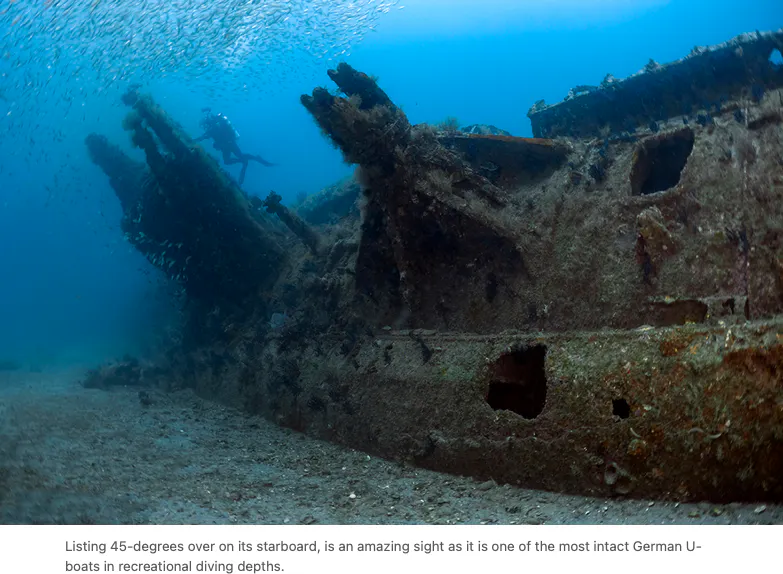
"One wreck of particular concern is a German UC-30 submarine located 66 nautical miles west of Nymindegab, Denmark [not the one in the photo]." Lying 23 meters below the surface on a shallow, sandy reef of glacial deposits in the North Sea, this UC-30 submarine specialized in minelaying intended to wreak havoc on enemy harbors and shipping lanes.
"A necessary part of that job was carrying lots of 2,4,6-trinitrotoluene, more commonly known as TNT, which was housed in 18 onboard sea mines." In a new study published in the journal Communications Earth & Environment, a team of researchers from Germany, Belgium, and Denmark analyzed sediments from the submarine’s minewells—six vertical shafts built into the pressure hull that carried three mines each—to understand the make-up of the microbiome at work.
"In samples taken from the wreck, scientists found distinct taxonomic shifts within the minewells of the wreck—specifically, a drastic increase of Proteobacteria like Haliaceae and Rhodobacteraceae, both of which are microbes that can break down hydrocarbons and survive extreme chemical stress." They do this by leveraging survival enzymes like glutathione transferases + oxidoreductases.
Ain't nature grand? Evolutionary selective pressure favors bacteria that can accomplish bioremediation.