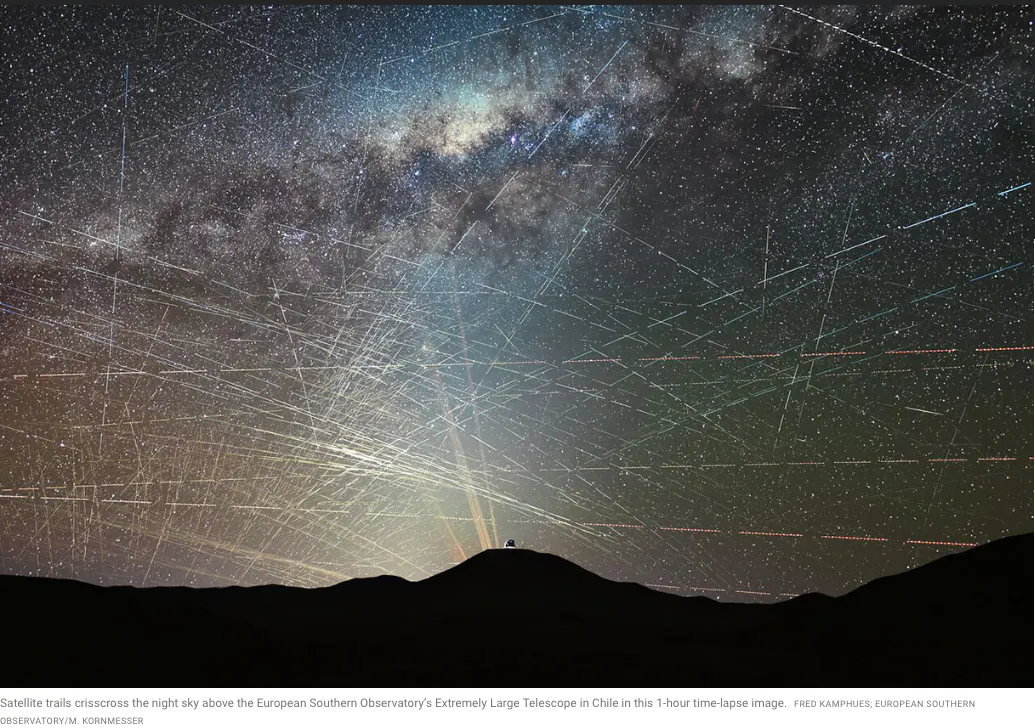
AAAS: "Proposed new satellite fleets could overwhelm the night sky."
Orbiting data centers + sunlight reflectors would severely degrade astronomy by leaving streaks on telescope images + brightening our pitch-black sky. Olivier Hainaut, an astronomer at the European Southern Observatory [ESO], examined 2 recent commercial proposals.
"In 2025, Reflect Orbital sought permission from Federal Communications Commission (FCC) to launch a test satellite carrying an 18-meter-wide reflector that would beam sunlight onto nighttime Earth." The company’s plans to launch 50,000 such reflectors to extend the operating hours of solar power arrays, mines, and emergency responders with artificial daylight.
"Prime astronomy sites such as ESO’s Paranal Observatory in Chile aim to keep light pollution below 1% of the natural night-sky brightness." A fleet of 5,000 Reflect Orbital craft would raise sky brightness worldwide by up to 30%; 50,000 craft would boost it as much as 300%.
'Reflect Orbital says it will steer its 5-km-wide beams, which appear 4-fold brighter than a full Moon, away from observatories.' But even outside the beam each of the 50,000 reflectors would shine as bright as Venus, the brightest object in the sky after the Moon.
Ever since SpaceX launched the first Starlink internet satellites in 2019, astronomers have worked with companies to reduce the impact of these so-called satellite megaconstellations. "SpaceX, for example, has made efforts to dim the reflectivity of its Starlink satellites, even as the constellation has grown." (More than 10,000 Starlinks are already in orbit and the company is planning 32,000 more.)
"Constellation of 1 million SpaceX data centers would make satellite trails in telescope images almost unavoidable for most of the night...especially for wide-viewing instruments such as the Vera C. Rubin Observatory in Chile.'
ESO + other bodies are working with International Astronomical Union to persuade satellite operators to lessen impact of their constellations, + through the UN to draw up international norms that countries can translate into national laws.
Wouldn't adding sunlight that should miss the Earth incrementally speed up global warming? Contact the FCC at [email protected] with header phrase "get form," + email address in the body of the message, as I just did.