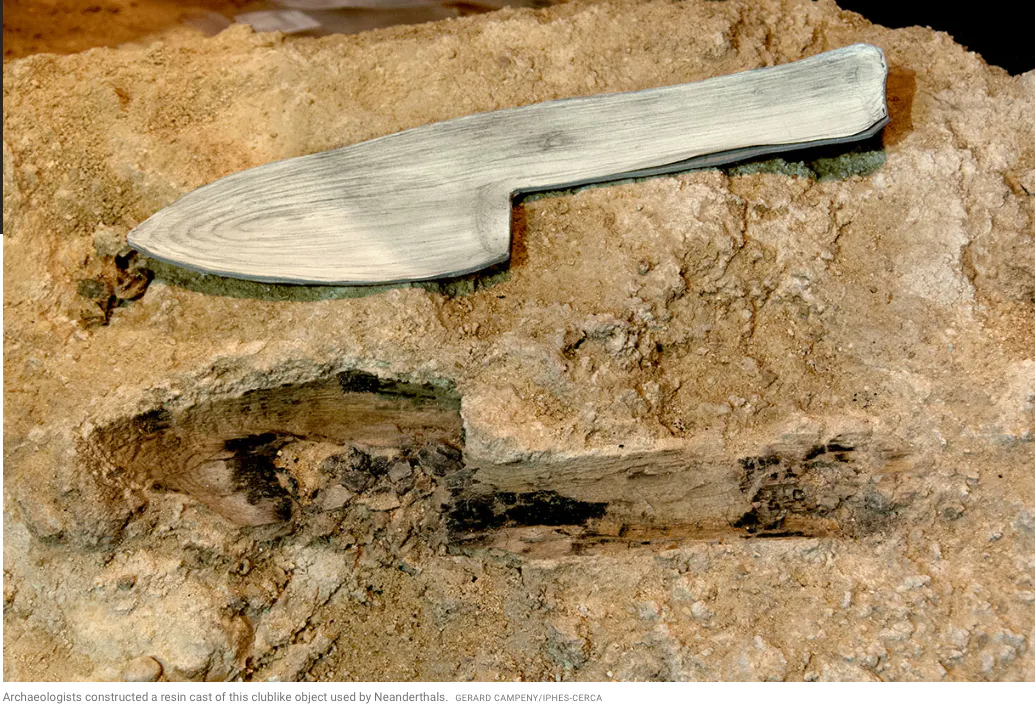
AAAS: "Neanderthals were skilled woodworkers, first-of-its-kind tool trove reveals," by Andrew Curry.
"More than 40,000 years ago, bands of Neanderthals turned a spacious rock shelter in the mountains of Spain into a cozy home, fashioning wood into tools + windbreaks + burning it for heat + light." This picture comes from a first-of-its-kind trove of Neanderthal wooden artifacts from a domestic space, found at a cliffside site called Abric Romaní, 50 km west of Barcelona.
"The objects mostly survived only as voids in the sediment; the original wood has decayed away, erasing some details." Added to even older evidence from sites in Germany + Italy, the tools from Abric Romaní provide strong evidence that our ancient hominin cousins were craftspeople roughly on par with our own species, the researchers published in Science Advances.
"Until now, most of the evidence for Paleolithic wood tools has come from muddy lakeshore sites where Neanderthals killed prey with wooden spears.' Abric Romaní, at 200 square meters, was a generous living space. Different types of fireplaces + concentrations of tools in various parts of the cave suggest Neanderthals divided it into separate sleeping + work areas.
"The team identified meter-long digging sticks near hearths + trash pits." In another spot, a straight, thin, 5-meter-long log stripped of branches might have served as the spine of a windbreak or perhaps part of a shelter for sleeping + resting. “We know what was happening in the kitchen, in the sleeping areas, in the hearths,” Chacón says.
“She credits periodic flooding for preserving the artifacts." Slow-rising water covered pieces of wood, animal bone, + stone tools while keeping animals from disturbing the floor of the shelter. "Over time, minerals in the water hardened into layers of travertine, a form of limestone."
"Uranium-series dates from the different layers show they were occupied between 60,000 + 40,000 years ago; core samples from lower, as-yet-unexcavated layers show people living at the shelter as early as 110,000 years ago."
A built environment, without landlords or rent raises. But periodic flooding perhaps not unlike today.