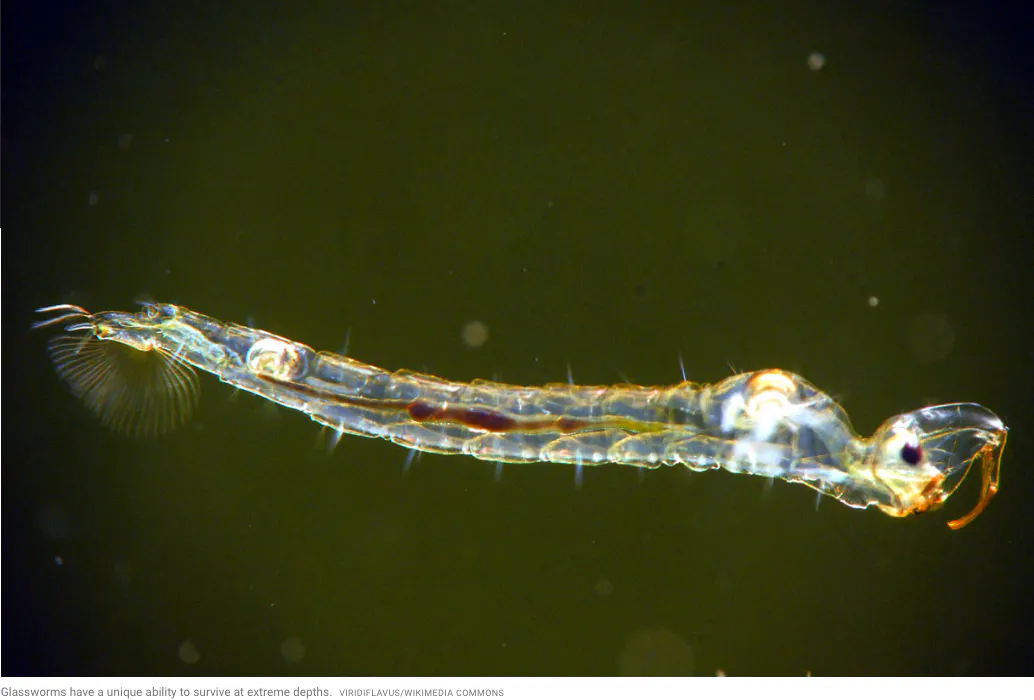
AAAS: "These insects should implode during deep dives. An unusual organ keeps them alive."
"Every day, tiny insect larvae descend into the murky depths of Lake Malawi, one of Africa’s deepest bodies of water." There, sometimes more than 200 meters down, these transparent “glassworms”—the young of the phantom midge fly (Chaoborus edulis)—wait it out while predatory fish roam the shallower waters.
"At night, the larvae return to the surface to feed under the cover of darkness." This daily migration means withstanding pressures 20 times greater than normal—a feat that would kill most humans and one thought impossible for insects, whose respiratory systems should implode under such conditions.
"Four long, banana-shaped air sacs expand and contract to adjust the glassworm’s buoyancy, yet they remain rigid enough to avoid being crushed—an adaptation not see in any other insect, researchers report [this wk] in Science."
Instead of lungs, insects have a tracheal system of air-filled tubes that run through their bodies, delivering oxygen + removing CO2. "Part of this system includes sacs that act as short-term storage for air." But unlike other insects, Chaoborus fly larvae don’t use these sacs to help them breathe, instead, they’ve converted them into organs that help them control their buoyancy.
"In 2022, Phil Matthews, a comparative physiologist at the University of British Columbia (UBC), + his team found that the air sacs were made up of bands of cuticles and resilin, a flexible protein, which itself is surrounded by a protective layer of tissue." Chemical changes in the larvae’s body cause the air sacs to expand “like an accordion” or shrink.
"To discover the limits of this system, Matthews and his colleagues turned to Lake Malawi." When Chaoborus larvae pupate and emerge as flies, he says, they “erupt out of the lake.” Using sonor, they found the glassworms reached a depth of 213 meters, though they sometimes dove as far as 258 meters = 846 ft.
Consider this your deep dive for today into insect physiology.