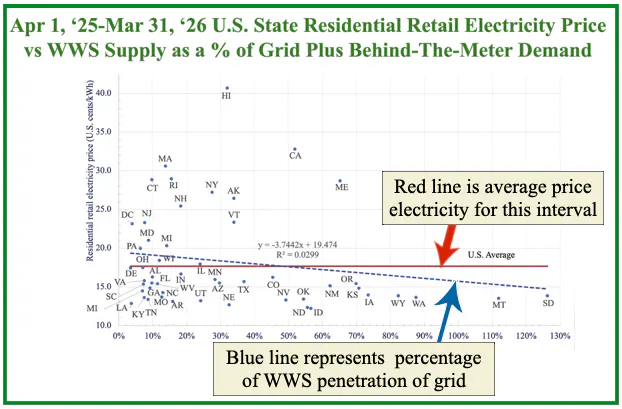
This is a companion piece to what I posted yesterday, Commenters in general sounds pretty serious when they claim that we can't afford solar + wind + storage 'because they make power less affordable.' This graph of all 50 states + D.C. + US territories plots residential retail electricity price against the fraction of electricity generation from renewable or sustainable power.
The red line is the average price per kWh for the twelve months up through the end of March this year, though actually at the moment the price is 18.44¢ per kWh, up 6.2% year-over-year. This is represented by the horizontal red line—flat as a pancake.
States such as Virginia + Louisiana + Kentucky on the left lie near the basement in terms of proportion of renewables on their grid.
Conversely, Montana + South Dakota on the right annually produce something l 120% of their demand, obviously exporting a lot of electricity to neighboring states. The blue line shows the inverse correlation between cost of electricity + higher fraction of renewables.
In 1932, U.S. Supreme Court Justice Louis Brandeis in an opinion used the phrase "states are the laboratories of democracy", which means individual state governments can try out + test new laws and social policies. With the data from yesterday + today we can see how these electrical laboratory experiments are playing out. Therefore, what we now know is 2 things.
First—while there are multitudinous influences on the grid—states that successfully experimented with renewables have lower electricity costs in 2026.
Second—solar + wind + storage in the grid of 2050 will take up less space than fossil fuels do right now.
I would like to argue that the data from yesterday + today should lay to rest at least some of the misinformation about solar + wind. Call me unrealistic, but I think of myself as rationally optimistic. Always.