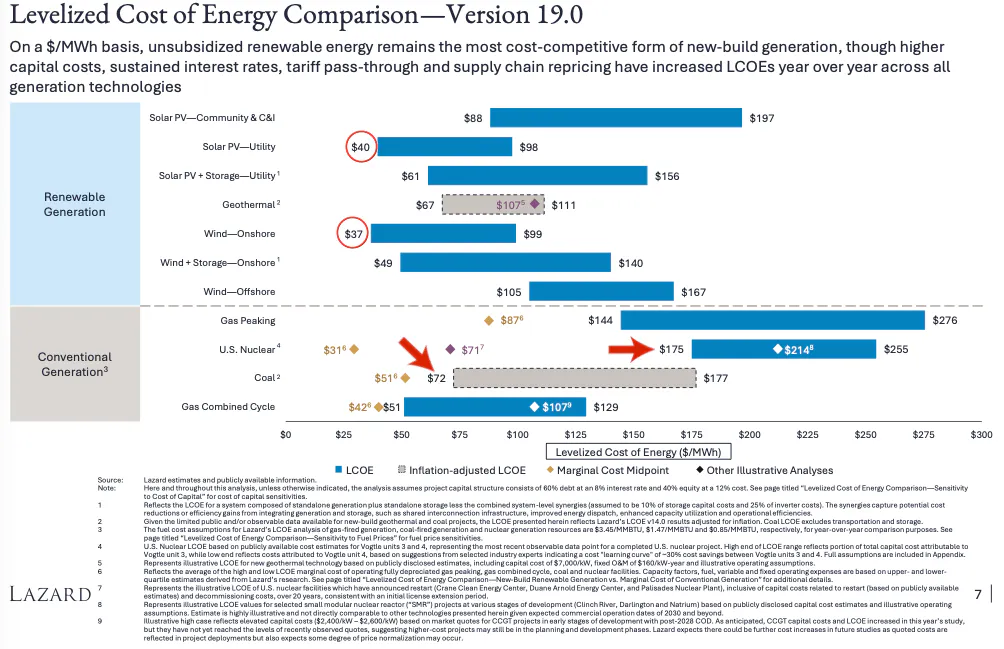
Lazard: "Levelized Cost of Energy Comparison—Version 19.0"
Weeks ago I discussed LCOE Version 18.0 from 2025, but mentioned that when the 2026 annual comparison arrived I would repost. The bars represent the range of cost for a given energy source, with all the subsidies stripped out, hence the designation "levelized," as in a fair playing field. Utilities think in megawatt-hours, but take away 3 zeroes + you get the kWhs that you see on your monthly electric bill.
Note first the lower end of utility-scale solar went up from $38 per megawatt-hour to $40 per MWh [red circle] from a yr ago.
Onshore wind, secondly, is unchanged from $37 per MWh [red circle]. [Wind with storage up from $44 to $49 per MWh].
These 2 sustainable generation assets continue to be the cost champions.
Coal is up from $71 to $72 per MWh [red arrow appropriately aiming down].
Nuclear is up from $173 to $175 per MWh [red arrow pushing ahead with over $100 billion of federal subsidies].
Setting aside for a moment the problems of radwaste, diversion of special nuclear material, radiation releases in the long front end + back end of the nuclear fuel cycle, major accidents—let's just focus on the economics of nuclear energy.
Nukes are slowest to build, + their electricity is the most expensive on the planet. So one can love nukes or not, but instead trust the market + let the chips fall where they may. Yes, we could have a long discussion about SMRs + other novel technologies, but none is proven yet in the US,+ we probably won't see operating plants until the mid-2030s at the earliest. Russia + China have the only examples of operating SMRs, but both are authoritarian countries that can just plow ahead + spend whatever they want. Is that who we are now?
And should the federal government be picking winners + losers anyway or should the market determine that?
And can any of you explain why globally the number of reactors has declined over the last 2 decades?
And why the world-wide share of nuclear electricity is down to 9%?
I look forward to some rational discussion of these points. And please take a stab at answering my questions. Thanks.