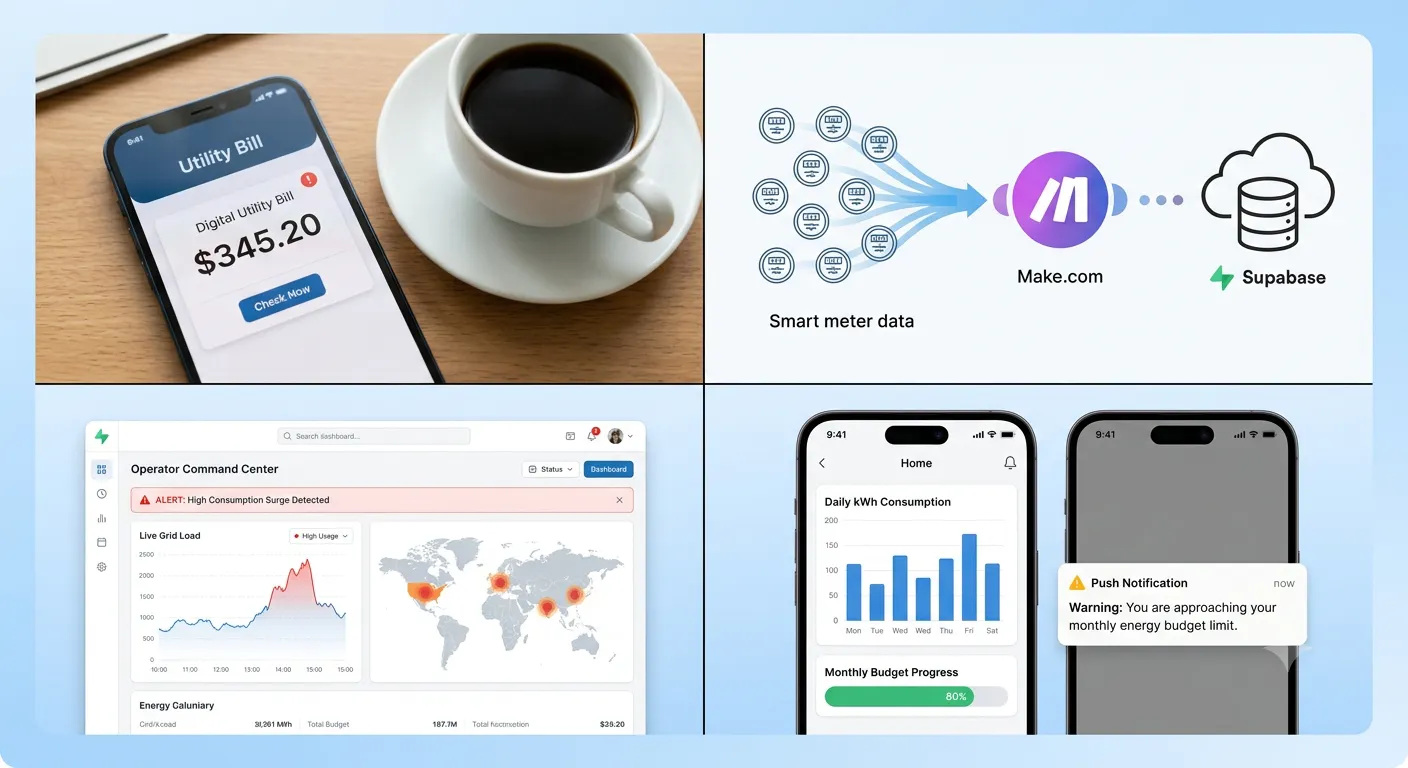
A few months ago, I opened my monthly electricity bill and almost dropped my coffee.
It was nearly double my usual average. No extra AC running, no new appliances, no obvious reason for the spike. When I called my utility provider to ask what happened, the representative was polite, but completely stuck. She had to search through three different internal software systems just to tell me: "Looks like there was a usage spike on the 14th, but I can't see what caused it."
That phone call stayed with me.
If a utility provider with all its infrastructure can’t easily track or explain energy data to a customer, imagine how much harder it is for their own field teams to manage grid efficiency behind the scenes.
Most people assume fixing this requires a $20 million enterprise software contract and a two-year deployment timeline. But it doesn't anymore.
When I sat down to see if a lightweight, modern alternative was possible, I realized you can actually build a working Energy Management App using no-code tools in just a few hours.
Here is the exact layout I mapped out:
Step 1: Connect the Data Pipeline
Smart meters are already collecting data every second. You just need a simple way to direct it.
Use Make.com or n8n to catch incoming data streams from meters or utility APIs.
Store that data in a fast relational database like Supabase or Xano (which handles high-volume data effortlessly).
Step 2: Build the Command Center
Operators don't need a hundred complex buttons; they need clarity.
Use Bubble or AppSmith to build a single dashboard showing live grid load and usage trends.
Set up simple automatic triggers: if usage surges past normal capacity, send an instant SMS alert to the field maintenance crew.
Step 3: Give Customers Real-Time Visibility
Avoid "bill shock" by giving users an easy way to monitor their own consumption.
Build a simple web app interface with FlutterFlow or Softr.
Show users their daily kWh usage, set a monthly budget threshold, and trigger a helpful push notification before their bill creeps into a higher tariff tier.
That frustrating phone call with my utility company proved one thing: the problem isn't a lack of energy data, it's that the data is locked inside old, clunky systems.
A simple, focused no-code app can bridge that gap in a weekend, proving that smart software doesn't have to be complicated to make a massive impact.