


When most people hear "nuclear reactor," they picture a massive concrete dome the size of a stadium — expensive, controversial, and slow to build. But a quiet shift is happening in how we think about nuclear power, and it's called the SMR. SMR stands for Small Modular Reactor. Let's break that down, because both words matter.
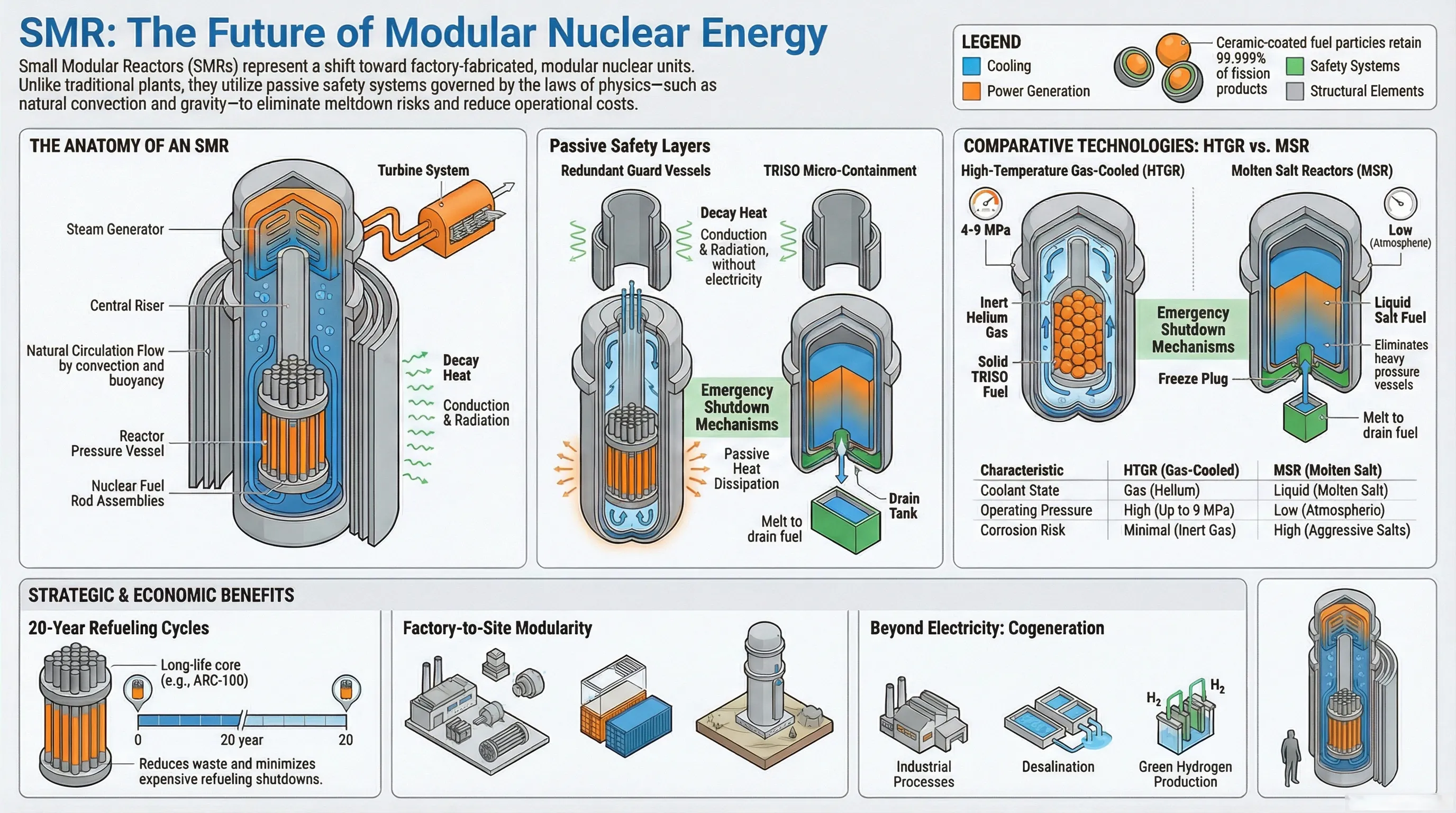
🔹 Small: Traditional reactors generate around 1,000+ megawatts (MW) — enough to power a large city. SMRs produce roughly 20 to 300 MW each. That's small enough that a single one could power a small town, a factory, a data center, or a remote mining site — not just a national grid.
🔹 Modular: This is the game-changer. Instead of building one giant custom plant on-site over a decade, SMRs are largely manufactured in a factory, then shipped and assembled like Lego blocks. Want more power? Add another module. Need less? Start with one.
🔹 Reactor: Same physics as the big plants — controlled nuclear fission splitting atoms to produce heat, which makes steam, which spins a turbine to generate electricity. But the engineering is smarter.
So why is everyone suddenly talking about them?
1. Speed and cost predictability
Big reactors routinely blow past budgets and timelines (a decade-plus to build). Factory production means standardized parts, fewer surprises, and faster deployment — often 3 to 5 years once manufacturing scales up.
2. Safety by design
Many modern SMR designs use passive safety systems — they rely on gravity, natural convection, and physics rather than pumps, switches, or human action to shut down safely if something goes wrong. Some can cool themselves for days without any power or operator intervention.
3. They fit where big reactors can't
Remote communities, industrial campuses, military bases, desalination plants, and hydrogen production facilities can all host an SMR. They also pair well with renewables — filling the gap when the sun doesn't shine and the wind doesn't blow.
4. Less waste, smarter fuel
Advanced designs run on fuel more efficiently and can even consume spent fuel from older reactors. The total volume of waste per unit of energy is small — a lifetime's worth for one person fits in a soda can, in physical terms.
The honest catch
SMRs aren't magic. The first units are still expensive because we haven't hit mass manufacturing yet. Regulatory approval varies by country. And public trust in nuclear remains a real hurdle. The technology is proven in concept; the challenge now is scale and economics, not physics.
Why you should care
As the world races to cut emissions while keeping the lights on, SMRs offer something rare: a source of clean, always-on, baseload power that doesn't depend on the weather.
#SMR #SmallModularReactor #NuclearEnergy #CleanEnergy #NetZero #AdvancedReactors #NuclearPower #Decarbonization #BaseloadPower #EnergyTransition