ClimateForwardNewsletter: "Birds are dying. Clues point to El Niño," by Catrin Einhorn.
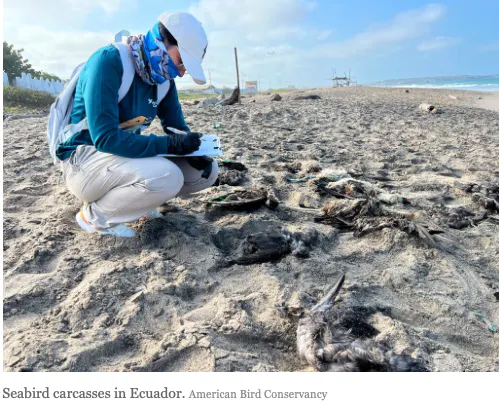
"Every month, Giovanny Suárez Espín walks a beach near his home in southern Ecuador, monitoring for dead seabirds." On recent surveys, the sand has been littered with carcasses. "It’s too soon to say for certain what has caused the spike in deaths, which has affected various species, including sooty shearwaters, Peruvian and blue-footed boobies, cormorants, petrels + the critically endangered waved albatross. Die-offs in sea birds aren’t uncommon, but these are unusually emaciated.
During an El Niño in the Pacific, the normal upwelling of cold, nutrient-rich waters weakens. Fewer nutrients near the surface lead to less phytoplankton, which leads to fewer small fish like sardines and anchovies, and so on up the food chain. “Larger fish have the opportunity to feed deeper if there are deeper resources available or to move out of the region, but the seabirds don’t have that luxury.
"Historically, seabird populations were much more robust than they have been in recent decades, which gave them better resilience during natural El Niño cycles." But between 1950 and 2010 alone, monitored seabird populations decreased by 70%. ”Coastal development is taking over habitats." Introduced predators like snakes and rats are decimating seabird eggs. "Fishing hooks [+ plastic] are choking them." Nets are drowning them.
"Then there is the bird-killing ocean heat, which isn’t always tied to El Niño but is intensified by climate change." About half of Alaska’s common murres, some four million birds, died as a result of a marine heat wave from 2015-16. In March and April, a marine heat wave in California may have been behind a brief increase in reports of dead birds, including brown pelicans, loons and grebes, said Krysta Rogers, environmental scientist focusing on avian investigations in California.
Since we are speaking of birds, recall the analogy of the canary in the coal mine. To extend this back further, link that coal burning to the devolving climate to the loss of seabirds. The connections are clear.
And the fossil fuel giants knew what was happening half a century ago.