


Feeling a little pain at your local gas pump today? Unpleasant, perhaps.
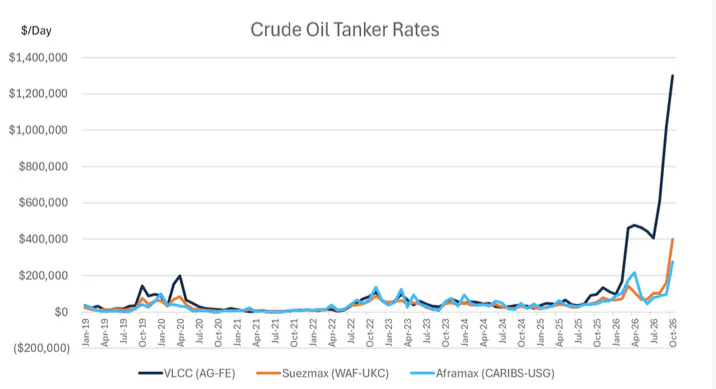
But you can bet it is nowhere near the pain oil shippers are feeling as crude oil tanker rates hit stratospheric heights.
As Poten & Partners’ October 2 Daily Market Report (DMR) notes, freight rates on many of the key routes for Very Large Crude Carriers (VLCC) show “eyewatering numbers.”
The report, produced by the global energy brokerage, monitors spot rates on major oil tanker trade routes.
Its October 2 dispatch reports that “across the board, tanker rates have reached levels never seen before.”
Example?
The DMR notes that January’s Brent crude oil price was around US$62 per barrel and the VLCC rates for the benchmark AG-Far East [Arabian Gulf to China, Japan, Korea] route were around US$30,000 per day.
That added roughly 3% (US$1.73 per barrel) to the delivered cost of crude on tanker traffic between the Middle East and the Far East.
Compare that equation with early October’s per-barrel market price for Brent crude (around US$120) and per-day VLCC rates (US$1.3 million). That’s just over 43 times the January tanker shipping price or a 4,233% increase.
According to Poten’s DMR estimates, it is the equivalent of an additional US$33 per barrel in shipping costs, or 27% of the delivered cost of the crude being shipped.
That, my friends, is world-class pain at the pump.
So, the 40% hike in average retail gasoline prices in the United States over the same period (to US$4.60 per gallon from US$3.30) and the 45% spike in national average gas prices in Canada (to $1.85 from $1.27 per litre) are far down the economic pain scale compared with crude oil shipping.
Where’s the pleasure in all this pain, you might ask?
Over at the oil tanker owners’ table, for starters, where consolidation, especially during the past year, has increased their negotiating leverage over tanker charterers.
At last count, the top 10 VLCC owners controlled approximately 48% of the non-sanctioned mainstream tanker fleet.
With roughly 130 VLCCs, South Korea’s Sinokor Merchant Marine alone controls an estimated 14% of the global fleet.
So, lots of crude pleasure there.
Also, you will find many smiling faces in the used VLCC market.
Konstantinos Nikolopoulos noted recently that a five-year-old VLCC “is now valued at US$215 million compared with US$131 million for a newbuilding.”
The ship finance expert at Swiss multinational financial services firm UBS Group (NYSE:UBS) pointed out that the premium of roughly 64% for a ship that is already in service compared with one that has yet to hit the water reflects the current VLCC market’s buoyancy.
“An existing vessel can capture today’s earnings,” Nikolopoulos points out, “while a newbuilding buyer has to wait for delivery.”
He contrasted the used-versus-new VLCC market with its dry bulk carrier counterpart, where a five-year-old Capesize bulk carrier is valued at US$75 million compared with US$76.5 million for a new one.
The main VLCC price inflation drivers are the usual suspects: Wars in Europe and the Middle East, attacks on Strait of Hormuz shipping, ship security concerns in the Bab el-Mandeb Strait and the Black Sea, and the subsequent spikes in vessel insurance and risk premiums.
Poten also points to the aforementioned VLCC ownership consolidation.
Add in resurgent crude oil demand in China and voyage rerouting that can add anywhere from 10 to 30 days to Mediterranean-Asia voyages compared with direct Arabian Gulf to China trade lanes.
A voyage's degree of difficulty for VLCCs also adds to crude oil shipping price premiums.
The DMR estimates, for example, that a long-haul cargo from the U.S. Gulf to Asia currently yields approximately US$400,000 per day for a VLCC owner, while an Arabian Gulf-to-Asia trip would generate closer to US$1 million per day.
So, add trade lane disruption, rerouting and an overall inefficiency of crude oil transportation to the tanker cost calculus.
As always, demand will dictate rates.
So, when lower demand and higher supply ease the pain at your local gas pump, the pain on the VLCC ownership bridge will increase, because, as Poten points out, “as soon as the crude oil market loosens, tanker rates will come off the boil quickly.”
No boil, no oil traffic freight rate bonanza.
www.linkedin.com/in/timothyrenshaw
@timothyrenshaw