


Boston imported liquefied natural gas (LNG) from Russia in 2018 due to inadequate gas supplies for both heating demand and for electricity generation in the region. But why has this situation arisen, and what are the implications for New Englanders for both the cost of energy and the presence of excess emissions?
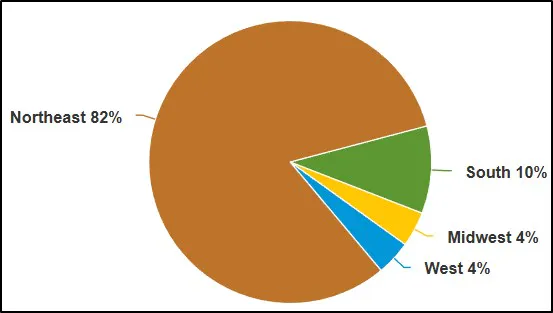
About 20% of households in the New England (3.93 million consumers) use heating oil as their main space heating fuel, and they account for about 82% of the U.S. households that use heating oil for space heating, consuming over 3 billion gallons of heating oil per year. By state, heating oil is the most common primary heating fuel used in 37.91% in Connecticut, 59.13% in Maine, 23.80% in Massachusetts, 41.74% in New Hampshire, 17.91% in New York, 27.65%in Rhode Island, and 40.88% in Vermont per EIA data. New Englanders use about 82% of all heating oil consumed in the U.S. as shown by Graph 1.
Graph 1: Heating Oil Demand By Region 2023-2024
https://www.eia.gov/energyexplained/heating-oil/use-of-heating-oil.php
Another view of New England’s use of heating oil is shown in Graph 2,
Graph 2 - How Do Americans Heat Their Homes

Heating Cost:
Since New England (NE) is the highest consuming U.S. region for the use of heating oil, Graph 3 shows the 36-year price history.
Graph 3: New England Heating Oil Price History October 1990 – January 2026
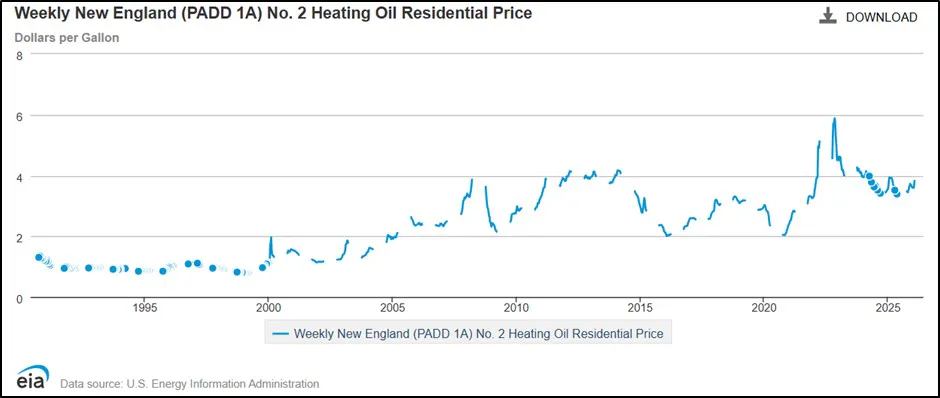
In January 2026, heating oil in New England was priced at $3.83 per gallon for 139,400 British Thermal Units (BTU), while emitting 73.96 kilograms of carbon dioxide (CO2) per million BTUs.
Assuming New England’s annual heating oil consumption is estimated at 3 billion gallons, the annual heating cost is $11.49 billion for a heating consumption of 0.4182 billion BTUs.
The Marcellus Field in Pennsylvania is the 2nd largest oil and gas producing basin in the U.S. behind the Permian Basin in Texas and southeastern New Mexico. The price history for January 2026 of Marcellus natural gas is shown below in Graph 4.
Graph 4: Marcellus Natural Gas Price History March 2025 - January 2026
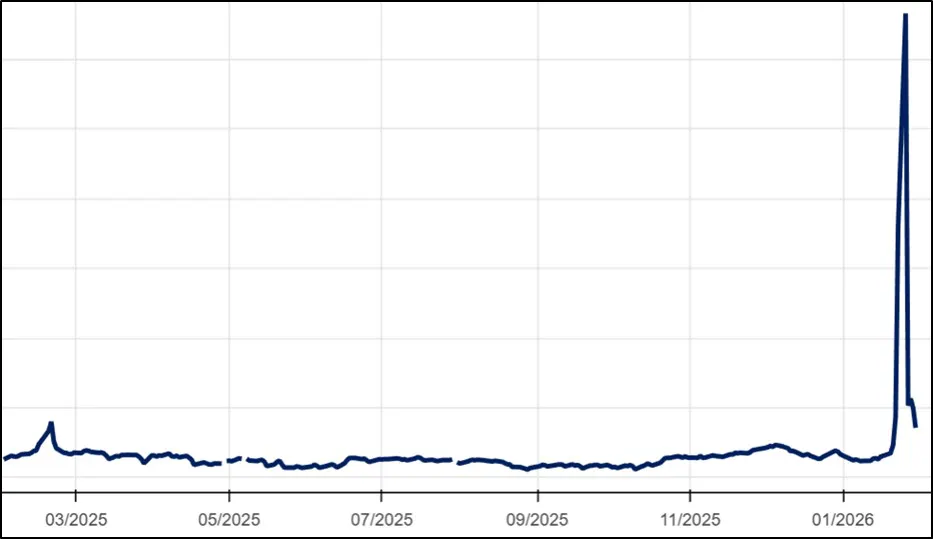
Natural gas from Pennsylvania’s Marcellus field is priced at $3-5/million BTU, and emits 53.06 kilograms of CO2 per million BTUs.
For supplying New England’s annual heating demand of 0.4182 billion BTUs as mentioned above, the cost of that heat for natural gas using a $4/million BTU price would be $1.673 billion.
Natural gas for New England would save consumers ($11.49 - $1.67), or $9.82 billion per year. Heating with heating oil is (11.49/1.67), or 6.88 times more expensive to the consumer per unit of heating (BTU).
Heating Emissions:
Heating with heating oil for New England annually emits 30.92 million kilograms of CO2, or 68.03 million pounds of CO2.
Heating with natural gas for New England annually emits 22.18 million kilograms of CO2, or 48.80 million pounds of CO2.
Natural gas emits 28.26% less CO2 emissions than from heating oil, therefore, natural gas in New England would save consumers (68.03-48.80), or 19.23 million pounds of CO2 per year. Said a different way, residential heating with heating oil is 39.39% more polluting to the environment than is heating with natural gas.
Expanded Use Of Heating Oil During January 2026:
On Jan. 26, 2026, due to Sunday’s significant snowstorm and the NE power grid with increased demand, the grid operator had federal government permission to prioritize reliability over air quality or other typical considerations.
At ISO-NE’s request, U.S. Secretary of Energy Chris Wright issued an emergency order allowing the grid operator to tap into the maximum output of certain power generation sources through Saturday, Jan. 31 in a bid to prevent blackouts.
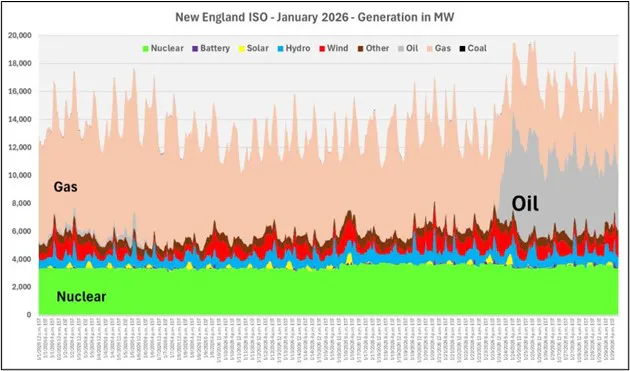
With the extended cold in New England in January 2026, natural gas to satisfy power stations has been inadequate, necessitating the use of even more heating oil, this time for electricity generation than for residential heating as shown in Graph 5.
Graph 5: New England ISO January 2026 Generation In MW and By Source
Source: https://lnkd.in/gACnu4qx
New England's reliance on natural gas generation drove energy bills up:
Energy rates, particularly those for electricity, are higher in New England than in most other parts of the country. That's primarily because the region has an overreliance on natural gas – it was responsible for 55% of generation in 2024 – and a constrained supply of the fossil fuel.
The impact becomes particularly pronounced in the winter when pipelines are at capacity and the regional electric grid must turn to more expensive peaker power plants that burn oil to supplement supplies.
Because natural gas is so important for power generation in New England, plants that use the fuel normally set the wholesale electric price in the region. Nationally, natural gas prices are rising, according to the U.S. Energy Information Administration, and they are expected to continue to go up.
The trend is more pronounced in the Northeast because of pipeline constraints. The average gas price in Massachusetts this past November was double what it was in November 2024, according to Independent System Operator New England, the nonprofit that manages the regional power grid.
Assuming this recent dependency upon heating oil for electricity generation becomes a more common event, the graph suggests that 5,000 megawatts (MW) is used in addition to the heating oil used for residential heating. For the month of January to supply 5,000 MW each hour would require 93 million gallons of heating oil at a cost of $356.19 million.
For the same production of 3.72 million MWh of electricity needed with natural gas and a conversion of 3.41 MMBTU per MWh, the requirement would be 12.69 million MMBTU of natural gas required with a cost of $50.74 million.
Just for the month of January 2026, consumers in New England paid 7.02 times the price to generate electricity with heating oil vs. natural gas, or $305.45 million more.
In addition to the increased cost, New England consumers are creating 583.49 million pounds of CO2 for using heating oil to produce electricity than with natural gas just for the month of January 2026.
What is the widespread use of fuel oil for home heating and the fuel acting as backup to natural gas in the ISO New England generation during the coldest winter days doing to help the clean energy goals of the Northeast U.S. states?
Alternatives To Heating Oil:
The U.S. is #1 in natural gas production and LNG export in the world with arguably the lowest price natural gas in the world.
Action to import Russian LNG only increases the price of gas to U.S. New Englanders, while also introducing greater environmental risk due to a long gas supply line (4,500 miles one-way) from Russia while those tankers add more emissions to our environment.
Plenty of gas is available from the Marcellus Field in Pennsylvania, Ohio, and West Virginia, however, insufficient New York (NY) pipeline capacity and lack of NY ambition inhibits the free market working its wonders for NE residents.
NE is lacking, and also unwilling to build, enough natural gas infrastructure to have gas delivered from the Marcellus shale and the Appalachia region.
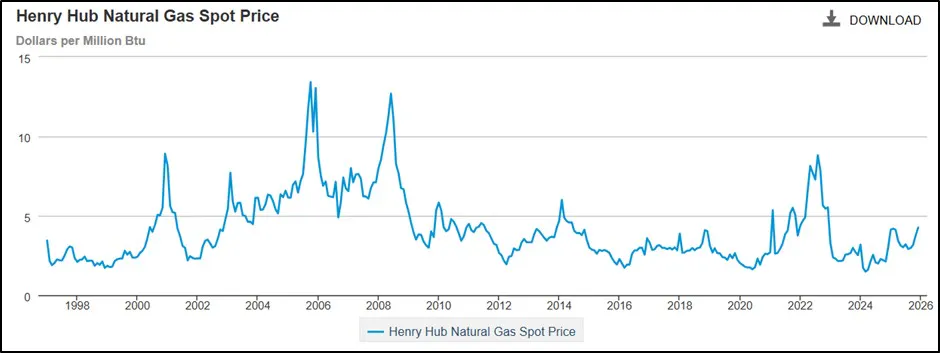
As New Englanders consider alternatives for heating and electricity demand, they could consider Graph 6 below with the history of Henry Hub (Louisiana) natural gas prices, and its relative stability after the fracking revolution in 2008. The prices for natural gas from the Marcellus Field in Pennsylvania reflect the overall national market from the Henry Hub pricing.
Graph 6: Henry Hub Natural Gas Spot Price History
Source: https://www.eia.gov/dnav/ng/hist/rngwhhdm.htm
The bottleneck of inadequate natural gas and pipeline capacity has forced NE ratepayers to foot the bill for importing costly international LNG from countries like Algeria, Qatar and even Russia in recent years, and/or use expensive and more-polluting heating oil for electricity generation.
The imported, more expensive LNG is transported all the way from Algeria and Trinidad instead of the U.S. Moreover, LNG is trucked rather than piped to the power-generating consumers, increasing CO2 emissions. There is no reason for this.
Former New York Gov. Cuomo's threat appeared to be short sighted as alternatives he stated were shipping gas via trucks vs. pipeline delivery. Those alternatives would be more costly to consumers, with more environmental and safety risk. With no new gas pipelines allowed in the state and no fracking, future winters could be very cold for New Englanders and New Yorkers...a man-made catastrophe. Under Cuomo, New York had unilaterally halted interstate pipeline construction, undermining the ability of other northeastern states in the region from accessing low-cost, American natural gas.
The article picture shows the Gaselys LNG tanker sitting at the Engie SA Everett import terminal in Boston on 28 Jan 2019. The giant tanker was carrying the first LNG exported by the Yamal facility, a $27 billion project whose majority owner is the Russian company Novatek. The Everett LNG terminal is the only LNG import terminal still operating in the lower 48 for the last 40 years, is owned by the giant French multinational Engie, and meets about 20 percent of the market demand for gas supplies in NE and the Northeast. Source: https://www.washingtonpost.com/business/economy/tanker-carrying-liquefied-natural-gas-from-russias-arctic-arrives-in-boston/2018/01/28/08d3894c-0497-11e8-8777-2a059f168dd2_story.html
The cold snap in NE early in 2019 and the shortage of pipeline capacity from gas-rich Pennsylvania created an appetite for natural gas imports even as the United States has exported LNG from other terminals on the Gulf Coast. Earlier in May 2019, some utilities resorted to burning relatively costly oil to meet heating demand, further exasperating CO2 emissions problems.
The U.S. has been the world’s No. 1 natural gas producer in every year since 2009, yet NE has a shortage of pipeline capacity from gas-rich Pennsylvania that has caused the LNG importation from the Russian Arctic 4,500 miles away. In spite of a huge supply of domestic natural gas, NE relies on imported LNG from faraway countries for about 20% of its supply.
What is the issue with solving this supply problem with increased pipeline capacity through New York? Perhaps political obstacles driven by environmental groups?
Over the past two years, two major natural gas pipeline projects have been cancelled due to regulatory issues. Massachusetts and New Hampshire blocked the $3 billion Access Northeast Pipeline.
People in NE should have access to reliable and affordable natural gas produced here in the United States, not in Russia’s Arctic. Expanding the pipeline capacity from the Marcellus shale gas fields in Pennsylvania to the NE region makes more sense than importing LNG. Even the Boston Globe has criticized the importation of LNG from Russia into the Everett LNG Import Terminal near Boston's Logan Airport.
While Massachusetts is importing LNG from Russia, Eastern and Western Europe (Latvia, Estonia and Lithuania) want to find other sources of natural gas and are coming to the United States as a growing source of LNG. Massachusetts’ anti-fossil-fuel policies are the primary reason why the state has relied on LNG imports from a Russian company that the State Department sanctioned during the Obama Administration.
Without access to cleaner-burning natural gas that is cheaper per million British Thermal Units (BTU) than fuel oil, the Northeast is saddled with higher CO2 emissions and higher cost for the NY decision to ban gas pipelines into the region.
LNG results in greater emissions than pipeline gas because cooling the gas to minus 260 degrees Fahrenheit and then shipping and re-gasifying it requires more energy than pumping natural gas through domestic pipelines. Generally, LNG produces 5 to 10 percent more emissions over its entire life cycle than piped gas.
Summary:
The reasons for the NE to use American natural gas instead of importing Russian LNG are the following:
1. Less LNG tankers at sea over 9,000 round trip miles, less fuel oil emissions
2. Safe, lower-cost, reliable supply of U.S. natural gas for U.S. citizens
3. Less emissions (18.5 million tons of CO2 per year) from reliance on 3 billion gallons of heating oil in the Northeast per year
4. Less energy expense for NE consumers of relatively-lower cost U.S. gas vs. Russian LNG with a premium of 200% over U.S. gas
5. We can be more energy-independent if we will let science, good business acumen, and common sense rule the day vs. purely political decisions.
I welcome your comments and questions, and the opportunity to assist you with your energy questions and concerns. I am the principal at Reliant Energy Solutions LLC, a Professional Engineer, Certified Energy Manager, Renewable Energy Professional, and can be reached at [email protected] . My website is: www.reliantenergysolutions.com
“It is better to debate a question without settling it, than to settle a question without debating it.” Joseph Joubert
Copyright © April 2026 Ronald L. Miller All Rights Reserved
#energy #newengland #fueloil #naturalgas #LNGimports #russiangas