


On 24 August 2026 Norway made two announcements. Europe noticed one of them. Oslo will develop Barents Sea oil and gas whatever Brussels decides about an Arctic moratorium. It also said it no longer sees itself as Europe’s green battery and will build no new interconnectors. The first announcement is a fight about climate policy. The second is a retreat from deeper integration with the European electricity system, and it is the more consequential of the two.
SECTION I
What was said
Terje Aasland gave the interview at ONS in Stavanger, Norway’s biannual energy conference. Three statements matter.
Barents development proceeds regardless. Norway will continue developing oil and gas in the Barents Sea whether or not the EU maintains its Arctic moratorium. Aasland framed it as a sovereign right: Norway would develop the areas, and it would then be for the Union to decide whether it wanted a moratorium on buying the output.
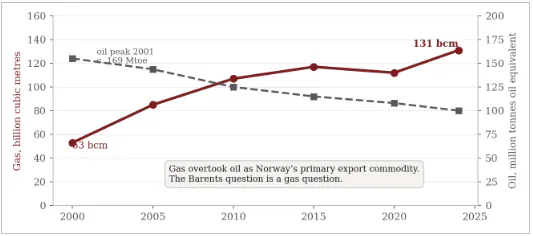
The output has somewhere else to go. Arctic oil sells into global markets regardless of European policy. Arctic gas can be liquefied at Equinor’s Melkøya plant near Hammerfest and shipped anywhere. The moratorium constrains European purchasing, not Norwegian production.
The green battery is over. Norway no longer accepts the role, will build no new interconnectors, and instead urges continental Europe to fix its own dispatchable supply, weakened by coal and nuclear closures and by underinvestment in gas generation.
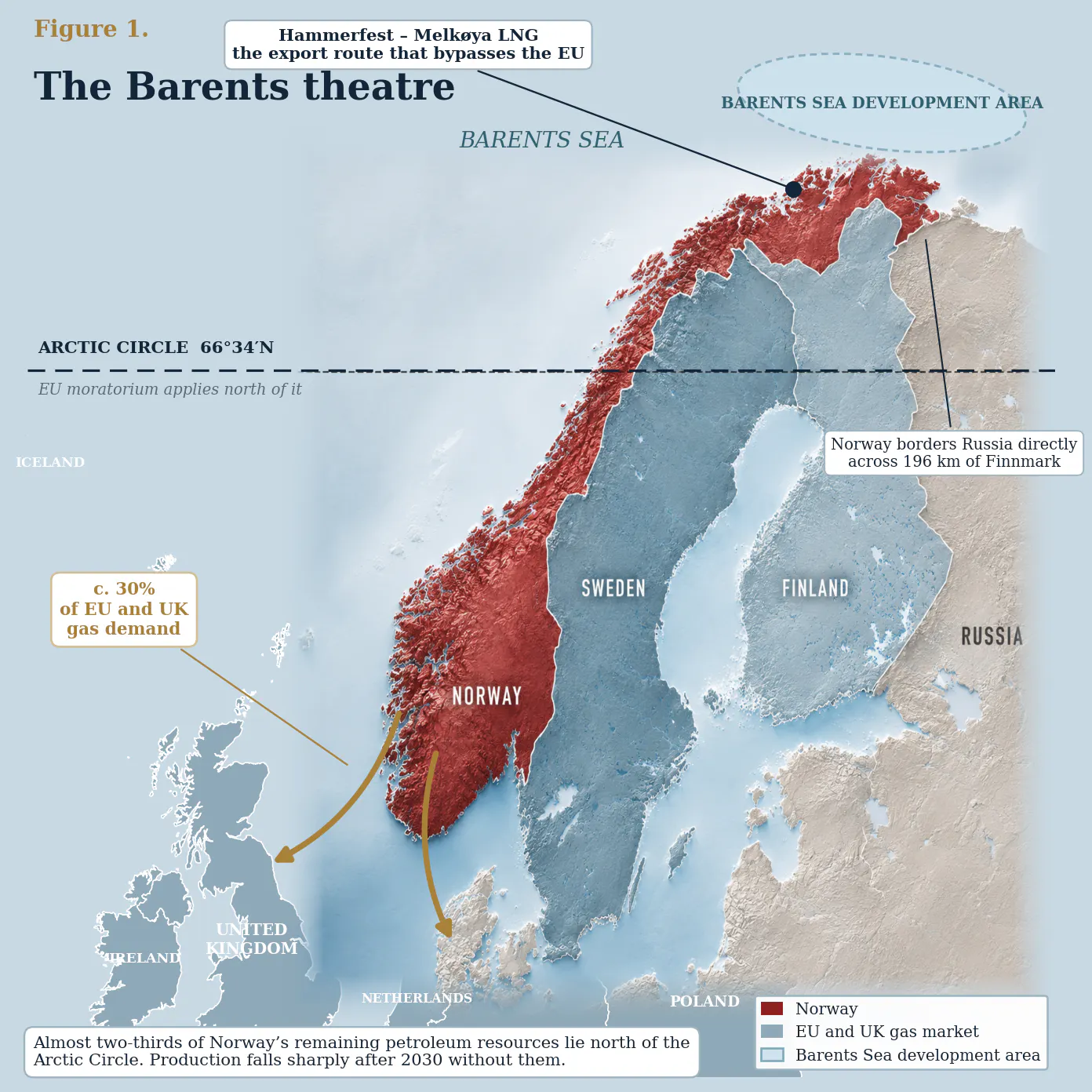
Figure 1. The Barents theatre. Almost two-thirds of Norway’s remaining petroleum resources lie north of the Arctic Circle, inside the area the EU moratorium covers. Melkøya LNG is the route that makes European consent optional. Borders drawn from Natural Earth 10m administrative data. Sources: Reuters; Bloomberg; Norwegian Petroleum Directorate.
SECTION II
Why Norway decided this
First: a production cliff after 2030
Norwegian gas output was near record levels in 2025 and oil reached its highest since 2009. Official forecasts show production falling sharply after 2030 unless new fields are found and developed. Almost two-thirds of remaining resources sit north of the Arctic Circle. There is no version of maintaining Norwegian output to 2035 that does not involve the Barents Sea.
The timing is not negotiable either. WWF estimates roughly eighteen years from discovery to production start in the Barents. A decision deferred to 2030 is a field producing in the late 2040s. Oslo is not choosing between drilling now and drilling later; it is choosing between drilling now and not drilling.
Article content
Second: the fiscal machine
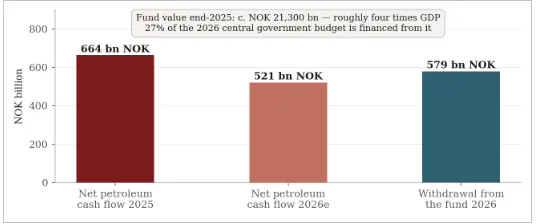
The state’s net cash flow from petroleum was NOK 664 billion in 2025 and is estimated at NOK 521 billion for 2026, on the October budget. The revised national budget puts total net government cash flow at NOK 686 billion for 2026, a materially different figure on a different boundary; both are reported as published.
That money does not fund current spending directly. It enters the Government Pension Fund Global, worth around NOK 21,300 billion at end-2025 — roughly four times Norwegian GDP, about NOK 3.8 million per resident, and the largest sovereign fund in the world. The fiscal rule permits withdrawals up to the fund’s expected real return of 3 per cent; the 2026 budget draws NOK 579 billion, or 2.8 per cent. Transfers from the fund finance approximately 27 per cent of the central government budget.
Article content
STRATEGIC HORIZON (SH) ASSESSMENT — WHAT THE FUND ACTUALLY DOES
The oil fund is usually described as the mechanism by which Norway escaped dependence on oil. It is at least as accurate to call it the mechanism by which Norway made continued production politically painless. Because the revenue is laundered through a global equity portfolio before it reaches the budget, no Norwegian voter experiences a barrel of Barents crude as the thing paying for their hospital. The connection is real and invisible at the same time.
This is why the Norwegian position is stable across governments and why external pressure has so little purchase on it. Twenty-seven per cent of the state budget is not a lobby to be outmanoeuvred. It is the fiscal architecture of the country.
Third: sovereignty, and a domestic price revolt
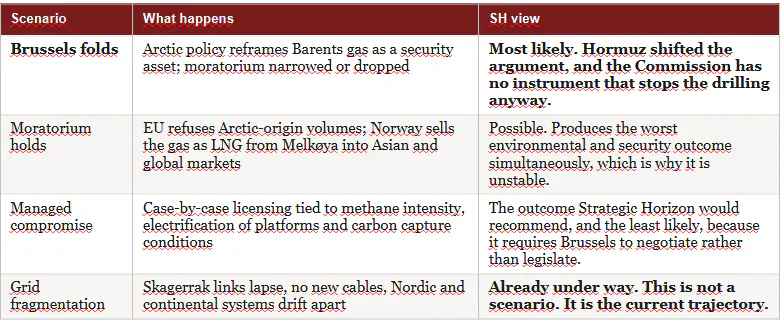
Since NordLink and North Sea Link opened in 2021, southern Norwegian prices have tracked continental levels while the north stayed cheap, shielded by limited internal transmission. In December 2024 the NO2 zone reached NOK 13.16 per kilowatt-hour, the highest since 2009 and roughly twenty times the previous week. Energy became the most divisive issue in Norwegian politics. Both governing parties campaigned in the September 2025 election on not renewing the Skagerrak links to Denmark. The Centre Party goes further, favouring renegotiation of the German and British agreements and export restrictions above a price threshold.
Aasland’s statement is therefore not a surprise turn. It is the ratification of a position Norwegian domestic politics settled some time ago.
SECTION III
The paradox, and why it is not one
The obvious objection: how does the most electrified society in Europe justify this?
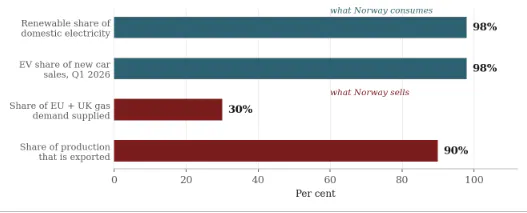
The numbers are not in dispute. Norway generates 98 per cent of its electricity from renewables, 89 per cent hydro and around 10 per cent wind. Electric vehicles were 95.9 per cent of new car sales in 2025 and 98 per cent in the first quarter of 2026; roughly a third of the entire car fleet is now electric. Around two-thirds of homes have a heat pump, in the country with Europe’s coldest winters. On any domestic metric Norway is the most advanced energy transition on earth.
It is also Western Europe’s largest oil and gas exporter, supplying about 30 per cent of EU and UK gas demand, and it exports almost everything it produces.
Article content
SH ASSESSMENT — THE ACCOUNTING, NOT THE HYPOCRISY
This is not hypocrisy. It is territorial emissions accounting working exactly as designed. Under the Paris framework, emissions are counted where fuel is burned, not where it is extracted. A tonne of Norwegian gas burned in Germany is a German emission. Norway therefore holds a genuinely clean domestic ledger and a genuinely large export business, and both statements are true under the rules everyone agreed to.
The strategic reading matters more than the moral one. Norway has decoupled its own energy consumption from the commodity it sells. That is not an accident of hydrology; it is the position a producer state wants to hold when the product it sells is in structural decline. Domestic electrification is not in tension with continued extraction. It is what makes continued extraction survivable, because it removes the domestic constituency that would otherwise feel the cost.
SECTION IV
What the EU wants, and what it can actually do
The European Union has supported a ban on new Arctic drilling since 2021, on climate grounds, defining the Arctic as the area above the polar circle. Norway disputes what that definition should mean for drilling. A new EU Arctic policy is due, and Norwegian politicians, civil servants and industry lobbyists have been in Brussels through 2026 arguing that Barents gas should be treated as a security question rather than a climate one. The other direction is also organised: asset managers, academics and climate groups wrote to the Commission urging it to maintain and reinforce the protections, warning of irreversible environmental damage and of locking in fossil dependence past the 2050 net-zero target.
Brussels is caught between two of its own commitments, and the Hormuz disruption of March 2026 moved the balance. Prime Minister Støre had already put the argument publicly in June: is it genuinely safer for Europe to buy gas from the United States or the Middle East than from a neighbouring ally?

Article content

Article content
Two timetables run in parallel and neither waits for the other. The Commission closed its Arctic consultation on 16 March 2026 and the revised policy follows; Rystad reads it as an opportunity to keep Barents volumes in play for the 2030s by drawing a narrower geographic and operational boundary without abandoning the climate position. On the Norwegian side, the regulatory consequences go before the Storting in the autumn session. Decisions taken after October 2026 should check both.
SH ASSESSMENT — THE MORATORIUM IS A PURCHASING DECISION, NOT A PRODUCTION ONE
Aasland framed the point precisely, and Brussels should read it carefully: Norway will develop the fields, and the EU may then decide whether to have a moratorium on buying the output. The Union has no jurisdiction over the Norwegian continental shelf. What it can regulate is what enters its own market. The moratorium therefore does not prevent Arctic extraction. It determines whether Arctic molecules arrive by pipeline from an ally or by tanker from somewhere else, having first been sold to a buyer with fewer objections.
That is the same structural error identified in Energy Statecraft Vol. 02 on the LNG question. An instrument that governs European purchasing while the underlying activity continues elsewhere does not reduce emissions. It relocates the counterparty, and usually to a worse one.
SECTION V
The second announcement, and who it hits
The Barents statement will generate the headlines. The interconnector statement will generate the consequences.
Article content
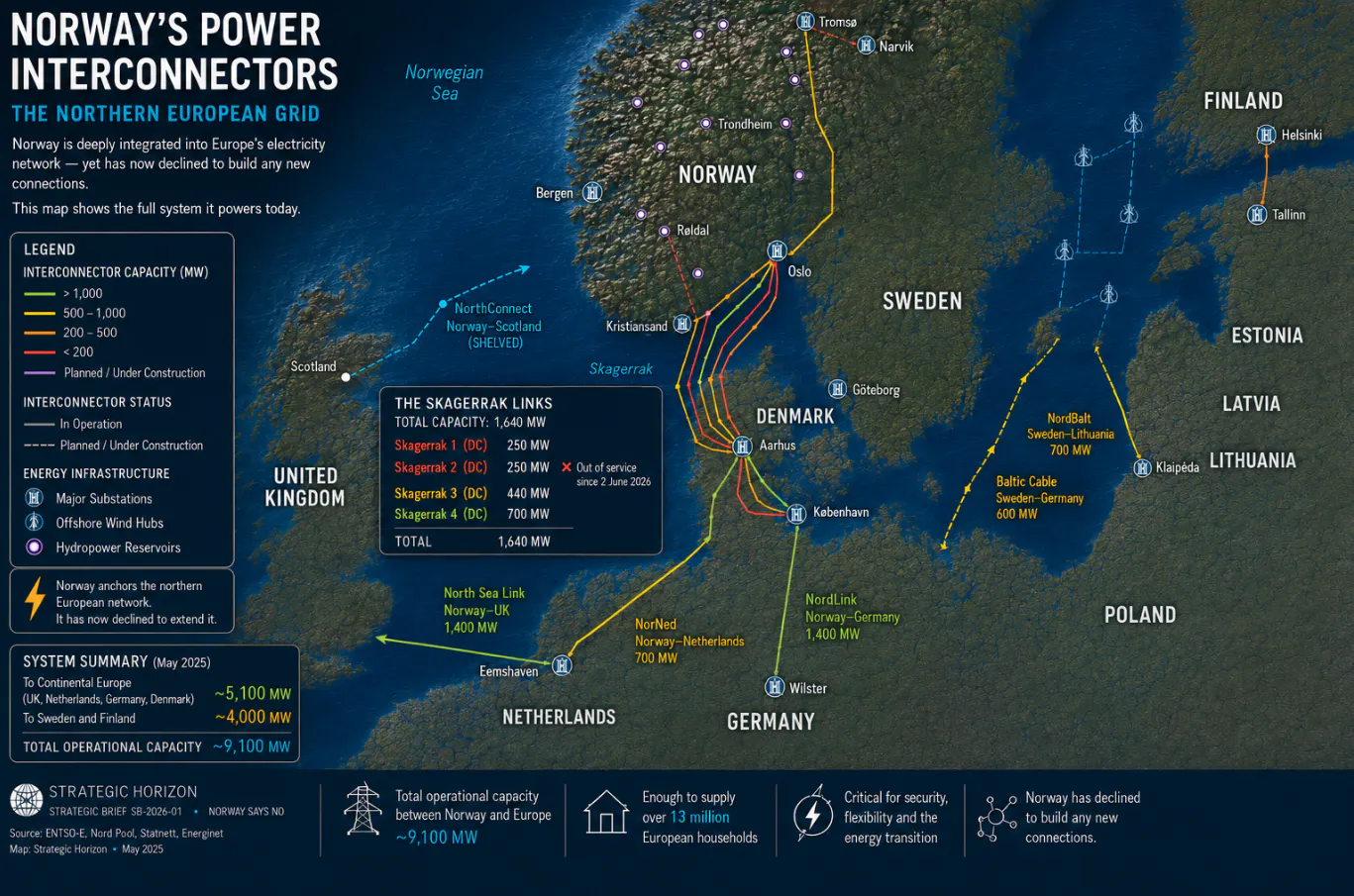
Norwegian reservoirs account for close to half of Europe’s energy storage capacity. The green battery concept — continental wind surplus stored in Norwegian reservoirs, returned when the wind drops — was the organising idea behind a decade of cable building. Aasland has retired the concept without cancelling the existing links: no new interconnectors, continued cooperation on what is already built. Both statements are true, and the difference between them is capital expenditure. What Europe loses is not current capacity but the option on more of it.
Article content
Denmark
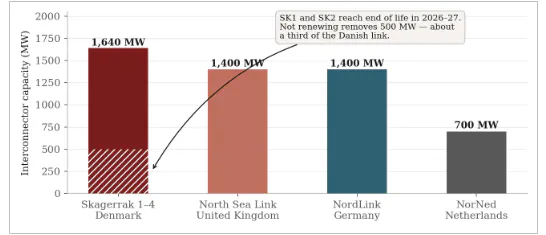
Most exposed. Skagerrak 1 and 2 entered service in 1976 and 1977 and reach the end of their technical lives in 2026 and 2027. Skagerrak 2 has been offline since June 2026 with a cable fault — sabotage ruled out, wear attributed — and Statnett has not excluded scrapping it outright. Non-renewal removes 500 MW of the 1,640 MW Danish link, roughly a third of it. Denmark also serves as a transit country for Norwegian power onward to Germany, Britain and the Netherlands, so the loss is not bilateral.
United Kingdom
North Sea Link, 1,400 MW between Kvilldal and Blyth, can carry around 12.3 TWh a year and was expected to deliver net imports of up to 10 TWh — roughly 4.2 per cent of British demand. Britain has no new Norwegian capacity coming: Norway suspended all further interconnector projects pending evaluation of NSL’s effects, including the merchant cable to Scotland. With nuclear and offshore wind both behind schedule, Britain remains structurally dependent on imported electricity, and its Norwegian option is now fixed at its current size. The June 2025 NSL trip, which cost 1.4 GW instantly and pulled British frequency to 49.66 Hz, is the shape of the exposure.
Sweden and Finland
Less directly hit, more systemically affected. The Nordic system is one coupled market: a hydrological shortage in Norway and Sweden reaches Finnish bills. Analysis for Nordic Energy Research finds that reduced interconnector availability would lower Nordic consumer prices but cut generator revenues by more, producing a net welfare loss concentrated in net exporters — Sweden above all. Sweden has meanwhile been running its own north-south price divide, with SE4 prices roughly double those of the north.
SH ASSESSMENT — WHAT NORWAY IS ACTUALLY SAYING TO ITS NEIGHBOURS
The green battery was always a bargain with an unstated term: Norway supplies flexibility, and in exchange Norwegian consumers do not pay continental prices. That term broke in 2021, and the political system removed the rest of the bargain. Nobody in Oslo is arguing that interconnection is uneconomic for Norway. Statnett has said the opposite. The argument is distributional, and the losing side is domestic.
The message to Copenhagen, London, Berlin and Stockholm is not that cooperation ends. It is that the storage will not be built, and each of them must now cover its own flexibility. That is a capital instruction, delivered as a diplomatic courtesy, and it lands on systems that had planned around the opposite. Aasland made it explicit when he told Europe to strengthen its own dispatchable supply, which coal closures, nuclear closures and gas underinvestment have weakened.
SECTION VI
Moscow and Helsinki
Russia — the same ocean, a different flag
The Barents is a shared sea, and the other littoral state is already doing what Brussels is deciding whether to permit. Russia operates Yamal LNG and the sanctioned Arctic LNG 2, ships through the Northern Sea Route, and has spent three years building the logistics to keep doing so under sanctions.
The results are uncomfortable reading against the moratorium debate. Russia exported 11.4 million tonnes of LNG in the first four months of 2026, up 8.6 per cent year on year. EU countries took 91 cargoes from Yamal over the same period — 6.69 million tonnes, an increase of 17.2 per cent, with Zeebrugge the leading destination. Arctic LNG 2 has moved roughly 2.3 million tonnes to Beihai in China this year, served by a fleet of at least eighteen carriers. The EU adopted a twentieth sanctions package in April 2026 with new restrictions aimed at Arctic oil and LNG; the United Kingdom banned UK-linked transport of Russian LNG from November 2025, phased through 2026.
SH ASSESSMENT — THE ARITHMETIC BRUSSELS HAS NOT DONE
Europe is deliberating a ban on Arctic gas from a NATO ally while its imports of Arctic LNG from Russia rose 17 per cent in the first four months of 2026. The moratorium defines the Arctic geographically, above the polar circle, and applies to what the Union permits inside its own regulatory reach. Russian Arctic molecules arrive by tanker into Zeebrugge and are governed by sanctions policy instead, which is a separate file with separate exemptions. Same ocean, same latitude, opposite treatment.
Moscow’s preferred outcome is the current one. A moratorium that denies or constrains European market access for Norwegian Barents volumes weakens the commercial case for developing the supplier best placed to displace Russian gas in Europe over the 2030s, while leaving Europe more dependent on the global LNG market where Russian cargoes compete with everyone else’s. The unintended strategic effect is uncomfortable: the current policy architecture can advantage Russian export interests while constraining the European market case for future Norwegian volumes.
There is a second Russian dimension that the climate framing misses entirely. Sanctioned shadow-fleet tankers, some without ice class and with unclear insurance, now transit the Norwegian and Barents seas routinely; Norway began inspecting them in August 2025. Continued Norwegian activity in the Barents means Norwegian vessels, platforms, monitoring and naval presence in a sea shared with Russia’s Northern Fleet. That is an argument for development that Oslo makes quietly and Brussels does not weigh at all.
Finland — the country that already took Aasland’s advice
Finland has no Barents coastline and no direct stake in the drilling question. Its stake is in the second announcement, and its recent history makes it the most instructive case in the region.
Russia cut electricity supply to Finland in May 2022. Finland entered the post-Russian-supply period with major firm domestic capacity already coming online: Olkiluoto 3 entered regular production in 2023, and net imports fell from around 20 TWh a year in 2019 to 3.8 per cent of consumption by 2024. The country strengthened its Nordic interconnections at the same time. The combination is precisely the prescription Aasland delivered to continental Europe — firm dispatchable supply of your own rather than flexibility borrowed from a neighbour — though Finland did not arrive at it by choosing between the two.
It did not make Finland independent of the Nordic system. In February 2026 Finnish imports averaged 1,830 MW, the highest sustained level since trade with Russia ended, and the new Aurora Line between northern Sweden and Finland, commissioned in December 2025, materially improved import capacity exactly when it was needed. Had a major Finnish nuclear unit been unavailable in the same period, automatic demand restraint might have been triggered.
SH ASSESSMENT — FINLAND PROVES BOTH HALVES OF THE ARGUMENT
Helsinki did the expensive thing and it worked. Finland is the counter-example that validates the Norwegian complaint: a state that built firm capacity at home rather than treating a neighbour’s reservoirs as a substitute for investment. Aasland is entitled to point at it.
And Finland is still coupled, which validates the Finnish objection. A hydrological shortage concentrated in Norway and Sweden still reaches Finnish bills, and February 2026 showed the system running close to its margin even with OL3 at full output. Finland therefore wants more Nordic integration, not less, and is on the losing side of a Norwegian withdrawal it had no part in causing. Its position is the one Brussels should be listening to: build your own firm capacity and keep the interconnection, because neither substitutes for the other.
SECTION VII
What could come of this
Article content
SECTION VIII
Conclusion — The Strategic Horizon View
The instinct to read this as Norwegian hypocrisy is comfortable and wrong. What happened on 24 August was a small, wealthy, exposed producer state doing exactly what Energy Statecraft Vol. 02 describes China doing at a different scale (available on 4 of September 2026, Fridays Exclusive Issues): separating what it consumes from what it sells, and refusing to let another jurisdiction set the terms of either.
Norway electrified its own system to near-completion, removing the domestic cost of continued extraction. It built a sovereign fund that converts a declining commodity into a permanent claim on global equity. And it has now declined to fund the flexibility European decarbonisation planned to borrow from Norwegian reservoirs. Each move is defensible. Together they describe a country that has stopped treating European energy integration as an unambiguous good.
STRATEGIC HORIZON VERDICT
Europe has spent four years congratulating itself on replacing Russian gas with Norwegian gas, and has not noticed that it swapped one concentrated supplier for another. Thirty per cent of EU and UK demand from a single non-member state, whose parliament debates export restrictions above a price threshold, is not a solved problem. It is a better-mannered version of the same problem, and 24 August was the reminder.
The interconnector decision is the larger loss and will be reported as the smaller story. Arctic gas is a fight the Union can lose without material damage; the molecules arrive either way. Losing the prospect of expanded access to Norwegian hydro flexibility, with reduced Danish capacity on top, is a physical constraint no policy reframing removes, and it lands as coal and nuclear leave the continental system. What is lost is not the storage Europe already draws on but every increment beyond it.
The uncomfortable conclusion for Brussels: Norway is behaving rationally, and the behaviour is a response to European failures. Norwegian consumers turned against interconnection because continental prices arrived through the cables and continental supply security did not. Aasland’s advice — fix your own dispatchable capacity — is not a deflection. It is the correct diagnosis, delivered by the counterparty.