


By Kennedy Maize
Donald Trump’s latest attack on offshore wind power is headed to court. Five projects off the East Coast from Massachusetts to Virginia — with some $25 billion in investments and 7-GW of generating capacity at risk — are pushing back. Their target is a December Interior Department order in December halting construction for at least 90 days.
The wind companies have sued DOI in multiple jurisdictions, seeking preliminary injunctions allowing construction to continue until the courts can take a close look at the legality of the agency’s order. In Virginia as 2025 closed, the U.S. District Court for the Eastern Division of Virginia rejected Dominion Energy’s request for a temporary restraining order as the court considers the permanent injunction request. A hearing on the original filing is set for Jan. 16.
In announcing the stop work order, Interior cited “national security risks identified by the Department of War in recently completed classified reports” without any specifications. That leads some observers to express skepticism about DOI’s legalistic rationale.
The only specific reason DOI cited was that “unclassified reports from the U.S. Government have long found that the movement of massive turbine blades and the highly reflective towers create radar interference called ‘clutter.’ The clutter caused by offshore wind projects obscures legitimate moving targets and generates false targets in the vicinity of the wind projects.”
Experts have long debunked DOI’s radar complaint as solved by existing aircraft transponder technology. Jeremy Slayton, a spokesman for Dominion Energy, developer of one of the halted projects, told the New York Times, that its project was vetted “in close coordination with the military,” and the project’s two pilot turbines had been operating for five years without causing any impacts to radar coverage. The site is located near the U.S. Navy’s major operations in Norfolk, Va.
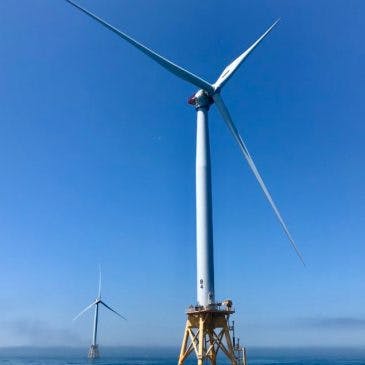
The targets of the Trump administration’s ire, all now sited off of states controlled by governors who are Democrats, are:
Vineyard 1, an 804-MW project 15 miles off Marth’s Vineyard, Mass., owned by Spain’s Iberdrola through its Avangrid U.S. subsidiary. Of the planned 62 turbines, 30 are operating. The estimated price tag for the full project is $2.8 billion.
Revolution Wind, a 704-MW, 65-turbine project off Rhode Island, developed by Denmark’s Orsted, with an estimated cost of $1.5 billion. The project is 87% complete.
Empire Wind 1, first of a 2-GW, 54-turbine project off New York and New Jersey, about 60% completed, with an estimated cost of $5 billion. The project developer is Equinor, 67% owned by the government of Norway.
Sunrise Wind, Orsted’s 924-MW, 84 turbine project off New York, with an estimated cost of $6 billion. The project’s unique feature is that it plans to move power to the mainland through a high-voltage, direct-current cable, the only HV-DC project among the five.
Coastal Virginia Offshore Wind (CVOW), a 2.6-GW, 176-turbine project off the Old Dominion’s Virginia Beach, being developed by Richmond’s Dominion Energy with an estimated cost of $10.7 billion. It is two-thirds compete and Dominion expected to have the project completed by the end of this year before DOI raised doubts about that timeline.
The Trump administration had halted work on both Revolution Wind and Empire Wind last April, which only lasted about a month. A court overturned the Revolution Wind order. Empire struck back when New York’s Democratic Gov. Kathy Hochul called on Trump to discuss the decision. The New York Times reported scuttlebutt that Hochul told Trump she could take another look at a controversial natural gas pipeline the state had halted in return for restarting the wind project, which she later denied. In any case, Trump lifted the Empire stop-work order.
Evidence that Interior’s latest wind order is entirely political comes from the circumstances around Virginia’s CVOW project. While the other four projects had already come under attack from Trump and his Interior Department, the Virginia project, the largest and furthest along, somehow avoided the administration’s gaze. Why could that unusual circumstance occur?
Perhaps it was because Virginia’s governor was Republican Glenn Youngkin, a former CEO of the Washington, D.C., based private equity firm The Carlyle Group, a friend of Trump with an estimated 2025 net worth of $540 million. CVOW completely escaped Trump’s ire during Youngkin’s four years as governor.
Because of Virginia’s one-term limit for governors, Youngkin could not run for reelection last year. His lieutenant governor, Winsome Earle-Sears, was the GOP nominee and lost badly to former Democratic congresswoman Abigail Spanberger. She will be sworn into office on January 17 in Richmond.
There was speculation during the campaign that a Democratic victory — and the Democrats crushed Virginia Republicans all across the state in the November election — would draw Trump’s attention to CVOW. That happened.
Trump’s playing out of his emotional antipathy toward all energy forms with a green taint, particularly wind power, may have undermined a Republican goal of rewriting long-standing environmental permitting laws, including the seminal 1969 National Environmental Policy Act. A bipartisan consensus on a regulatory overhaul, known as the SPEED Act (“Standardizing Permitting and Expediting Economic Development Act”), was moving in Congress when DOI announced the wind stop-work order.
The DOI order may have stalled SPEED’s momentum. Politico reported, “The Trump administration’s blocking of renewable projects is putting in jeopardy the long-running talks to reduce red tape for energy projects.” The article quoted “top Democrats” as saying, “The illegal attacks on fully permitted renewable energy projects must be reversed if there is to be any chance that permitting talks resume. There is no path to permitting reform if this administration refuses to follow the law.”
