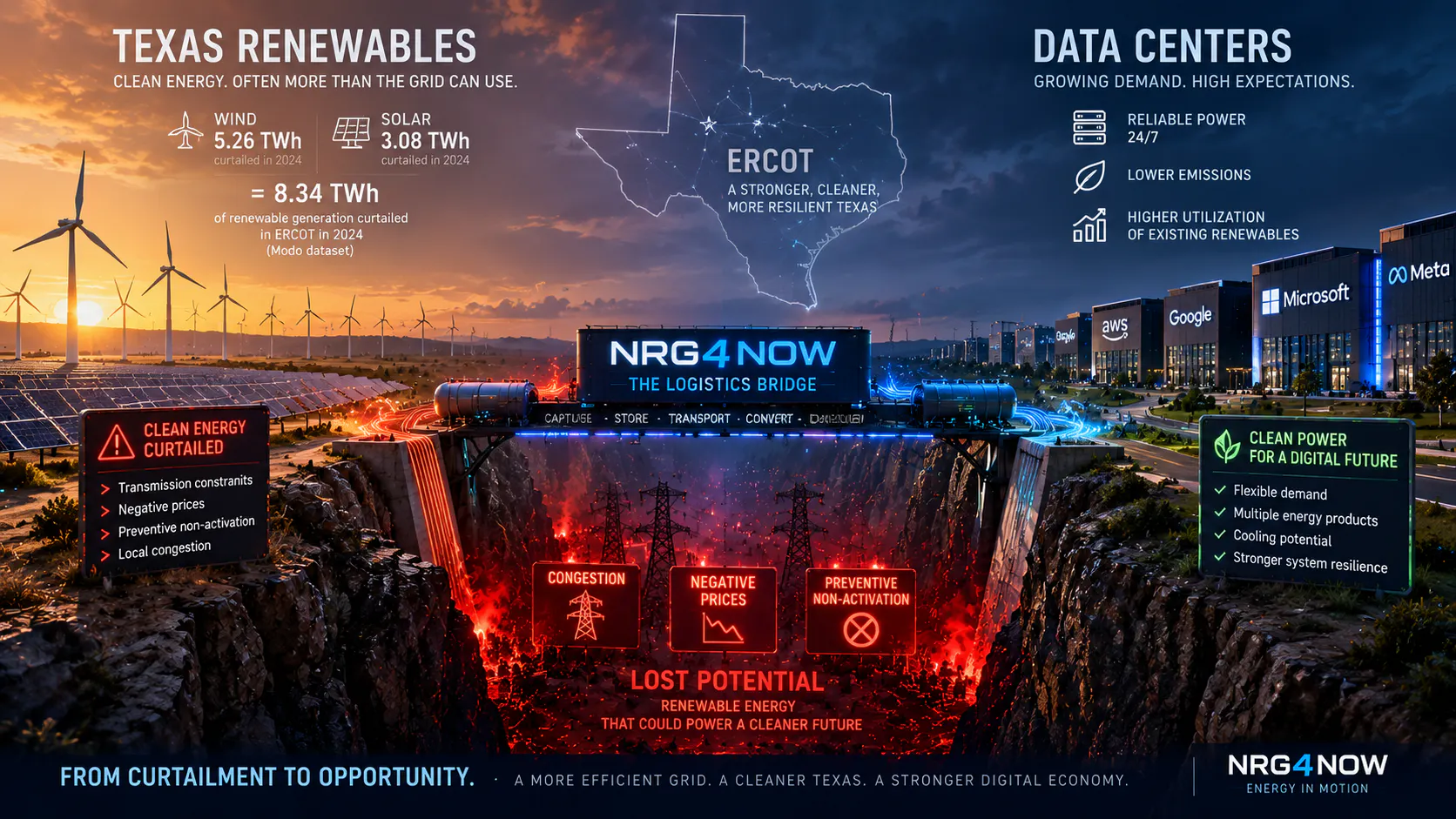
Texas is preparing for massive new electricity demand from data centers. At the same time, substantial volumes of renewable generation are already being curtailed. The question is whether these two developments can be connected more intelligently.
Texas is facing an unusual energy-system paradox.
On one side, ERCOT is integrating large volumes of wind and solar generation while transmission constraints continue to produce significant curtailment in particular regions and at particular resources.
On the other, hyperscalers and other large industrial loads are creating an entirely new electricity-demand challenge. Data centers are no longer a marginal issue for U.S. grid planning; Energy Central itself has recently highlighted the implications of rapidly growing data-center demand for resource adequacy and grid infrastructure.
This raises a different question from the conventional debate about adding generation:
Before building everything from scratch to serve new loads, how much better could we utilize energy infrastructure that already exists?
That question became the starting point for my recently published system and site assessment of ERCOT.
Curtailment Is Large — But the Statewide Number Is Not the Most Important Number
An S&P Global Market Intelligence analysis published on May 5, 2026 by Dan Thompson and Tony Lenoir examined renewable curtailment as a potential surplus-energy opportunity for Texas data centers.
That observation prompted me to investigate the issue at system, resource and site level.
The evaluated Modo/ERCOT dataset indicates approximately 8.34 TWh of wind and solar curtailment in 2024, consisting of roughly 5.26 TWh of wind and 3.08 TWh of solar generation. An S&P Global estimate for 2025 arrived at 9.8 TWh using a different methodology. The figures therefore should not simply be merged, but both indicate that the issue is material.
Yet the statewide TWh figure is not the most important result.
Curtailment is not a virtual reservoir containing 8 or 10 TWh of electricity that can be accessed anywhere in Texas. It occurs at particular Resource Nodes, during particular dispatch intervals and behind particular transmission constraints.
In the evaluated 2024 dataset, the West, South, North and Far West weather zones accounted for approximately 89.3% of identified curtailment.
For project development, the relevant question therefore changes from:
How much renewable electricity is curtailed in ERCOT?
to:
Where, when, how often and at what power level is generation repeatedly unable to reach the market?
That is a much more useful engineering question.
From TWh to MW: The Los Vientos Example
Resource-level analysis illustrates the difference.
The most-curtailed wind resource in the evaluated 2024 dataset, LV2_LV2 / Los Vientos, recorded approximately 196.45 GWh of curtailed energy across 4,430 affected hours.
Across those affected hours, this corresponds to approximately 44.35 MW of average unavailable injection.
This does not mean that 44 MW was continuously available throughout the year. Curtailment is variable, and no flexible load should be dimensioned simply by dividing annual curtailed energy by affected hours.
Nevertheless, the result provides a useful first engineering boundary.
It suggests that a modular flexible load in the range of 40–50 MW deserves detailed investigation at such a location. The actual utilization factor would have to be established through five-minute ERCOT data, including HSL, Base Point, actual injection, prices and binding constraints.
This is where “curtailment” stops being merely a statistic and begins to become a potential infrastructure resource.
The Utilization Gap May Be Larger Than Reported Curtailment
There is another issue that deserves more attention.
Public curtailment statistics do not necessarily represent the entire difference between meteorologically available renewable generation and electricity ultimately injected into the grid.
For ERCOT, several quantities must be distinguished:
Meteorological potential → High Sustainable Limit (HSL) → Base Point → actual injection
The difference between HSL and Base Point can indicate visible dispatch reduction. But the difference between meteorological potential and HSL is more difficult to interpret.
A low HSL may result from technical unavailability, operating limitations, conservative declaration or preventive non-activation. Without plant-status and meteorological information, those causes cannot be uniquely separated.
For this reason, my analysis deliberately does not classify every missing MWh as curtailment. A robust reconstruction requires meteorological expected output, HSL, Base Point and actual injection at high temporal resolution.
Germany provides an interesting illustration of why this distinction matters.
During observations of clear summer days in 2026, realized German PV output around midday sometimes represented only about 40% of installed PV capacity.
That observation alone does not prove that the remaining capacity was deliberately switched off. Module orientation, inverter sizing, temperature, regional conditions, behind-the-meter consumption, maintenance and other technical factors can contribute to the difference.
But a persistent gap under favorable irradiation raises an important system question:
How much technically available renewable generation never appears in conventional curtailment statistics because its limitation occurs before measured grid injection?
This distinction matters far beyond Germany or Texas.
If renewable capacity is expanding faster than the infrastructure capable of transporting or productively consuming its output, installed GW increasingly become an incomplete measure of system performance.
What If the Load Goes to the Constraint?
The conventional response to grid congestion is transmission expansion.
Transmission remains essential. But it is not the only possible response.
If a flexible industrial load can be located electrically upstream of a recurring binding constraint, it may consume energy that would otherwise be curtailed before that energy attempts to cross the constrained interface.
This does not mean that flexible loads can generally replace transmission.
They cannot.
Any claim of avoided or deferred network investment requires a nodal counterfactual demonstrating that the load is located on the correct side of the relevant constraint, operates during the relevant intervals and can reduce consumption when system conditions require it.
But where those conditions are satisfied, flexible load becomes more than demand.
It becomes a grid-utilization instrument.
From Flexible Load to Energy Logistics
This is the problem for which I examined NRG4NOW.
NRG4NOW is not intended as a single storage technology. It is an open, standardized energy-logistics architecture connecting energy sources, storage modules, conversion equipment, transportation, grid interfaces, energy hubs, module identity and adaptive orchestration.
Compression and the Tube Storage Tank Module (TSTM) are application modules within that larger architecture.
The basic concept is to treat energy partly as a logistics flow.
A compressor can act as a directly controllable electrical load behind a constraint. Electrical energy is converted into a transportable molecular-energy inventory. That inventory can then be stored locally or moved using pipelines, road, rail or other logistics infrastructure.
At the destination, it can support different conversion pathways depending on the application.
The significance of this architecture is not that it “stores electricity” in the conventional battery sense.
It is that it provides another possible route around a spatial and temporal mismatch:
Instead of requiring every MWh to cross the electrical bottleneck at the instant it is generated, part of the energy can leave the constrained area through another infrastructure system.
That proposition is what now needs to be tested economically and operationally.
BESS and Molecular Storage Address Different Time Scales
This should not be interpreted as an argument against battery energy storage.
BESS is exceptionally valuable for fast electrical response, frequency services, ramp management and short-duration energy shifting.
The ERCOT assessment instead treats different technologies as complementary layers.
A flywheel can address milliseconds to minutes. Batteries can address seconds to hours. Compressors can provide productive controllable load. Molecular inventory can address much longer periods and can also be physically transported.
That distinction becomes especially relevant for data centers.
A hyperscale data center is not a two-hour load. It requires continuous energy availability.
The system problem therefore extends beyond moving an afternoon renewable peak several hours into the evening. It involves connecting variable generation with continuous demand across different locations and much longer time horizons.
Data Centers Add Another Interesting Dimension: Cooling
Pressure-based energy logistics may also provide another useful service.
When high-pressure gas is expanded, cooling or expansion work can potentially be recovered. My ERCOT assessment therefore identifies data centers, cold storage and gas-processing facilities among possible users of this co-product.
This is not free energy. Any project must account for the complete thermodynamic balance, including pressure, temperature, mass flow and auxiliary electricity.
Nevertheless, it changes the economic question.
The value of an energy-logistics system may not consist of a single storage arbitrage spread. Potential revenue or avoided-cost streams can include curtailment-energy utilization, compression services, storage capacity, energy logistics, electricity generation at destination, cooling, expansion work and resilience.
A viable project would likely require several of these streams rather than depending on one.
Brownfields May Be Part of the Answer
Location remains decisive.
My preliminary screening examined five Texas brownfield sites: Rio Pecos, Oklaunion, Coleto Creek, San Miguel and Sandow.
The purpose was not to declare a winning site. It was to determine whether existing industrial locations could offer combinations of grid infrastructure, gas infrastructure, transportation access, land and permitting history that justify more detailed investigation.
Among them, Rio Pecos emerged as a particularly interesting candidate for a capture-oriented pilot because of its location in West/Far West Texas, historical electrical infrastructure and proximity to pipelines.
But significant questions remain: ownership, actual pipeline pressure and available capacity, electrical interconnection conditions, environmental status and the cost of reusing existing infrastructure all require verification.
A brownfield is valuable only if the infrastructure that matters can actually be reused.
The Next Step Is Pre-FEED, Not Construction
The principal conclusion of the assessment is deliberately restrained:
Go to Pre-FEED — not Go to Construction.
Before an investment decision, the concept requires at least:
24–36 months of five-minute ERCOT data for candidate Resource Nodes;
identification of binding constraints and shift factors;
compressor vendor performance curves and quotations;
verified pipeline pressure, diameter and available capacity;
certified engineering and installed-cost estimates for the storage system;
grid and interconnection studies;
brownfield environmental and title due diligence; and
commercial term sheets with generators, offtakers or data-center operators.
The proposed Pre-FEED therefore follows two tracks: direct coupling to a highly curtailed renewable resource, and development of a brownfield energy hub.
A Different Question for the Data-Center Boom
Texas will need new generation. It will need transmission. It will need storage. And it will need flexible demand.
These are not mutually exclusive choices.
But as electricity demand from hyperscalers grows, another metric deserves greater attention alongside installed GW:
utilization of the generation and infrastructure that already exist.
If renewable generation is repeatedly available in the wrong place at the wrong time, simply adding more generation does not by itself solve the underlying architecture problem.
The more interesting question may therefore be:
Can we move the demand to the energy — and, where necessary, move the energy without moving the electricity?
That is the hypothesis the ERCOT assessment is intended to test.
The complete 18-page system and site assessment, including methodology, resource-level curtailment data, technology comparison, preliminary economics, brownfield screening, risk matrix and proposed pilot-development plan, is publicly available on Zenodo:
Ryszard Dzikowski — The Invisible Gap in the Texas Power System: Economic and Site Assessment
Full report — DOI 10.5281/zenodo.22310345