


By Kennedy Maize
What’s the key to fusion energy making a significant contribution to powering the world? According to a new paper from a Massachusetts Institute of Technology team, the answer is “Q.”
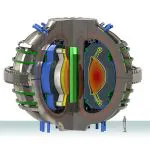
Writing in the Journal of Fusion Energy, the MIT researchers stress that the dominant thrust for fusion power in the past 75 years has been in physics and engineering. Fusors, tokamaks, stellarators, lasers and inertial confinement, cold fusion, neutron fluxes, materials performance, and the like.
The vision for fusion is endless energy from smashing elements together — primarily isotopes of hydrogen — to produce great amounts of energy. That takes a lot of energy input. That’s where the first meaning of “Q” arises: “the ratio of fusion power produced in a nuclear fusion reactor to the power required to maintain the plasma in a steady state.”
The holy grail of fusion is a Q of greater than 1.
In just the U.S., where a fusion frenzy has been underway for a decade, half a dozen startup firms have collectively raised more than $4 billion to pursue various technologies. All are looking at the early 2030s for deployment of working technologies. There are plenty of reasons to view those projections as driven more by market hype than technological achievement.
In southern France, 33 nations have been beavering away for two decades to develop a magnetic confinement tokamak with a Q greater than 1, at a cost of about $44.7 billion through 2024. Originally called the “International Thermonuclear Experimental Reactor,” now simply ITER (“the way” in Latin), the project describes itself as “one of the most ambitious energy projects in the world today.”
So the first order of business is Q. Then there’s another version of “Q” proposed by the MIT team: Qecon, described as “the economic gain factor.”
As the legendary political guru James Carvill observed in the 1992 presidential race, “It’s the economy, stupid.”
Co-author Dennis Whyte, professor of nuclear science and engineering at MIT told MIT News, “It’s all the things that come along with finding, allocating, and spending money at this scale. This is critical to what we do. We should look at the economics. If we want this technology to actually be meaningful in the world economy, we have to start getting straight with ourselves about these topics.”

He said the goal of the paper is to create a “framework where are all the economics are clear, and then we understand what it would mean for any fusion energy power plant.”
The journal article posits an economic model that “exploits temporal equilibrium, and engineering and cost parameters normalized to the energy capture surface. The derived criteria for economic gain are therefore independent of the power plant’s absolute power, impartial to the particulars of its fusion technology, and can be applied to any fusion confinement concept.”
The derivation of the economic Q factor, according to the article, “results in nonlinear equations with ten controlling normalized design parameters ranging from fusion power density and surface component lifetime to energy fluence, price of energy, and component efficiency and cost. These ten controlling parameters are varied over a wide range to provide high-level insights in design, finance and operational tradeoffs that improve the prospects for economically viable fusion energy.”
The MIT News article notes that “Whyte is a former head of MIT’s Department of Nuclear Science and Engineering and a former director of MIT’s Plasma Science and Fusion Center. He co-founded Commonwealth Fusion Systems, an MIT spinoff firm that is one of the leaders in the fusion industry.”
Commonwealth has raised about $3 billion for its magnetic confinement technology using superconducting magnets.
Whyte and co-author Andew W. Lo of MIT’s Sloan School of Management, “also co-founded Rutherford Energy Ventures, a consultancy and investment advisory firm, which is working with the U.S. Department of Energy’s Oak Ridge National Laboratory to build a consortium for new fusion research.”
Lo said, “It’s challenging to reduce complex scientific and engineering requirements to economic consequences. But if we don’t do that, we’re not going to get the funding we need to achieve the impact we want.”
On Aug. 12, the United Kingdom Atomic Energy Authority Group (UKAEA) named Whyte as its new CEO “following an open international recruitment process, taking up the role this autumn as the UK progresses its work to commercialise fusion energy technologies.” UKAE is the country’s lead government agency for developing fusion energy.
The Quad Report, covering energy policy and politics